

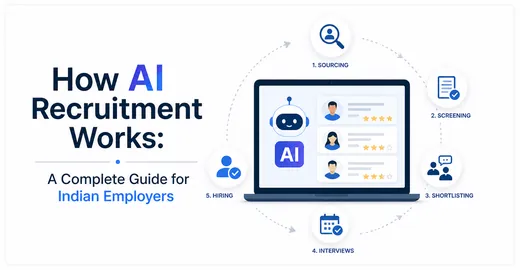
AI recruitment works in five steps. You define the role. The platform searches for matching people, including those not applying. It contacts them and confirms interest. It scores the interested candidates on fit and likelihood of joining. It then hands you a ranked shortlist. Unlike a job board, it goes looking instead of waiting. On Hire22, that typically takes under 22 hours from posting, and your team still runs the interviews and makes the hire.
This guide walks through each step, what the scoring looks at, how mid and senior hiring differs, and where AI should and shouldn't decide. For the broader picture, read AI in recruitment, or see the AI hiring platform for mid and senior roles.
How is AI recruitment different from a job board?
- Active, not passive. A job board waits for applications. AI recruitment searches for people who match.
- Several signals, not keywords. A keyword filter checks whether a word appears on a CV. AI scoring weighs depth, recency, career path and intent together.
- Ranked by fit, not by date. Candidates arrive ordered by predicted fit and likelihood of joining.
How does AI recruitment work, step by step?
| Step | What you do | What the AI does on Hire22 |
| 1. Brief | Enter the role, skills, experience, CTC band and location | Builds a matching profile from the brief |
| 2. Search | Nothing | Hunter AI searches both the Hire22 database and the web, so passive candidates are included |
| 3. Outreach | Nothing | CoNCT AI sends the role by SMS, WhatsApp, email and AI voice calls and confirms interest |
| 4. Ranking | Nothing | JoinX AI scores interested candidates on 200+ parameters |
| 5. Shortlist | Review the ranked shortlist | Delivered typically within 22 hours of posting |
| 6. Interviews and offer | Interview, select and make the offer | Hire22's part ends at the shortlist |
SARA, Hire22's AI recruiter, coordinates steps 2 to 5. The quality of step 1 decides the quality of everything after it.
A good brief names three or four must-have skills with context ("led vendor negotiations for a multi-city FMCG distribution network", not "5+ years in supply chain"), a realistic CTC band, the location and hybrid arrangement, and the joining window. Each of those feeds a scoring signal.
What does the AI evaluate?
- Skills, weighted for recency and depth. A skill used last year counts differently from one used eight years ago.
- Career path. Progression, tenure and industry moves.
- Fit to this role, not the title. A Head of Sales who owned a ₹5 crore target differs from one who owned ₹50 crore.
- Seniority in context. Eight years at a large company and five at a scaling startup can mean different things.
- Practical fit: CTC expectations, location and notice period.
- Intent to join: whether the person is likely to accept and move now.
The JoinX Score combines these across 200+ parameters, so you interview the people most likely both to fit and to join.
AI ranking is strongest where profiles differ a lot, as in mid and senior roles. For uniform entry-level roles, simpler volume tools are often enough.
Why does this matter more for mid and senior hiring?
Senior candidates are mostly employed and rarely apply, so a platform limited to applicants misses most of them. Many also won't consider a role publicly. On Hire22, a candidate's name, phone, email and resume stay hidden from the employer until the candidate accepts. Employers can also choose to hide their company name; see anonymous hiring.
Offer drop-outs are the other senior-level risk. Counter-offers and competing offers often arrive during 60 to 90-day notice periods. Ranking on intent to join, and checking notice period and CTC early, reduces the chance of building a shortlist of people who won't move.
The market makes speed matter: 82% of Indian employers told ManpowerGroup's 2026 Talent Shortage Survey they struggle to find skilled talent.
What should AI decide, and what should people decide?
| AI does well | People should own |
| Searching large pools quickly | Judging leadership, values and team fit |
| Applying the same criteria to everyone | Interviews and reference checks |
| First contact and interest checks | Persuasion and closing |
| Ranking by fit and intent | The final hire-or-reject decision |
Keep criteria explicit and review who gets filtered out. HBR's analysis of hiring algorithms explains how unchecked AI can repeat past bias.
What results should you expect?
These are three real funnels from our case studies, where Hire22 delivered the shortlist and the client interviewed and hired:
- Senior Investment Professional: 288 found, 50+ screened, 5 interview-ready, 1 hired.
- ServiceNow Developer: 165 found, 74 screened, 18 interview-ready, 2 hired.
- Agentic AI Engineer: 250 found, 148 screened, 17 interview-ready, 2 hired.
Pricing is a flat package per job posting, with no success fee or per-profile charge; see pricing.
Also useful: how SARA works, step by step and how to choose an AI recruitment platform.
Frequently Asked Questions
What is AI recruitment?
The use of AI to source, contact, screen and rank candidates. It replaces manual, step-by-step searching with a process that runs in parallel and returns a ranked shortlist.
How long does an AI shortlist take?
On Hire22, typically within 22 hours of posting. Interviews and notice periods still take their own time.
Does AI recruitment work for senior roles?
It works especially well for them, because senior candidates are mostly passive and need to be found and approached privately.
What does AI recruitment cost compared to an agency?
Agencies commonly charge one to two months of the hire's CTC. Flat-priced platforms charge per job posting, which usually works out cheaper for companies making several senior hires a year.
Does the AI decide who gets hired?
No. On Hire22, AI delivers a ranked shortlist with the reasons behind each rank, and your team interviews and decides.


