Search for "AI recruitment platform" and you'll get a mix of applicant tracking systems with a chatbot bolted on, resume parsers rebranded as "AI-powered," and a handful of tools that actually change how candidates get found and ranked. If you're an employer trying to work out what an AI-based recruitment platform really does, and whether your current tech stack even qualifies as one, this is meant to answer that directly.
What Is an AI Recruitment Platform?
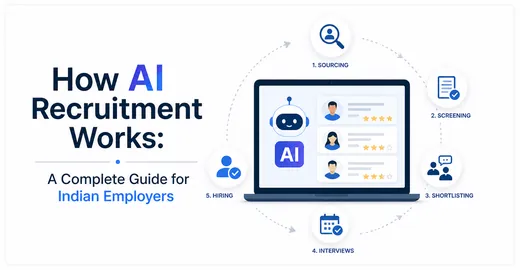
An AI recruitment platform uses machine learning and automation to handle one or more stages of hiring: finding candidates, screening them against a role's requirements, ranking who's the best fit, and in some cases managing outreach and scheduling. The term gets used loosely. A job board with a filter is not an AI recruitment platform. A tool that parses resumes into a database is closer, but still only covers one piece of the funnel.
The more useful way to think about it is by what the platform actually automates. There are four jobs in recruitment that AI can meaningfully take on:
- Sourcing: finding candidates who match a role, including people who aren't actively browsing job boards.
- Screening and matching means comparing candidate profiles against job requirements on skills, experience, and other criteria.
- Ranking is ordering matched candidates so recruiters know who to look at first, and why.
- Outreach and scheduling: contacting shortlisted candidates and coordinating next steps.
Most tools that call themselves "AI recruitment platforms" only cover one or two of these. Fewer cover all four end to end.
How AI-Based Recruitment Platforms Actually Work
Strip away the marketing and the mechanics are fairly consistent across platforms. An employer defines a role and its requirements. The platform then pulls in candidates, either from its own database, from integrated job boards, or by actively sourcing from other platforms. Each candidate is scored against the role's criteria using some combination of skills matching, experience parsing, and sometimes behavioral or assessment data. The highest-scoring candidates get surfaced to the recruiter, often with outreach handled automatically to confirm interest before a human gets involved.
Where platforms differ is in how far they go. A basic tool stops at resume parsing: matching keywords on a resume to keywords in a job description, which is a weak signal on its own. A more capable platform also factors in things a keyword match misses entirely: compensation expectations, notice period, location constraints, and whether the candidate is actually likely to join if offered the role. That last factor, joining intent, is where a lot of mid-and-senior hiring actually breaks down, since a candidate can look perfect on paper and still be unreachable or uninterested.
The Recruitment Tech Stack: What Actually Belongs in It
"Best tech stack for recruitment agencies" is a fair question to ask, because most agencies end up with five or six disconnected tools rather than a stack. Here's what the core layers look like and what each one is responsible for:
| Layer | What it does | Common failure mode without AI |
|---|---|---|
| Sourcing | Finds candidates across job boards, databases, and professional networks | Limited to inbound applicants only; misses passive candidates |
| Screening & matching | Compares candidates against role requirements | Manual resume review; slow and inconsistent |
| Ranking | Orders candidates by fit so recruiters prioritize correctly | No objective ranking; recruiters review in application order |
| Outreach | Contacts and engages shortlisted candidates | Manual calling and messaging; slow response cycles |
| Scheduling | Coordinates interviews between candidate and employer | Back-and-forth email threads |
| Analytics | Tracks time-to-hire, pipeline health, and source quality | No visibility until after the fact |
For a small or mid-sized agency, the realistic goal isn't to buy six specialized tools. It's to find a platform that covers sourcing, screening, and outreach in one flow, so candidates don't fall through the gaps between systems that don't talk to each other.
How Hire22.ai Works as an AI Recruitment Platform
Hire22.ai is built specifically for mid and senior-level hiring in India, where the sourcing problem is different from entry-level hiring: the right candidates are rarely applying to job boards, and the ones who are often aren't the strongest fit. The platform handles the full chain rather than a single piece of it.
An employer posts a role through JobCoNCT, which is coordinated by SARA, Hire22.ai's coordinating AI agent. Hunter AI then sources candidates from more than 40 platforms, including passive candidates who aren't actively applying anywhere. Once candidates are identified, CoNCT AI handles outreach through SMS, WhatsApp, email, and AI voice calls; there's no telecalling involved. Candidates who respond and show interest are then scored by JoinX AI, which produces the JoinX Score based on skills fit, experience, CTC fit, location, notice period, and joining intent.
Employers typically receive a ranked shortlist within 22 hours of posting. Both employer and candidate identities stay anonymous until the candidate accepts the JobCoNCT, which keeps the process free of the usual back-channel noise around compensation and competitor poaching. Hire22.ai never interviews, selects, or hires on an employer's behalf. The platform narrows a large candidate pool down to a ranked shortlist, and the hiring decision stays entirely with the employer.
Pricing is a flat package rather than a per-profile or success-fee model: a Trial Package at ₹2,999+GST (list price ₹9,999) gives first-time employers 3 job postings over 3 months, and the Starter Package at ₹60,000+GST includes 15 postings and 2 sub-users over 6 months. It's free for candidates to use, with no exceptions.
What to Look for When Evaluating an AI Recruitment Platform
Not every platform that uses AI is worth switching to. A few things are worth checking before you commit:
- Sourcing breadth. Does it only see candidates who apply, or does it actively source passive candidates from multiple platforms?
- Ranking transparency. Can you see why a candidate was ranked where they were, or is it a black-box score?
- Role specialization. A platform built for high-volume entry-level hiring handles mid-senior roles very differently: notice periods, CTC negotiation, and joining intent matter far more at that level.
- Anonymity and compliance. Does the platform protect candidate and employer identity, and is it clear about how it handles personal data under the DPDP Act 2023?
- Pricing structure. Flat packages are easier to budget against than per-resume or success-fee pricing that scales unpredictably with hiring volume.
- Speed to shortlist. Ask for a real number, not a vague promise. How long does it actually take to get a usable shortlist after posting a role?
Benefits Employers See When They Move to AI-Based Recruitment
The gains from AI recruitment platforms tend to show up in a few consistent places. Time-to-shortlist drops significantly because sourcing and initial screening happen in parallel instead of sequentially. Recruiters spend less time on manual resume review and more time on actual conversations with qualified candidates. Reach extends to passive candidates who were never going to see a job posting on their own. And because ranking criteria are applied consistently to every candidate, the process is less dependent on whichever recruiter happens to be reviewing a given resume that day.
None of this replaces human judgment at the decision stage; it changes what recruiters spend their time on, shifting it from sorting to deciding.
Common Concerns About AI in Recruitment
Does AI introduce new bias?
It can, if the underlying matching criteria are poorly designed or trained on skewed historical data. The way to manage this is to keep ranking criteria explicit and auditable (skills, experience, CTC fit, location, notice period) rather than relying on opaque scoring that can't be explained or checked.
What happens to candidate data?
Any platform handling candidate information in India needs to be compliant with the DPDP Act 2023. Ask how long data is retained, who it's shared with, and whether candidates can request it be removed.
Does this replace recruiters?
It shouldn't, and a well-built platform doesn't try to. AI recruitment platforms are built to narrow a large pool down to a manageable, ranked shortlist. The interview, the final call, and the offer decision stay with the employer and the recruiting team.
Signs Your Current Hiring Process Needs This
Not every hiring team needs to overhaul its tech stack. A few patterns are usually a reliable signal that manual sourcing and screening have stopped scaling:
- Roles stay open for weeks longer than they should, mostly because recruiters are waiting on applications rather than actively sourcing.
- Strong candidates go cold between the first conversation and the interview, because outreach and scheduling take too long.
- Every recruiter screens slightly differently, so shortlist quality depends heavily on who happened to review the pipeline that week.
- Mid and senior roles in particular sit unfilled, because the right candidates were never actively applying anywhere and inbound sourcing never reaches them.
If more than one of these sounds familiar, the bottleneck usually isn't recruiter effort. It's a sourcing and screening process that can't reach or process candidates fast enough on its own.
AI Recruitment Platforms vs. Agencies and Job Boards
Traditional recruitment agencies bring judgment and relationship-driven sourcing, but they scale slowly and charge success fees that climb with seniority. Job boards give you volume but almost no screening: you get whatever applies, ranked by nothing more than recency. AI recruitment platforms sit in between: faster and more consistent than an agency, but with actual screening and ranking that a job board doesn't offer. For mid and senior roles specifically, where the right candidate is usually passive rather than actively applying, platforms built for that segment (see our breakdown of mid-senior hiring platforms in India and hiring for senior tech roles) tend to outperform both.
What exactly makes a recruitment platform "AI-based" rather than just automated?
Automation follows fixed rules: if a resume contains a keyword, it passes. AI-based platforms use models that weigh multiple factors together, like skills, experience, CTC fit, and joining intent, to produce a ranked score rather than a simple pass or fail.
Can an AI recruitment platform find candidates who aren't actively job hunting?
Yes, if it's built for active sourcing rather than just managing inbound applications. Hunter AI on Hire22.ai, for example, sources from more than 40 platforms specifically to reach passive candidates who aren't applying anywhere.
How long does it take to get a shortlist from an AI recruitment platform?
It varies by platform, but it should be measured in hours, not weeks. On Hire22.ai, employers typically receive a ranked shortlist within 22 hours of posting a role.
What should a recruitment agency's tech stack actually include?
At minimum: sourcing that reaches beyond inbound applicants, automated screening and matching against role requirements, a transparent ranking system, and outreach tools that don't rely entirely on manual calling. Analytics to track time-to-hire and pipeline health rounds it out.
Is an AI recruitment platform the same as an ATS?
No. An applicant tracking system (ATS) is primarily a database and workflow tool for managing candidates who've already applied. An AI recruitment platform typically handles sourcing and ranking as well, not just tracking.
Does using an AI recruitment platform mean I lose control over who gets hired?
No. A platform like Hire22.ai narrows candidates down to a ranked shortlist, but it never interviews, selects, or hires on your behalf. The final decision always stays with the employer.
How is candidate and employer anonymity handled?
On Hire22.ai, both employer and candidate identities stay anonymous until the candidate accepts the JobCoNCT, which avoids premature disclosure of compensation details or company identity during early-stage screening.
What does an AI recruitment platform typically cost?
Pricing models vary. Some charge per profile or a success fee tied to salary. Hire22.ai uses flat packages instead: a Trial Package at ₹2,999+GST for 3 postings over 3 months, and a Starter Package at ₹60,000+GST for 15 postings over 6 months with 2 sub-users. It's always free for candidates.
Where This Leaves You
An AI recruitment platform is only as useful as the stages of hiring it actually automates. If it only parses resumes, you're still doing the hard part (sourcing and judgment) manually. The platforms worth paying for cover sourcing, screening, ranking, and outreach as one connected flow, with enough transparency that you can trust the shortlist you're handed.
If you're hiring for mid or senior roles in India and want to see this in practice, you can post a role on Hire22.ai or check current pricing before you commit.