In agentic recruitment you give an AI agent a hiring goal, such as five interview-ready candidates for a VP Finance role, and it chooses the steps: searching, contacting, ranking. People still decide who to interview and hire. For Indian mid-senior roles the useful question is which steps to hand over, because a tool that only drafts messages is not the same as one that finds and confirms candidates.
This post covers what LinkedIn's Hiring Assistant shows about where agents are today, a table of steps to hand over and steps to keep, a five-part pilot for a senior role and where Hire22 sits. The sources were opened on 17 November 2026. For the opinion side, see our page on agentic AI recruiting.
What does an AI agent do that normal hiring automation does not?
Automation follows a fixed rule: when a candidate applies, send this email. An agent starts from a goal, picks its own search and outreach steps, and changes course when the results are poor. That difference is the test to apply to any vendor who uses the word "agentic".
Three behaviours separate an agent from a workflow with a new label:
- It decides what to try next without a recruiter writing each rule, for example widening a search when too few people match.
- It uses tools on your behalf: a candidate database, messaging channels, your ATS.
- It learns from your feedback on its output, so a rejected profile changes the next batch.
If a product does none of these, you are buying automation, which can still be useful but should be priced as automation.
What has LinkedIn's Hiring Assistant shown so far?
LinkedIn is the largest public example, so its record is a fair reference. In its October 2024 announcement, LinkedIn described Hiring Assistant as designed to take on a recruiter's most repetitive tasks. TechCrunch's report added the detail: it could build qualifications from a job description, produce an initial candidate pipeline, search by skills and connect with third-party applicant tracking systems.
Messaging, interview scheduling and follow-ups were listed as coming soon, and only a select group of customers had it.
By September 2026, Business Today reported a LinkedIn executive saying customers saw an 80% reduction in the profiles recruiters need to review and a 66% increase in InMail acceptance. Those are LinkedIn's own figures, not an independent test. The same report quotes TCS, a pilot participant, as "only halfway through adoption", and notes that the AI can assess only candidates whose data it can reach.
Two lessons carry over. Agents take over search and first-pass review before they take over the judgement calls. And an agent sees only the pool it can reach, which matters for senior roles where the best person may have a thin online profile.
Which hiring steps can you hand to an agent?
Split a senior search by the cost of a wrong move. A weak search result costs a few hours. A wrong offer costs months.
| Step | Reasonable to hand to an agent | Keep with a person |
|---|---|---|
| Turning the brief into search criteria | Drafting criteria from the job description and similar roles | Deciding what is a must-have and what is negotiable |
| Finding candidates | Searching databases and the web, including people who have not applied | Checking that the pool is not missing a profile type you want |
| First contact | Sending the job details and asking whether the person is interested | Approving the wording for a confidential or leadership role |
| Ranking | Sorting interested people on skills, CTC fit, location and notice period | Reading the top profiles yourself before anyone is rejected |
| Interview, selection and offer | Scheduling at most | All of it: who to meet, who to hire, what to offer |
Notice period belongs in the ranking step, not at the offer. In India, senior candidates often serve 60 to 90 days, so an agent that ranks without it hands you people you cannot get this quarter.
How do you pilot an AI agent on a senior role?
Run it on a role you have not yet filled and keep your normal process running beside it, so you can compare the two.
- Write the brief once, with the CTC band, notice-period limit and location. Give the same brief to the agent and to your team.
- Ask the vendor to show every step the agent took, including searches it abandoned. A black box is hard to defend to a hiring manager.
- Count how many people on the agent's list were not already in your database or ATS. That number is the value of its sourcing.
- Check that each person on the list confirmed interest in the role and the CTC range, not only that a profile matched.
- Ask what candidate data is stored, who can see it and how deletion works. Resumes and phone numbers are personal data under the Digital Personal Data Protection Act, 2023, so get the answers in writing and ask your legal team what it needs.
If the agent's list adds nobody new and nobody confirmed, it is a ranking tool. Judge it on that basis.
Where does Hire22 fit?
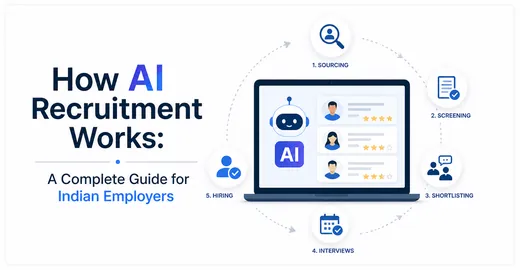
Hire22 applies the agent idea to one stage: getting from a job post to a shortlist. You post the role as a JobCoNCT, and SARA, Hire22's AI recruiter, runs the pipeline. Hunter AI searches the Hire22 candidate database and the web, including passive candidates. CoNCT AI reaches them by SMS, WhatsApp, email and AI voice calls and confirms interest, so your team makes no calls. JoinX AI ranks the interested candidates on 200+ parameters, including notice period, CTC fit and intent to join.
Employers typically get an interview-ready shortlist within 22 hours of posting. Your team interviews, selects and hires; Hire22 doesn't interview or hire. One limit: Hire22 is built for mid and senior roles, so a high-volume fresher drive suits a different tool.
Have a senior role open? Post it as a JobCoNCT and compare the people who confirm interest with what your own pipeline holds.
Related reading: how AI recruitment platforms source, screen and rank, how SARA works step by step and what to test in an AI ATS.
Is agentic recruitment the same as a recruiting chatbot?
No. A chatbot answers questions inside a fixed script. An agent works towards a goal, such as a shortlist, by choosing its own searches and contact steps. Ask a vendor to show which steps the tool chose without a rule written by your team.
Can an AI agent hire a candidate on its own?
It should not. Search, first contact and ranking are reasonable to hand over, while interviews, selection and offers stay with your team. LinkedIn describes its own agent as taking on repetitive tasks so recruiters can advise hiring managers and speak to candidates.
Does agentic recruitment work for senior roles in India?
It can for search and first contact, where the best candidates are employed and not applying. Test it on one real senior brief and count the people it finds who were not already in your database.
What candidate data does a recruiting agent need?
Typically profiles, contact details and resumes, which are personal data under the Digital Personal Data Protection Act, 2023. Ask where data is stored, who can see it and how a record is deleted, and get the answers in writing.
How do I tell a real agent from relabelled automation?
Ask for a log of one search. A real agent shows steps it chose, searches it changed and results it dropped. Automation shows the same fixed sequence every time.