
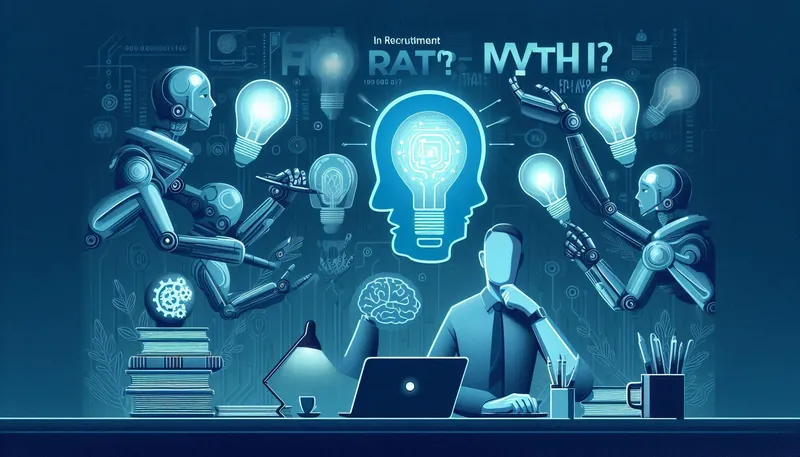
The most common myths about AI in recruitment are that it replaces recruiters, removes bias automatically, makes hiring impersonal, suits only large companies, takes months to set up, judges soft skills as well as people, and makes the final decision. In reality, AI handles sourcing, screening, ranking and first contact well. People still judge fit, persuade candidates and decide. Bias depends on design and oversight.
Below, nine myths are set against what is actually true, followed by questions that test whether a vendor's AI claims are real. For a plain explanation of how it works, read AI in recruitment, or see how an AI hiring platform for mid and senior roles applies it.
Why does AI recruitment attract so many myths?
"AI recruitment platform" is a label stuck on very different products: some use real matching and ranking models, while others are keyword filters with a new name, and marketing on both sides blurs the difference until buyers can't tell which is which.
What is myth and what is fact?
Myth 1: AI will replace recruiters
Fact: it hasn't, and today's tools aren't built to. AI takes the repetitive, high-volume work: sourcing, first screening, ranking and outreach. Recruiters spend more time on conversations, negotiation and hiring-manager alignment.
Myth 2: AI removes bias
Fact: not automatically. AI reflects its training data and design. A model trained on past hires can copy past bias, as HBR's analysis of hiring algorithms explains. Hiding identity at first screening and reviewing outcomes reduces it; nothing eliminates it.
Myth 3: AI makes hiring impersonal
Fact: it depends on use, because generic automated messages feel cold, whereas AI used well removes the admin so recruiters have more time for real conversations with the people who matter.
Myth 4: AI tools are only for large companies
Fact: that was truer a few years ago. Packaged tools for small and mid-size employers now exist at flat prices. Hire22, for example, starts at ₹2,999 + GST for 3 job postings for first-time employers; see pricing.
Myth 5: Setting up AI recruitment is complicated
Fact: some enterprise suites do take weeks to configure, but many platforms now let you post a role and receive ranked candidates within a day, so the real work is writing a sharp brief.
Myth 6: AI judges soft skills as well as people do
Fact: not reliably. AI matches structured data (skills, experience, notice period, pay expectations) well. Team fit, leadership and values are better judged in structured interviews. The Schmidt and Hunter meta-analysis found structured interviews among the best predictors of performance.
Myth 7: Every "AI recruitment platform" uses AI
Fact: not always, since some products are keyword filters on an ATS that were rebranded once AI became a selling point, so ask exactly what the ranking is built from.
Myth 8: More AI means more candidates in your inbox
Fact: for mid and senior hiring, good AI does the opposite, narrowing the field so that you see a short, ranked list of interested people instead of hundreds of mixed applications.
Myth 9: AI makes the final hiring decision
Fact: legitimate platforms don't. Hire22 sources, contacts and ranks candidates and delivers a shortlist, typically within 22 hours. The employer interviews and hires.
What should you look for in a real AI recruitment platform?
- Sourcing reach: does it find passive candidates, or only rank applicants?
- Outreach: does it contact candidates by SMS, WhatsApp, email or voice, or leave that to your team?
- Ranking logic: which concrete factors does it score, such as skills, experience, CTC fit, notice period and intent?
- Privacy: is candidate identity hidden at first review?
- Honesty about limits: does it say clearly that it shortlists but doesn't decide?
On Hire22, a role posted as a JobCoNCT goes to Hunter AI, which searches the Hire22 database and the web. CoNCT AI confirms interest, and JoinX AI ranks candidates on 200+ parameters. Candidates' names and contact details stay hidden until they accept, and your company name can stay hidden as well.
Even good AI depends on the inputs. A weak brief or a skewed scoring model will give a poor ranking, so keep a person reviewing every shortlist.
How can you tell whether a vendor's AI claim is real?
- Ask exactly what data the score is built from. A vague answer is a warning sign.
- Ask whether it sources passive candidates or only works on inbound applications.
- Ask for the real time to a usable shortlist, not the best case.
- Ask whether it makes decisions or only ranks.
- Ask for the total cost, including any per-profile or success fees.
- Ask how candidate data is handled under the Digital Personal Data Protection Act, 2023.
Adoption is no longer the question: a BCG survey reported by The Tribune found 92% of Indian employees use generative AI tools. Knowing what AI really does is what matters now.
Also useful: the ethics of AI in recruitment.
Frequently Asked Questions
Can AI completely replace human judgement in hiring?
No. AI handles sourcing, screening and ranking well. Judging fit and leadership, and making the final call, need people.
Does AI remove bias in recruitment?
Not automatically. It can reduce some bias when designed to, for example by hiding identity at first screening, but it can also repeat bias from past data.
Is AI recruitment expensive?
Not necessarily. Many platforms now offer flat packages for small and mid-size employers, often cheaper than one agency fee for a senior hire.
Do candidates mind AI outreach?
Not when the role is relevant and the message is specific. Irrelevant mass messages put people off, whether sent by a person or a tool.
How quickly can AI recruitment show results?
The first ranked shortlist can arrive within a day. Judge the overall value after several completed hires.