Ask any HR head in India what "lateral hiring" means and they'll answer without pausing: it's the opposite of campus hiring. You're not recruiting a batch of fresh graduates in October for a January joining date; you're filling one specific seat, right now, with someone who already has the skills and can plug the gap this quarter, not three years from now.
That distinction sounds obvious, but a surprising number of companies still run lateral hiring through processes built for campus intake: long job descriptions, generic portals, a one-size-fits-all interview panel. It doesn't work, and the reasons it doesn't work are specific enough to be worth walking through before you open your next lateral requisition.
Why Lateral Hiring Is a Structurally Different Problem
Campus hiring is a volume exercise on a fixed calendar. You know roughly when you're hiring, you evaluate aptitude and trainability more than specific experience, and the compensation conversation is largely standardised across the batch. Lateral hiring breaks every one of those assumptions.
- Speed works against you, not for you. A campus hire has nowhere else to be. A lateral candidate is employed, often fielding more than one conversation at once, and a slow process loses good people to whoever moves first, sometimes their own employer, with a counteroffer.
- Skills-match replaces aptitude-match. You're not betting on potential over a multi-year runway. You need someone who can do a defined part of the job in the first 60-90 days, which means the screening question shifts from "can this person learn fast" to "has this person actually done this specific thing before."
- Salary negotiation gets real. A campus offer is usually a fixed band everyone in the batch gets. A lateral hire negotiates against their current CTC, often with a 20-40% hike expectation, sometimes with a buyout clause for their notice period, and frequently with a competing offer in hand.
- Notice periods become the critical path. Most mid and senior professionals in India serve 30, 60, or 90-day notice periods. A lateral search that doesn't account for this from day one ends up with an accepted offer and a three-month wait, or worse, a candidate who gets a buyout counteroffer during that window and backs out.
None of this is specific to one industry. It's true whether you're hiring a lateral Java developer in Pune, a lateral finance controller in Gurgaon, or a lateral regional sales head in Chennai. The mechanics of experienced-hire recruiting are the same even when the function changes.
What Good Lateral Hiring Actually Looks Like
The companies that do lateral hiring well in India tend to get a few specific things right, consistently:
- They write a brief, not a job description. "5+ years, SQL, Python" tells you nothing about whether the candidate has actually built what you need built. A real brief specifies scope, tools in context, team size, and what success looks like at 90 days.
- They factor in notice period from the start, not after an offer is accepted. Knowing a candidate's current notice period and whether they'd consider a buyout changes how you sequence the whole process.
- They keep the search confidential where it needs to be. A lateral hire for a role replacing an underperforming incumbent, or a confidential expansion into a new team, cannot leak. This protects the business and protects the candidate, who is very likely still employed and does not want their current employer finding out they're interviewing.
- They move fast on decisions, slow on diligence. Speed matters most between "shortlist" and "offer," not in skipping reference checks or technical rounds. The time to compress is the back-and-forth scheduling and internal approval delays, not the actual evaluation.
- They go to where the passive candidates are, rather than waiting for applications. The best lateral candidates, the ones already doing well where they are, are rarely the ones actively applying to job postings.
Where a Platform Built for Lateral Hiring Helps
This is exactly the gap Hire22.ai (an AI hiring platform for mid and senior roles in India, built by the Freshersworld team) is designed to close. The mechanism maps directly onto the lateral hiring problems above.
An employer posts a JobCoNCT instead of a public job ad, a private, structured invitation rather than a listing anyone can browse. SARA, the AI recruiting agent, coordinates the process end to end. Hunter AI searches more than 40 platforms and sources for candidates matching the brief, including passive candidates who have never applied anywhere, which, as covered above, is where most strong lateral candidates actually sit.
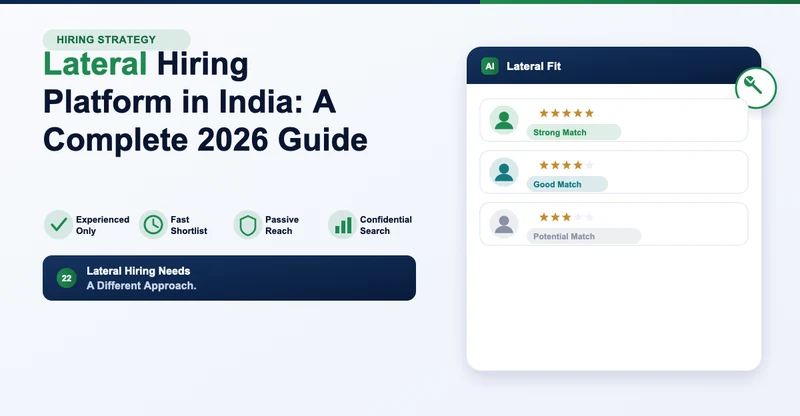
CoNCT AI handles outreach through SMS, WhatsApp, email, and AI voice calls (no telecalling), and confirms whether the candidate is genuinely interested before anyone invests time in them. JoinX AI then scores and ranks every interested candidate on the JoinX Score: skills fit, experience, CTC/compensation fit, location, notice period, and joining-intent signals, together. Notice period being a direct input to the score matters specifically for lateral hiring, where a brilliant candidate on a 90-day lock-in may not be the right pick for a role that needs to be filled in three weeks.
Most employers get a ranked shortlist within 22 hours of posting. Both employer and candidate stay anonymous until the candidate accepts the JobCoNCT, which is useful for exactly the confidential-replacement and competitive-situation scenarios lateral hiring often involves. And to be clear about where the AI's role ends: Hire22.ai never interviews, selects, or hires on the employer's behalf. It delivers the shortlist; your team runs the interviews and makes the call.
For technical lateral roles specifically, it's worth reading how to hire senior software engineers in India for brief-writing specifics. And if your lateral hiring tends to run into leadership-level replacements, common leadership hiring mistakes covers several traps (vague briefs, rushed references, ignoring counteroffer risk) that apply directly to lateral senior hires too.
Pricing for Lateral Hiring on Hire22.ai
Pricing is flat and tied to job postings, with no success fee and no per-profile charges. First-time employers can start with the Trial Package at ₹2,999 + GST (list price ₹9,999) for 3 job postings over 3 months. Beyond that, the Starter Package is ₹60,000 + GST for 15 job postings and 2 sub-users over 6 months, with custom Starter plans available for other volumes. Full details are on the pricing page.
Compare that to a traditional recruitment agency fee for a lateral hire, typically 8.33%–16.67% of annual CTC. On a lateral hire at ₹18 LPA, that's upward of ₹1.5-3 lakh in fees for a single seat. If lateral hiring is a recurring need rather than a one-off, the flat-fee model changes the economics considerably over a quarter or two. If you're currently weighing Hire22.ai against an agency, LinkedIn Recruiter, or iimjobs for lateral roles specifically, we've written direct comparisons: vs. recruitment agencies, vs. LinkedIn Recruiter, and vs. iimjobs.
Candidates never pay to use the platform. It's free for candidates, always, and candidate data is handled in line with the Digital Personal Data Protection Act, 2023, with explicit consent and the ability to update or delete a profile at any time.
Getting Started
If you have a lateral requisition open right now, the fastest way to judge fit is to post one JobCoNCT with a specific brief (scope, comp band, notice period tolerance, must-have skills) and compare the ranked shortlist against whatever your current sourcing channel is producing.
Post your first JobCoNCT on Hire22.ai and see your ranked shortlist within 22 hours.
Frequently Asked Questions
What is lateral hiring in the Indian HR context?
Lateral hiring is recruiting experienced professionals directly into a specific role, as opposed to campus or entry-level hiring where candidates are recruited on a fixed annual cycle and trained into a role. A lateral hire is expected to be productive quickly, is evaluated primarily on skills-match rather than aptitude, and negotiates compensation against their current CTC rather than accepting a standardised batch offer.
How is a lateral hiring platform different from a campus hiring platform?
A campus hiring platform is built around volume: managing large applicant pools, bulk assessments, and a fixed hiring calendar. A lateral hiring platform needs to solve a different problem: finding a small number of specific, often passive, experienced candidates quickly, scoring them on real skills-match and compensation fit, and managing notice-period logistics. Hire22.ai is built specifically for this second problem, mid and senior lateral hiring, rather than high-volume entry-level recruiting.
How does Hire22.ai find candidates for lateral roles who aren't actively job hunting?
Hunter AI searches more than 40 platforms and sources for candidates matching a JobCoNCT's requirements, including passive candidates who have never applied anywhere. For lateral hiring specifically, this matters because the strongest candidates are usually employed and performing well, not actively browsing job boards. CoNCT AI then reaches out through SMS, WhatsApp, email, and AI voice calls (never telecalling) to confirm genuine interest before a candidate enters the shortlist process.
How does notice period get handled in lateral hiring on Hire22.ai?
Notice period is one of the direct inputs to the JoinX Score, alongside skills fit, experience, CTC/compensation fit, location, and joining-intent signals. This lets employers see, at the shortlist stage, which candidates can realistically join within their required timeline and which would need a longer runway or a notice-period buyout, rather than discovering this only after an offer has already been made.
Can lateral hiring stay confidential on Hire22.ai?
Yes. A JobCoNCT is a private invitation, not a public listing, and both the employer and candidate stay anonymous until the candidate accepts the JobCoNCT. This matters for lateral hiring in particular, since many lateral candidates are currently employed and do not want their job search visible to their current employer, and many employers don't want a confidential replacement or expansion hire to be publicly visible before it's finalised. Details are on the anonymous hiring page.
What does lateral hiring cost on Hire22.ai?
Pricing is flat and tied to job postings, with no success fee and no per-profile charges. First-time employers can start with the Trial Package at ₹2,999 + GST (list price ₹9,999) for 3 job postings over 3 months. The Starter Package is ₹60,000 + GST for 15 job postings and 2 sub-users over 6 months, with custom plans available for other volumes. See the pricing page for full details.
Does Hire22.ai make the final hiring decision for lateral roles?
No. Hire22.ai never interviews, selects, or hires on the employer's behalf, for lateral roles or any other level. SARA, Hunter AI, CoNCT AI, and JoinX AI handle sourcing, outreach, interest confirmation, and ranking, and deliver a shortlist within roughly 22 hours of posting. The employer's own team conducts interviews and makes the final hiring decision.