A Series C founder calls their HR head on a Sunday evening. The CFO has just resigned, effective in six weeks, to join a competitor. The board wants a replacement lined up before the next investor update. And nobody outside the leadership team can know the seat is open until a successor is ready to sign. No job posting. No LinkedIn announcement. No agency blast that tips off the market, the team, or the current CFO's own notice-period negotiations.
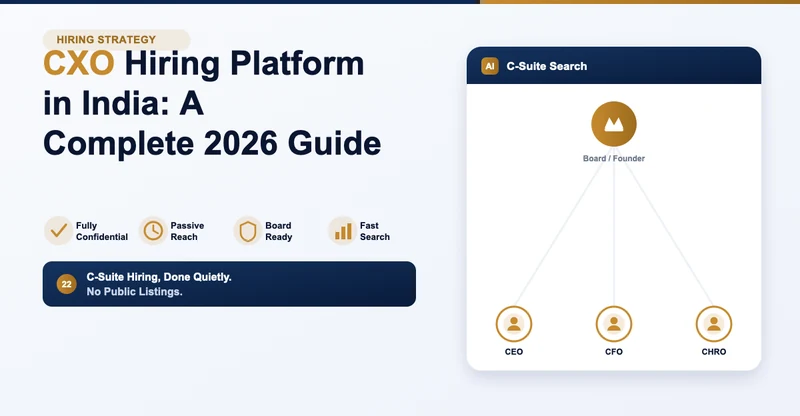
This is what CXO hiring actually looks like in India, and it is nothing like hiring a Manager or even a VP. The stakes are higher, the pool is smaller, the candidates are almost never looking on a job board, and one wrong call can cost a year of organisational momentum. This guide is for founders, boards, and HR leaders who need to fill a CEO, CFO, CTO, CHRO, or COO seat, fast, quietly, and without betting the company on a single headhunter's black book.
Why CXO Hiring Breaks the Normal Hiring Playbook
Every HR head knows hiring gets harder as you go up the ladder. At the CXO level, it doesn't just get harder. It becomes a structurally different problem.
The pool is tiny, and almost nobody in it is "looking"
For a Manager-level role, you might get 150 applications from a single job posting. For a CFO role at a Rs 500 crore revenue company, the realistic universe of qualified candidates in India might be 40 to 80 people, and the overwhelming majority of them are employed, performing well, and not browsing job boards at 11 PM. They're not applying anywhere. They're being approached, carefully, by someone who already has their trust or a credible mutual connection.
Notice periods and counteroffers stretch the timeline
CXOs in India routinely sit on 3-to-6-month notice periods, and many carry garden leave or non-compete clauses that complicate an exit further. Once a strong candidate signals interest, their current employer often responds with an aggressive counteroffer (a comp bump, a promotion, a retention bonus) precisely because losing a CXO is expensive for them too. A search that doesn't account for this will lose its best candidate at the finish line, more than once.
Confidentiality isn't a nice-to-have: it's the whole game
Most CXO searches in India are replacement hires, not net-new roles. That means the current incumbent either doesn't know they're being replaced, or the company doesn't want the market, customers, or the rest of the leadership team to know a transition is coming before it's settled. A public job posting for "CFO" at a identifiable company signals distress to investors and competitors alike. The search has to run in a sealed room until there's a signed offer, which rules out most conventional job boards and even a lot of "confidential" postings that still leak company identity through role specificity.
The cost of getting it wrong is not linear
A bad Manager hire costs a few months of lost productivity and a re-hire cycle. A bad CXO hire costs strategic direction, team attrition under a leader who doesn't fit, investor confidence, and often 12 to 18 months before the board is willing to try again. Boards don't talk about this often, but a failed CXO hire is one of the most expensive mistakes a growth-stage company can make: not because of any single number, but because of what it does to momentum, morale, and the next fundraise narrative.
The Traditional Route: Retained Executive Search, and What It Actually Costs
For decades, the answer to all four problems above has been the same: hire a retained search firm. A consultant who already knows the 40-to-80-person universe for your specific function and sector, who can approach passive candidates discreetly on your behalf, and who manages the counteroffer dance because they've seen it a hundred times.
This works. It is also slow and expensive by design. Retained and contingency search fees in India typically run 8.33% to 16.67% of the candidate's annual CTC: a range that's publicly documented and holds whether you're hiring a Director or a CEO (see our breakdown of these fee structures on the recruitment agency alternative comparison page). For a CXO hire at a Rs 60 to 90 LPA package, that's a fee in the Rs 5 to 15 lakh range for one hire, before you even factor in the 10-to-16-week timeline that confidential CXO searches typically take, because the entire sourcing motion happens one relationship-driven conversation at a time.
None of this makes retained search wrong. For a board-level CEO succession at a listed company, a human-led, relationship-based search is often still the right call, and we say so plainly in our comparison of executive hiring platforms in India. But for the much larger set of CXO and senior-leadership mandates below that (a CFO for a growth-stage company, a CHRO for a 500-person firm, a CTO replacement at a funded startup), paying search-firm economics and waiting three to four months is often more than the situation calls for.
How AI-Driven Sourcing Changes the Economics of a CXO Search
The reason retained search is slow isn't the people: it's the method. A single consultant, working their own network and a handful of calls a day, cannot scan the entire relevant candidate universe in a week. An AI system built specifically to search across platforms, 24 hours a day, can.
This is the mechanism behind Hire22.ai, built by the Freshersworld team as an AI hiring platform for mid and senior roles in India. For a CXO search, it works like this:
- The employer defines the role as a JobCoNCT: a private job invitation, not a public listing. Nothing about it appears on a public job board, and the employer's identity stays hidden at this stage.
- SARA, the AI recruiting agent, coordinates the entire process from here. There's no human recruiter manually juggling spreadsheets and follow-up calls.
- Hunter AI searches more than 40 platforms and sources to find matching candidates, including passive professionals who have never applied anywhere, which, as we've established, describes most of the real CXO candidate pool.
- CoNCT AI handles the outreach: SMS, WhatsApp, email, and AI voice calls, explicitly with no telecalling, and confirms whether each candidate is genuinely interested before they ever enter your shortlist.
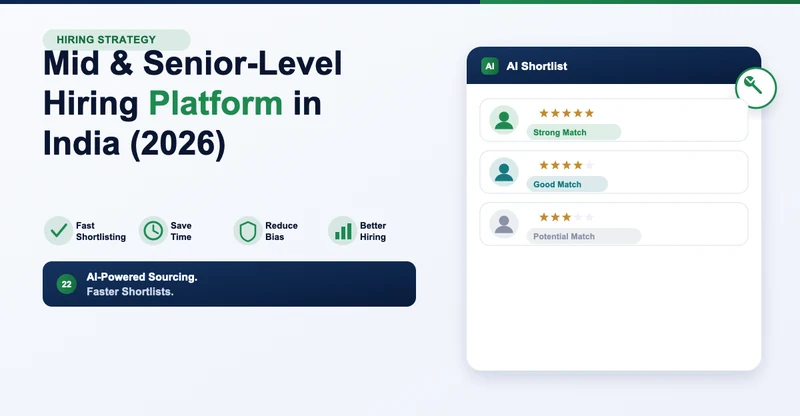
- JoinX AI scores and ranks every interested candidate on fit, experience, CTC alignment, location, notice period, and joining-intent signals, producing a ranked shortlist most employers receive within 22 hours.
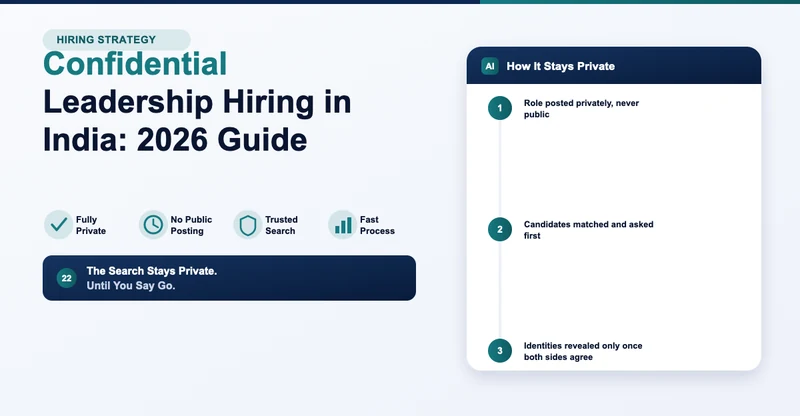
The part that matters most for CXO searches specifically: both the employer and the candidate stay anonymous until the candidate accepts the JobCoNCT. This is not a privacy checkbox. It's genuinely confidential hiring. A CFO candidate can see a detailed, anonymised brief of the opportunity, the function, the sector, and the comp band, and decide whether to engage, without their current employer, their network, or the market ever knowing they looked. The employer, meanwhile, can run the entire early-stage search (sourcing, outreach, ranking) without the role ever becoming visible as "Company X is replacing its CFO."
On cost, there's no success fee and no per-profile charge, and the platform never uses a credit system. Employers run on either the Trial Package (Rs 2,999 + GST, list Rs 9,999, for 3 job postings over 3 months, a one-time offer for first-time employers) or the Starter Package at Rs 60,000 + GST for 15 job postings and 2 sub-users over 6 months, with custom Starter plans available for other volumes. Compare that to a single retained search fee of Rs 5 to 15 lakh for one CXO hire, and the economics of running even several senior searches a year look very different.
Where Hire22.ai Fits, and Where It Doesn't
To be direct about the boundaries: Hire22.ai does not interview, select, or hire on your behalf. It delivers a ranked, anonymous shortlist of candidates who have already confirmed genuine interest. Your team does every interview, every reference check, and makes the final call, exactly as it should for a hire this consequential.
Where the platform earns its place in a CXO search is the part that traditionally ate the most time and money: finding and qualifying the right 10 to 15 passive candidates out of a near-invisible pool, confidentially, in under a day instead of over several weeks. For a CEO-1 or CEO-2 level hire (CFO, CTO, CHRO, COO, Chief Revenue Officer), this is frequently a faster and structurally cheaper path to a strong shortlist than opening a six-figure retained search engagement, particularly for growth-stage and mid-size companies that can't justify that spend for every leadership seat.
For the highest-stakes, most relationship-dependent mandates (a listed-company CEO succession, a board-level independent director search), pairing AI-sourced shortlisting with a retained search partner's judgment and references is often the strongest combination, not an either/or choice. We go deeper on the mistakes companies make at this level in our piece on leadership hiring mistakes, and if your CXO search is really a VP or Director mandate, our executive hiring platforms comparison breaks down more options.
If you want to see how this plays out in practice rather than theory, our case studies page walks through real searches we've run (including a Senior Investment Professional hire) with the actual process, not invented numbers.
Running a Confidential CXO Search, Step by Step
If you're the HR head or founder actually running this search this quarter, here's the practical sequence:
- Write the brief like a scorecard, not a job ad. For a CXO role, specify P&L or budget scope, team size, reporting line, the specific sector or regulatory context (BFSI, SaaS, D2C; these matter enormously at this level), and the comp band. A vague "strategic leader with 15+ years" brief produces a vague shortlist.
- Post it as a JobCoNCT, not a public listing. Keep company identity hidden at the sourcing stage. This alone rules out the two biggest leak risks: your own team finding out early, and the market reading a public posting as a signal of trouble.
- Let Hunter AI and CoNCT AI do the first pass. The platform scans 40+ sources for passive matches and confirms real interest before anyone sees a name. You're not chasing cold leads.
- Review the JoinX-ranked shortlist, anonymously, within roughly a day. You'll see skills fit, experience, CTC alignment, notice period, and joining-intent signals for each candidate before you know who they are.
- Reveal identities only on mutual acceptance. Once a candidate accepts the JobCoNCT, both sides can finally see who they're talking to, and your internal interview process takes over from there.
- Run your own structured interviews and references. This part never changes, and shouldn't. A CXO hire deserves panel interviews, backchannel references, and board input before an offer goes out.
Ready to start? Post your first confidential CXO search on Hire22.ai →
Frequently Asked Questions
What makes CXO hiring different from hiring a VP or Director in India?
Scale and stakes, mostly. CXO candidates sit in a much smaller pool, almost always employed and not actively job-hunting, with longer notice periods (often 3 to 6 months) and a higher chance of a counteroffer once they signal interest. Confidentiality matters more too, since most CXO searches are replacement hires where the incumbent's exit, or even the fact that a search is underway, has to stay quiet until there's a signed offer.
How much does it cost to hire a CXO through a search firm in India?
Retained and contingency search firms in India typically charge 8.33% to 16.67% of the candidate's annual CTC. For a CFO or CTO package in the Rs 60 to 90 LPA range, that works out to roughly Rs 5 to 15 lakh for a single hire, usually over a 10-to-16-week engagement. These figures are public market ranges, not platform-specific numbers.
Can a CXO search stay confidential if the company doesn't know a replacement is needed yet?
Yes, and this is exactly the scenario anonymous hiring on Hire22.ai is built for. The role is posted as a private JobCoNCT rather than a public listing, the employer's identity stays hidden until a candidate accepts, and candidates can evaluate the opportunity without their current employer or network ever finding out they looked. Identities are revealed to both sides only after mutual acceptance.
How fast can I get a shortlist for a CXO role?
Most employers using Hire22.ai receive a JoinX Score-ranked shortlist within 22 hours of posting the role, because Hunter AI scans 40+ platforms and sources continuously rather than waiting on inbound applications. That's the shortlist stage. Your own interviews, references, and offer negotiation still take the time a CXO decision genuinely deserves.
Does Hire22.ai interview or select the CXO candidate for us?
No. Hire22.ai never interviews, selects, or hires on an employer's behalf. SARA and the underlying AI tools handle sourcing, outreach, interest confirmation, and ranking. Your team runs every interview and makes the final call, which is how it should work for a decision this consequential.
What does Hire22.ai cost compared to a retained search firm?
Hire22.ai charges no success fee and no per-profile charge. Employers use either the Trial Package (Rs 2,999 + GST, list Rs 9,999, for 3 job postings over 3 months, a one-time offer for first-time employers) or the Starter Package (Rs 60,000 + GST for 15 job postings and 2 sub-users over 6 months, with custom plans for other volumes). That's a flat cost covering multiple roles, compared to a single retained search fee that can run Rs 5 to 15 lakh for one CXO hire.
Should every CXO search use AI sourcing instead of a retained search firm?
Not necessarily. For a listed-company CEO succession or a board-level mandate with heavy relationship and governance dependencies, a retained search partner's judgment and references still carry real weight, and combining both approaches is common. For most other CXO-level and senior-leadership roles (CFO, CTO, CHRO, COO at a growth-stage or mid-size company), AI-driven sourcing is frequently faster and considerably cheaper for reaching the same passive candidate pool.
How is candidate data handled and kept compliant?
Hire22.ai operates under the Digital Personal Data Protection Act, 2023. Candidates give explicit consent before their profile is used, data is encrypted, and candidates can update or delete their profile at any time. The platform is also free for candidates, always.