A senior engineer req sits open for weeks, the hiring manager keeps asking for an update, and the candidates coming through Naukri or a referral link all turn out to be mid-level at best. That is not bad luck. Senior software engineers in India who are actually good rarely apply anywhere. They get pulled, quietly, by a recruiter who already knows what they are working on.
Why does hiring senior software engineers in India take so long?
Three things stack up against a typical job posting. First, the engineers you want are employed, well paid, and not browsing job boards; if they move, it is usually because someone reached out with a specific, relevant opening, not because they went looking. Second, notice periods for senior roles in Indian product and services companies commonly run 60 to 90 days, so even a fast "yes" still means a long wait before the person actually joins, and a long wait is a long window for a counteroffer. Third, most postings are written for volume hiring (generic responsibilities, no real signal on stack depth or ownership level), so the people who would actually qualify skim past them.
None of this means senior engineering talent is scarce in India. It means it is largely invisible to a standard job posting, and reachable only through direct, targeted outreach.
Where do senior software engineers in India actually look for their next role?
Mostly, they don't look. They get approached: by a recruiter at a company they already respect, by a former colleague now hiring elsewhere, or occasionally by a well-targeted LinkedIn message that actually names the system they'd be working on instead of a generic "exciting opportunity." A smaller share browse niche communities (language- or framework-specific Slack and Discord groups, conference circuits) when they are genuinely open, but even there, most are weighing one or two specific conversations, not scanning listings.
That is the practical reason sourcing senior engineers is a different exercise from sourcing anyone else: you are not competing for attention in a feed, you are trying to get found by someone who isn't looking.
How much does a senior software engineer cost in India right now?
It varies enormously by stack, city, and company stage. A senior backend engineer at a funded Series B startup in Bengaluru and a senior engineer at a large GCC in Hyderabad are not drawing from the same band, even for similar seniority. Compensation for genuinely senior, hands-on engineers at product companies typically sits well into double-digit LPA territory and climbs further for specialised skills (distributed systems, ML infrastructure, platform engineering) where demand has outpaced supply. Rather than anchor to a single number that will be stale within a quarter, the more useful habit is benchmarking against your last three completed senior hires, adjusted for the specific stack (a live market read, not a fixed figure).
What should a senior engineering job post actually say?
Specificity does the filtering for you. A posting that says "senior backend engineer" gets flooded with mid-level applicants hoping to stretch. A posting that names the actual system ("own the payments reconciliation service, Go and Postgres, handling production incidents for a service doing X requests a day") gets fewer applicants and a much higher share of people who can actually do the job. The same logic applies to seniority signals: say explicitly whether this role owns architecture decisions, mentors other engineers, or is purely an individual contributor track, because senior engineers self-select hard on that distinction.
How Hire22.ai changes the sourcing math for senior engineering roles
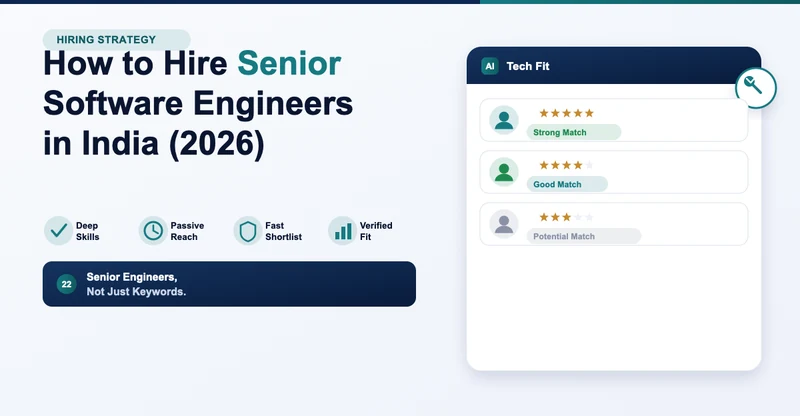
Hire22.ai is built for exactly this problem: mid and senior hiring in India, built by the team behind Freshersworld. The employer posts a JobCoNCT (a private job post that is never published as a public listing), which matters for a role you don't want advertised to your competitors or your current team. SARA, Hire22's AI recruiter, then runs the pipeline: Hunter AI searches Hire22's database and goes beyond it to the open web for candidates who match, including passive engineers who are not applying anywhere. CoNCT AI gets missing contact details and reaches them directly by SMS, WhatsApp, email and AI voice calls to explain the role and confirm interest. "No telecalling" means your own team never has to make a single cold call. JoinX AI then scores each candidate's fitment and persona across 200+ parameters into a JoinX Score, which shows how likely they actually are to join if offered, not just whether their resume matches keywords.
Most employers get an interview-ready shortlist within 22 hours of posting. From there, it's your team's call: you interview, you decide, you make the offer. Hire22's part ends at the shortlist.
In one recent case study, a search for an Agentic AI Engineer surfaced 250 matching profiles, of which 17 were shortlisted and 2 were hired by the employer, a reasonable picture of what a well-targeted senior technical search actually yields once you stop relying on inbound applications alone.
What if the role needs to stay confidential?
Senior engineering hires (a lead replacing someone who's leaving, a new team being built ahead of an announcement) often can't be posted publicly without tipping off competitors or unsettling the current team. Employers on Hire22 can choose to hide their company name, in which case candidates see an alias instead; this is optional, not the default, so you decide case by case whether the role needs that cover.
Related reading
For other platforms beyond Hire22, see the top platforms for hiring senior executives in India. If the hiring bottleneck is upstream of sourcing (your own internal tooling), a look at what a modern hiring tech stack should include is a useful next read.
Frequently asked questions
How long does it take to hire a senior software engineer in India?
Sourcing and shortlisting is the fast part when done right: Hire22.ai typically delivers an interview-ready shortlist within 22 hours of posting. The slower part is usually the candidate's notice period, which commonly runs 60 to 90 days for senior roles in India, so plan the full timeline around that, not just the sourcing step.
Why don't senior engineers apply to job postings?
Most are already employed and not actively looking. They move when a specific, relevant opportunity reaches them directly, not when they happen to see a listing. This is why outreach-based sourcing (searching for passive candidates and contacting them directly) consistently surfaces stronger senior candidates than a public posting alone.
What is the difference between hiring a senior engineer and a mid-level engineer in India?
Beyond compensation, the biggest practical difference is channel: mid-level engineers apply to postings in meaningful numbers, so inbound hiring works reasonably well. Senior engineers mostly don't apply anywhere, so the hire depends on direct sourcing and outreach, a longer notice period, and a job description specific enough to self-select the right candidates.
Can a senior engineering role be hired confidentially in India?
Yes. On Hire22.ai, the employer posts a private JobCoNCT that is never published as a public listing, and can choose to hide the company name so candidates see an alias instead. This is useful for a backfill, a quiet team build, or any role you don't want visible to competitors or your current team before it's finalised.
Does Hire22.ai charge per candidate profile?
No. Pricing is per job posting (JobCoNCT), with no per-profile charge and no success or placement fee. Packages start from ₹2,999 + GST as a first-time trial offer covering 3 job postings for 3 months; see hire22.ai/recruit/pricing for current plans.
If a senior engineering role has been open for more than a few weeks, the posting probably isn't the problem; the channel is. Post the role as a JobCoNCT and let SARA search beyond the applicants who were never going to apply in the first place.