Hiring smarter with AI means improving quality of hire as well as speed. A fast shortlist of people who won't accept, or won't last, wastes more time than a slow one. The best AI hiring tools search beyond applicants, confirm interest before you see anyone, and score candidates on fit and on intent to join. You then judge the final few with structured interviews. Speed comes from automation, quality from what you measure and how you interview.
This guide explains why speed and quality usually trade off, what an AI platform does differently from a job board, how to measure quality of hire, and a checklist for balancing the two. For the platform itself, see the AI hiring platform for mid and senior roles.
Why do speed and quality usually trade off?
Imagine a mid-senior role posted on a Monday. By Friday there are hundreds of applications and perhaps five worth a call. A recruiter racing through them misses good people and lets weak ones through. A recruiter going slowly loses the good candidates to faster employers.
Both lose. The trade-off disappears only when the shortlist arrives quickly and is already filtered for fit and intent.
What does an AI recruitment platform do differently from a job board?
| Job board | AI recruitment platform |
| Public listing; waits for applicants | Searches for matching people, including passive ones |
| Applications of mixed quality | Interest confirmed before you see the profile |
| Sorted by date or keywords | Ranked on fit and likelihood of joining |
| Your team screens everything | Your team reviews a short ranked list |
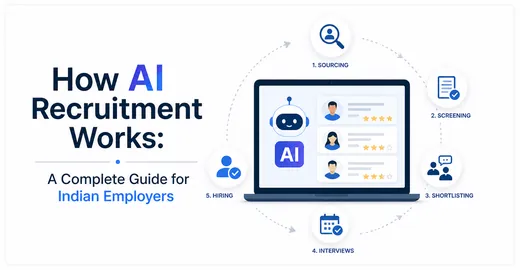
On Hire22, the role goes out as a private JobCoNCT. Hunter AI searches the Hire22 database and the web. CoNCT AI contacts candidates by SMS, WhatsApp, email and AI voice calls and confirms interest, so your team makes no cold calls. Employers typically get the shortlist within 22 hours.
What does quality of hire depend on?
Three things: whether the person can do the job, whether they will accept and join, and whether they will stay and perform. Hire22's JoinX Score covers the first two before interviews, using 200+ parameters including:
This works best for experienced roles. For hundreds of entry-level hires, volume channels are usually cheaper per hire.
- Skills matched against the role's real requirements, not just keyword overlap.
- Experience and its relevance to the role's seniority.
- CTC fit against the band.
- Location and working pattern.
- Notice period against your timeline.
- Intent to join: how likely the person is to accept if offered.
The third, staying and performing, depends on your interviews, onboarding and manager. Structured interviews and work samples are the strongest predictors of job performance, according to the Schmidt and Hunter meta-analysis of selection methods.
What does a fast but poor shortlist cost?
More than it looks. Each wrong interview takes an hour of a senior manager's time, plus preparation and feedback. Each offer declined at the last step restarts weeks of work.
And each hire who leaves within six months means the whole search again, with the team carrying the gap twice. A slightly slower shortlist of the right people is cheaper, because a good fit saves more time than a fast list does.
How do you measure quality of hire?
Combine three inputs collected the same way every time: the hiring manager's rating at 90 days, the performance rating at six months, and whether the person is still there at 12 months. Track it by source, so you can see whether faster channels also produce good hires. Our guide to HR metrics has the formulas.
How do you balance speed and quality?
- Write a specific brief with must-have skills, CTC band and joining window.
- Source beyond applicants, so the shortlist includes the best people, not just the available ones.
- Confirm interest and CTC early, before any interview.
- Interview with a structure: three rounds and the same scorecard for everyone.
- Decide quickly. Agree approvals before the final round.
- Measure 90-day outcomes and adjust the brief for the next role.
One practical tip: review the first shortlist with the hiring manager within a day. Ask which two candidates are closest and what is missing from the others. Feed that back into the brief. The second shortlist is usually noticeably better than the first.
What doesn't AI do here?
Hire22 doesn't interview, select or hire. Its role ends at a ranked, interview-ready shortlist. Names, contact details and resumes reach you only after a candidate accepts, and you decide whether candidates see your company name; see anonymous hiring. Pricing is a flat package with no success fee; see pricing.
Skilled people are scarce, with 82% of Indian employers reporting difficulty in ManpowerGroup's 2026 survey, so the trade-off matters. Related reading: the real cost of a bad hire.
Get a shortlist ranked for fit and intent
Frequently Asked Questions
Does faster hiring mean lower quality?
Not if the speed comes from automating sourcing and screening rather than skipping interviews. Faster offers often improve acceptance, because candidates are still engaged.
What is the best measure of quality of hire?
A combination of the manager's 90-day rating, six-month performance and 12-month retention, tracked by source.
How does intent to join improve quality of hire?
It stops you spending interview time on people who are unlikely to accept or move, so your best interview slots go to candidates who might actually join.
Is a JobCoNCT the same as a job posting?
It is a job posting sent privately to matched candidates rather than published publicly. One JobCoNCT covers one role.
Does AI make the final hiring decision?
No. AI ranks candidates on fit and intent to join, but your hiring manager interviews them and makes the final call.