A SaaS startup in Bangalore just closed its Series B. The founding engineer who built the product over three years is brilliant at writing code but has never managed more than four people, has no experience with a board deck, and privately admits he doesn't want the job anyway. The investors are asking, politely but repeatedly, when a "real CTO" is joining. The founder has spent six weeks on LinkedIn, sent out two dozen InMails, and has exactly one call booked, with a candidate who's clearly using the conversation to benchmark their current comp.
This is the single most common CTO hiring story in Indian tech right now: a company that has outgrown its founding engineering setup and needs someone who can both go deep technically and run a team, a roadmap, and a board conversation. The second most common version is quieter. It's a company replacing an underperforming or departed CTO, where the search has to happen without the engineering team, customers, or the market finding out before it's resolved. Both versions run into the same wall: the pool of people who can actually do this job is smaller than anyone expects, and almost none of them are looking.
Why Hiring a CTO in India Is Genuinely Hard
The pool of "technical enough AND can lead" is small
India has an enormous base of strong senior engineers. It has a much smaller number of people who combine deep technical judgment (architecture decisions, platform scalability, build-vs-buy calls) with the ability to hire, retain, and get the best out of a 15-to-100-person engineering org, and then explain all of it clearly to a board that doesn't care about your tech stack, only about delivery and risk. A lot of Engineering Directors and VP Engineering profiles look right on paper but have never actually owned the full scope: tech strategy, people, budget, and external stakeholders, all at once.
The best candidates are employed, busy, and not checking job boards
A CTO-caliber professional at a funded startup or a tech-forward enterprise is rarely unemployed and rarely scrolling Naukri. They're heads-down running their current org, and the only way most of them hear about a new opportunity is through a warm introduction or a direct, credible approach that respects their time and their current employer's confidentiality. Posting "Hiring CTO" publicly on a job board mostly attracts candidates who are actively job-hunting, which for this specific role is frequently a negative signal rather than a positive one.
Confidentiality matters more than most companies admit
If you're replacing a CTO, the search cannot leak. Engineers read signals fast. If word gets out that leadership is quietly interviewing a replacement, you risk a wave of anxious resignations before you've even found the right person. If you're hiring your first CTO while the founding engineer stays on in a different role, that transition needs careful, private handling too, so it doesn't look like a demotion playing out in public. Either way, confidentiality isn't optional; it's a precondition for the search going well.
What to Actually Evaluate, Beyond "Can They Code"
The single biggest mistake companies make hiring a CTO is over-indexing on technical depth in the interview process and under-indexing on everything that actually determines whether the hire works a year in. Here's what deserves equal or greater weight:
Delivery track record, not just technical opinions
Ask for specifics: What did they actually ship, at what scale, and what broke along the way? A candidate who can talk fluently about microservices and event-driven architecture but can't point to a system they built that survived real production load, real incident response, and real scaling pain is a risk. Look for evidence of judgment under pressure. A bad outage handled well tells you more than a clean roadmap slide.
Team-building and retention, specifically
A CTO's real job past a certain company size is building and keeping a strong engineering org, not writing the most code personally. Ask how many engineers they've hired directly, what their team's attrition looked like under them, and whether senior engineers who worked for them before would follow them again. This is one of the hardest things to fake in an interview and one of the most predictive of success.
Stakeholder communication with board, investors, and non-technical leadership
Can this person explain a six-month delay to a board in a way that builds confidence rather than alarm? Can they negotiate priorities with a Head of Sales who wants a feature yesterday? A technically excellent CTO who can't communicate with non-technical stakeholders will either get sidelined in strategic conversations or become the person the CEO has to constantly translate for. Neither is sustainable past the first year.
Fit to your specific stage and sector
A CTO who thrived scaling a consumer D2C app's infrastructure through a festive-season traffic spike is solving a different problem than one who built compliance-heavy systems at a BFSI fintech, or one who ran a lean, 8-person engineering team at a pre-Series-A company. None is "better" in the abstract. The question is whether their specific experience maps to your next 18 months, not their last 18.
These same evaluation principles apply closely to other confidential leadership searches too. CHRO hiring in India runs into a near-identical small-pool, mostly-passive-candidate problem, and so does CFO search in India, where regulatory and investor-reporting depth matters as much as the finance fundamentals. If either of those is on your plate this quarter, our executive hiring page covers the broader leadership search process, and this piece on leadership hiring mistakes is worth reading before you post anything.
Where the Usual Sourcing Channels Fall Short
Job boards were never built for this. A CTO is not going to apply to a Naukri posting, and the handful who might are disproportionately the ones between jobs for a reason worth investigating carefully. We've covered this gap in more detail in our comparison of executive hiring platforms in India. For senior tech leadership specifically, LinkedIn Recruiter and niche tech platforms do reasonably well at surfacing people, but LinkedIn InMail has a real problem at this level: the best CTO candidates get flooded with recruiter messages, and response rates drop accordingly.
A retained executive search firm solves the discretion problem but reintroduces cost and time. Search fees in India for senior technology leadership typically land in the same 8.33% to 16.67% of CTC range that applies across executive search broadly (see the detail on our recruitment agency alternative comparison page). On a CTO package of Rs 70 to 1.2 crore, that's a fee that can run into several lakh for a single hire, with a search timeline typically stretching 10 or more weeks given how relationship-dependent passive outreach is when it's done manually, one conversation at a time.
How Hire22.ai's Sourcing Actually Helps for This Specific Role
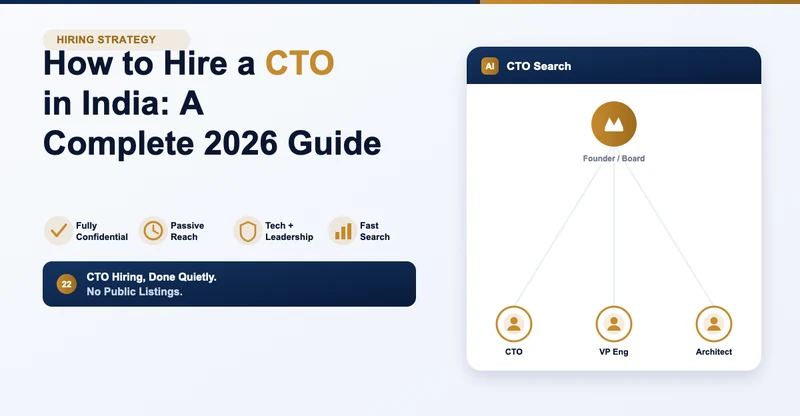
The reason AI-driven sourcing matters so much for CTO hiring specifically is that the core problem (reaching a small, mostly-passive, currently-employed pool, discreetly) is exactly what it's built to solve. Hire22.ai, built by the Freshersworld team as an AI hiring platform for mid and senior roles in India, works like this for a CTO search:
- You post the role as a JobCoNCT, a private invitation rather than a public listing, so there's no public "CTO wanted" signal for your engineering team, your competitors, or a departing CTO's network to notice.
- SARA, the AI recruiting agent, runs the process end to end so you're not relying on one recruiter's bandwidth or network ceiling.
- Hunter AI searches more than 40 platforms and sources (well beyond the usual LinkedIn-and-job-board loop) specifically to surface passive candidates who have never applied anywhere, which describes most strong CTO candidates.
- CoNCT AI reaches out through SMS, WhatsApp, email, and AI voice calls (explicitly no telecalling) and confirms genuine interest before anyone lands on your shortlist, so you're not chasing people who were never really open to a move.
- JoinX AI scores and ranks every confirmed candidate on skills fit, experience, CTC and compensation alignment, location, notice period, and joining-intent signals, and most employers get a ranked shortlist within 22 hours.
Both employer and candidate stay anonymous until the candidate accepts the JobCoNCT. For a CTO search, this solves the exact confidentiality problem described earlier: a candidate currently employed as VP Engineering somewhere else can review your anonymised brief (sector, scale, team size, comp band) and decide whether to engage without their employer or network ever knowing they looked. You, in turn, can run the entire sourcing and shortlisting process without the role being publicly tied to your company until there's a candidate worth revealing it to.
And to be clear about what this doesn't replace: Hire22.ai never interviews, selects, or hires the CTO on your behalf. It delivers the anonymous, ranked shortlist. The technical deep-dive, the architecture review, the reference calls with people who've actually worked under this person, and the final call. All of that stays with your team, as it should for a hire this central to your company's next few years.
On cost, there's no success fee, no per-profile charge, and no credit system, just the Trial Package (Rs 2,999 + GST, list Rs 9,999, for 3 job postings over 3 months, a one-time offer for first-time employers) or the Starter Package (Rs 60,000 + GST for 15 job postings and 2 sub-users over 6 months, with custom plans for other volumes). You can see how this has played out in a real technical hire (including an Agentic AI Engineer search) on our case studies page.
A Practical Process for Hiring Your Next CTO
- Write the brief around delivery and leadership, not a tech stack checklist. Specify team size they'd own, the specific technical scale problem you need solved in the next 12 months, and whether this is a build-the-org role or a stabilise-and-scale role. These call for different people.
- Post it as a JobCoNCT, keeping company identity hidden at the sourcing stage. This protects you whether you're hiring your first CTO or quietly replacing one.
- Let Hunter AI and CoNCT AI do the passive-candidate legwork. You're not chasing cold LinkedIn leads; you're reviewing people who've already confirmed real interest.
- Review the JoinX-ranked shortlist anonymously. Check fit, experience, CTC alignment, and notice period before any name is attached.
- Reveal identities only after mutual acceptance, then run your real evaluation. Architecture deep-dives, team-building track record, stakeholder communication, and references with former direct reports, not just former peers.
- Involve your existing engineering leadership in the final rounds. The people who will report to this CTO should have a voice before the offer goes out, even if they weren't part of the confidential sourcing stage.
Ready to start your search? Post your CTO role on Hire22.ai →
Frequently Asked Questions
Why is it so hard to hire a good CTO in India right now?
The pool of people who are both deeply technical and capable of leading and scaling an engineering team is small relative to demand, and most of them are already employed and not actively job-hunting. Add in that strong CTO candidates typically need a discreet, trust-based approach rather than a public job posting, and the usual sourcing channels (job boards, cold LinkedIn outreach) struggle to reach them at all.
What should I evaluate in a CTO candidate besides technical skills?
Four things matter as much as technical depth: an actual delivery track record (what they shipped at scale, and how they handled things going wrong), team-building and retention history (would their past engineers work for them again), stakeholder communication (can they explain technical risk to a board or non-technical leadership clearly), and fit to your specific stage and sector rather than generic seniority.
How do I hire a CTO confidentially if I'm replacing an existing one?
Keep the search off public job boards entirely. On Hire22.ai, the role is posted as a private JobCoNCT rather than a listing, and both employer and candidate identities stay hidden until a candidate accepts the invitation. This lets you source and shortlist candidates without your engineering team, customers, or the market finding out a replacement search is underway before it's resolved.
How much does it cost to hire a CTO through a search firm versus an AI platform?
Retained search firms for senior technology leadership in India typically charge 8.33% to 16.67% of annual CTC. On a Rs 70 lakh to 1.2 crore CTO package, that's often several lakh rupees for one hire. Hire22.ai charges no success fee and no per-profile charge: employers use the Trial Package (Rs 2,999 + GST for 3 postings over 3 months) or the Starter Package (Rs 60,000 + GST for 15 postings over 6 months, with custom volumes available).
How fast can I get a CTO shortlist?
Most employers on Hire22.ai receive a JoinX Score-ranked shortlist within 22 hours of posting, since Hunter AI continuously scans 40+ platforms for passive matches rather than waiting on inbound applications. The technical evaluation, architecture review, and reference checks after that still take the time a CTO decision deserves.
Can AI sourcing reach CTO candidates who aren't actively job-hunting?
Yes, this is the main reason it's useful for this specific role. Hunter AI searches 40+ platforms and sources for matching candidates, including passive professionals who have never applied anywhere. CoNCT AI then reaches out via SMS, WhatsApp, email, and AI voice calls (no telecalling) to confirm genuine interest before anyone appears on your shortlist.
Does hiring a CTO through Hire22.ai mean the platform picks the candidate for us?
No. Hire22.ai never interviews, selects, or hires on an employer's behalf. It delivers an anonymous, ranked shortlist of candidates who've already confirmed genuine interest. Your team runs the technical deep-dive, leadership evaluation, and reference checks, and makes the final decision.
Does the same approach work for hiring a CHRO or CFO in India?
Largely, yes. CHRO and CFO searches in India face a very similar problem: a small pool, mostly passive candidates, and a strong need for confidentiality when it's a replacement hire. The same JobCoNCT, Hunter AI, and JoinX Score mechanism applies. The main difference is the specific evaluation criteria, which for a CFO leans on regulatory and investor-reporting depth, and for a CHRO on organisation design and change-management experience.