A Head of Talent Acquisition running searches out of a Mumbai BFSI head office and a counterpart doing the same job for a Hyderabad GCC are, on paper, doing identical work: find a senior leader, get them through interviews, close the offer. In practice, the two searches look almost nothing alike. One is negotiating against a candidate who's comparing three financial services employers within walking distance of each other. The other is competing with a pharma major, a hyperscaler's India campus, and a dozen Global Capability Centres all hiring the same kind of engineering leader out of the same HITEC City talent pool. Treating "senior hiring in India" as one market with one playbook is how both searches end up taking longer than they should.
This isn't a new idea to anyone who's run searches in more than one Indian city, but it's worth spelling out exactly where the differences sit, because each one changes what a hiring team should actually do. Compensation benchmarks move with the density of MNCs, GCCs, and listed companies in a city: a Director-level comp band that looks generous in one market can look under-priced the moment it's measured against what a nearby GCC or regional HQ is paying for the same seniority. Talent density and the breadth of who's competing for the same person vary sharply: a city with five large employers in a sector behaves very differently from one with fifty. And notice periods, while broadly similar across India at the senior level, interact with local market dynamics differently. A ninety-day gap matters more in a city where three competing offers are the norm than in one where it isn't.
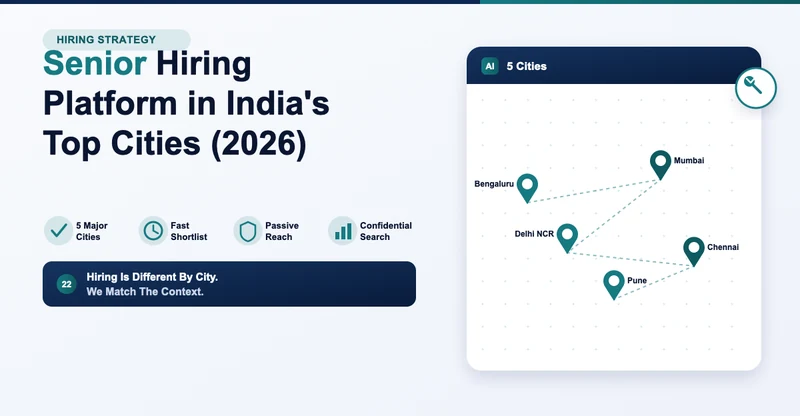
This page walks through five of India's largest senior-hiring markets (Hyderabad, Pune, Delhi NCR, Chennai, and Mumbai) and what's actually different about hiring senior and leadership talent in each one. The underlying hiring mechanism we'll describe, built around passive-candidate sourcing and anonymous job invitations, works the same way regardless of city. The market context around it does not.
How Hire22.ai's Model Works, Regardless of City
Before getting into city-specific detail, it's worth being clear about the mechanism itself, since it's the one constant across every market covered below. An employer doesn't post a public job ad. They create a JobCoNCT (a private job invitation rather than a listing anyone can browse) and SARA, the AI recruiting agent, coordinates the process from there.
Hunter AI searches more than 40 platforms and sources to find candidates matching the brief, including passive candidates who have never applied to anything and show no public sign of looking. This matters everywhere senior hiring happens, because the overwhelming majority of good senior talent in any Indian city is currently employed and not browsing job boards. But it matters by different degrees depending on how thin or thick the local market for a given function is. CoNCT AI then handles outreach through SMS, WhatsApp, email, and AI voice calls (no telecalling) and confirms genuine interest before anyone invests time in a cold pitch. JoinX AI scores and ranks every responding candidate using the JoinX Score: skills fit, experience, CTC/compensation fit, location, notice period, and joining-intent signals, together. Most employers see a ranked shortlist within 22 hours of posting.
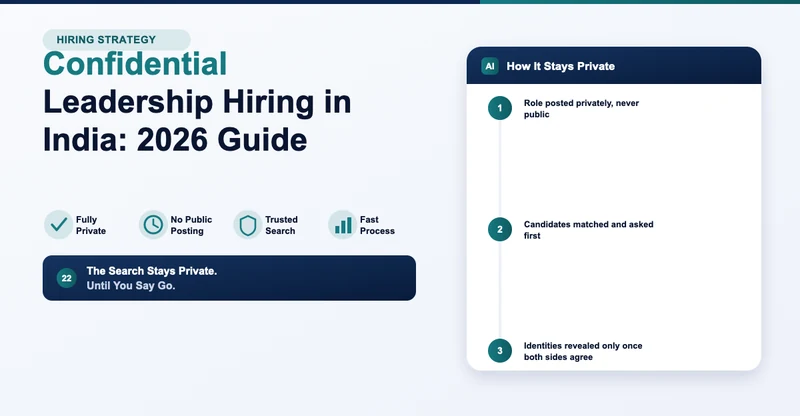
Both employer and candidate stay anonymous until the candidate accepts the JobCoNCT. See how this works on the anonymous hiring page. Hire22.ai never interviews, selects, or hires on the employer's behalf; it delivers the shortlist, and your own team runs the interviews and makes the call. Pricing doesn't change by city: a Trial Package at ₹2,999 + GST (list price ₹9,999) for 3 job postings over 3 months for first-time employers, and a Starter Package at ₹60,000 + GST for 15 job postings and 2 sub-users over 6 months, with custom plans for other volumes. No success fee, no per-profile charge, always free for candidates, a meaningfully different structure from a traditional executive search firm's 8.33%-16.67% of CTC fee, covered in more detail on the recruitment agency alternative comparison.
Senior Hiring Platform in Hyderabad
Hyderabad's senior talent market runs on two engines that don't always overlap: a long-established pharma and biotech leadership base clustered around Genome Valley, and a much newer, fast-growing tech and GCC presence packed into HITEC City and the Gachibowli-Madhapur corridor. A company hiring a VP of Quality or a Head of Regulatory Affairs is drawing from a genuinely deep, India-specific pharma leadership pool that's been building in the city for two decades. A company hiring an Engineering Director or a Head of Data is drawing from a very different pool, one that's grown rapidly as global banks, insurers, and tech companies have opened Global Capability Centres in the city and started hiring senior technical leadership locally rather than importing it.
The friction shows up differently depending on which pool you're in. In pharma and biotech, the senior pool is close-knit and reputation travels fast. A bad exit or a difficult reference check becomes known quickly. In the GCC-heavy tech corridor, the friction is closer to what Bangalore sees: a widening set of remote and hybrid alternatives, GCCs benchmarking against near-global pay bands, and a senior engineering leader fielding interest from two or three centres at once without having applied anywhere. Either way, a job posting that waits for inbound applications misses most of the people worth hiring. Hunter AI's passive search matters as much for a Head of Regulatory Affairs who's never looked at a job board as it does for an Engineering Director who's quietly being courted by three GCCs simultaneously.
Senior Hiring Platform in Pune
Pune's senior hiring story starts with auto and manufacturing: decades of engineering leadership built around the city's automotive and industrial base means there's a genuinely deep bench of people who've run plants, led quality functions, or managed large manufacturing P&Ls. What's changed over the last several years is the Hinjewadi corridor's growth into a serious tech and GCC hub, which has put a second, faster-moving senior talent market right alongside the older manufacturing one.
That overlap creates a specific kind of competition for talent that didn't exist in Pune a decade ago: a manufacturing company hiring a Plant Head isn't competing with the Hinjewadi tech crowd, but a company hiring a Director of Engineering or a Head of Product very much is, and that pool is now pulled upon by IT services majors, product companies, and an increasing number of GCCs setting up engineering centres in Pune specifically because Bangalore and Hyderabad have gotten more expensive and more contested. The practical effect is that senior technical hiring in Pune has started to behave more like Bangalore's market than people expect, while manufacturing leadership hiring remains its own, more traditional, relationship-driven search. A platform that only searches active job-board applicants tends to do reasonably well for manufacturing leadership roles, where the pool is smaller and more stable, and noticeably worse for Hinjewadi-corridor tech leadership roles, where passive candidates dominate.
Senior Hiring Platform in Delhi NCR
Delhi NCR's defining feature at the senior level is the sheer density of MNC regional and India headquarters, consulting firms, and FMCG majors packed into Gurgaon and Noida. Walk through DLF Cyber City, Golf Course Road, or Udyog Vihar in Gurgaon, or Sector 62 and the Noida Expressway corridor on the other side of the river, and you're passing the India leadership teams of a long list of global companies, all drawing from an overlapping senior talent pool. The result is a market where compensation at the Director level and above is set less by what the Indian market average looks like and more by what the nearest global company's regional pay band allows; candidates routinely field more than one serious conversation at a time, simply because there are so many comparable employers within a short drive of each other.
The Gurgaon-versus-Noida split adds its own friction: a candidate who's built a decade of commute habits and school-catchment decisions around Gurgaon's side of NCR will often decline an otherwise strong Noida-based role purely over the cross-city commute, and the reverse happens just as often. Notice periods of up to ninety days at the senior level, combined with how many comparable employers sit within reach, mean a signed candidate has plenty of opportunity to get pulled away before joining if the employer isn't actively managing that gap. For a deeper look at this specific market, see our dedicated piece on executive search in Gurgaon.
Senior Hiring in Chennai
Chennai's senior talent market is anchored by manufacturing and auto components in a way few other Indian cities can match: decades of automotive OEM and component manufacturing have built a deep bench of plant leadership, quality heads, and supply chain executives who've spent entire careers in the city's industrial belt. Layered on top of that is a steadily growing GCC presence and a genuine tech corridor along Old Mahabalipuram Road, where global banks, insurers, and technology companies have been expanding engineering and analytics leadership teams for years.
What makes senior hiring in Chennai distinct is how these two worlds rarely compete for the same candidate but both suffer from the same sourcing problem: the people worth hiring in either world are rarely active on job boards. A Plant Head with fifteen years in the city's auto-components belt isn't scrolling Naukri, and neither is a Senior Engineering Manager three years into a comfortable GCC role on OMR. Both are reachable, but only through sourcing that goes looking for them rather than waiting for an application. Chennai also tends to have a somewhat more stable senior workforce than Bangalore or Delhi NCR (people who've built a life in the city are often reluctant to relocate for a marginally better offer elsewhere), which can work in a local employer's favour if the brief and compensation band are specific enough to actually reach the right person. That stability cuts both ways, though: a company trying to pull senior manufacturing leadership away from a competitor on the same industrial belt is often fighting years of local loyalty and a candidate's own network of suppliers and plant relationships built over a long tenure, not just a compensation gap.
Leadership Hiring in Mumbai
Mumbai's senior hiring market is built around BFSI in a way no other Indian city replicates: banks, insurers, asset managers, and NBFCs headquartered in BKC, Lower Parel, and Nariman Point compete for the same CFOs, Risk Heads, and business leaders, often within the same few square kilometres. Add in the city's concentration of media, FMCG headquarters, and large conglomerate leadership teams, and Mumbai ends up being less a single talent market than three or four overlapping ones, each with its own compensation logic and its own small circle of people who've moved between the same handful of companies for years.
Leadership hiring here runs into a specific version of the counteroffer problem: a BFSI leader who signals they're leaving is usually someone whose current employer knows precisely what replacing them will cost in time and continuity, which makes aggressive counteroffers common and fast. Compensation structures at this level are also more layered than a simple CTC number: variable pay tied to business performance, deferred bonus structures common in financial services, and sometimes buyout clauses tied to regulatory cooling-off periods for certain BFSI roles all add negotiation complexity that a generic senior search doesn't usually have to deal with. A leadership search in Mumbai benefits disproportionately from getting the brief specific (reporting line, P&L size, regulatory scope) because a vague "Business Head" brief in a market this layered produces a shortlist that looks fine on paper and falls apart in the first real conversation. The same density that makes Mumbai's BFSI leadership pool so well-networked also makes confidentiality harder to maintain through word of mouth alone, which is precisely where an anonymous search earns its keep rather than being a nice-to-have.
| City | Dominant senior-talent sectors | Biggest sourcing friction |
| Hyderabad | Pharma/biotech, GCC and HITEC City tech leadership | Two separate pools that rarely overlap, each needing its own brief |
| Pune | Auto/manufacturing leadership, Hinjewadi tech and GCC | Older manufacturing pool vs. a newer, faster-moving tech pool |
| Delhi NCR | MNC regional HQs, consulting, FMCG, split across Gurgaon/Noida | Extreme employer density pushing comp up and offers overlapping |
| Chennai | Manufacturing, auto components, OMR tech and GCCs | Stable workforce, but almost entirely inactive on job boards |
| Mumbai | BFSI, media, FMCG and conglomerate leadership | Layered comp (variable pay, deferred bonus) and fast counteroffers |
The pattern across all five rows is the same one that made a single consolidated page worth writing instead of five thin ones: the sourcing mechanism doesn't change, but what counts as a "specific enough" brief does, city by city and sometimes sector by sector within the same city.
Choosing the Right Approach for Your City
None of this means the five cities need five different hiring platforms or five different strategies from scratch. The mechanism that actually solves the shared problem (most senior and leadership candidates aren't applying anywhere, and the ones who are don't represent the full market) is the same everywhere. What changes is the brief: how specific you need to be about compensation band, location within the city, and reporting structure to get a shortlist that reflects the local market rather than a generic one. A Hyderabad brief that doesn't distinguish pharma from GCC-tech will get a muddled shortlist. A Mumbai brief that doesn't specify BFSI sub-sector will do the same. The platform does the searching; the quality of the brief determines how well it searches.
For a broader look at how AI-driven platforms handle senior hiring across functions, see our guide to mid and senior hiring platforms in India and how executive hiring platforms work in India. If you're specifically hiring for a technical leadership role in Bangalore, our dedicated piece on senior tech hiring in Bangalore covers that market in the same depth as the cities above.
If you have a senior or leadership role open right now in any of these cities, post a JobCoNCT on Hire22.ai and see a ranked shortlist (including passive candidates your current sourcing is missing) within 22 hours.
Frequently Asked Questions: Senior Hiring Platforms Across Indian Cities
Does senior hiring really work differently across Indian cities, or is it mostly the same everywhere?
The underlying problem is the same everywhere. Most senior candidates aren't actively job-hunting, and relying on inbound applications misses most of the market. But the specifics differ meaningfully by city: who you're competing with, how compensation benchmarks are set, and how long notice periods realistically stretch out all vary with the density and mix of employers in that city's market.
What makes senior hiring in Hyderabad different from other cities?
Hyderabad runs on two distinct senior talent pools: a long-established pharma and biotech leadership base around Genome Valley, and a fast-growing GCC and tech leadership pool concentrated in HITEC City and Gachibowli-Madhapur. The two rarely compete for the same roles, but both require sourcing that goes beyond job-board applicants, since senior candidates in either pool are rarely actively looking.
Why is Pune's senior talent market changing?
Pune's senior hiring has traditionally centred on auto and manufacturing leadership, but the Hinjewadi corridor's growth into a genuine tech and GCC hub has created a second, faster-moving senior talent market alongside the older manufacturing one. Senior technical leadership hiring in Pune increasingly behaves like Bangalore's market, with passive candidates and multiple simultaneous offers, while manufacturing leadership hiring remains more stable and relationship-driven.
What's unique about senior hiring in Delhi NCR?
Delhi NCR has an unusually high density of MNC regional and India headquarters, consulting firms, and FMCG majors concentrated in Gurgaon and Noida, which means senior candidates routinely field multiple comparable offers at once and compensation is often benchmarked against global pay bands rather than local averages. The Gurgaon-versus-Noida commute split also matters more here than in most cities. See our dedicated piece on executive search in Gurgaon for more detail.
Is senior hiring in Chennai easier than in Bangalore or Mumbai?
In some respects, yes. Chennai's senior workforce, especially in its manufacturing and auto-components base, tends to be more stable and less prone to relocating for marginal offers. But the core sourcing challenge is the same: senior candidates in both Chennai's manufacturing belt and its OMR tech corridor are rarely active on job boards, so passive sourcing matters just as much as in any other major city.
Why does the term "leadership hiring" fit Mumbai specifically?
Mumbai's senior hiring market is heavily shaped by BFSI leadership (CFOs, Risk Heads, and business leaders at banks, insurers, and asset managers headquartered in BKC and Lower Parel) alongside media and FMCG headquarters leadership. Compensation structures at this level often involve variable pay, deferred bonuses, and sometimes regulatory cooling-off periods, making "leadership hiring" a more accurate description than a generic senior-hiring label.
How does Hunter AI source passive candidates differently across these five cities?
The mechanism itself doesn't change by city. Hunter AI searches more than 40 platforms and sources for candidates matching a role's requirements, including passive candidates who've never applied anywhere. What changes is the brief: a specific, well-written JobCoNCT that reflects the local market (for example, distinguishing pharma from GCC-tech in Hyderabad, or specifying BFSI sub-sector in Mumbai) produces a more accurate shortlist than a generic one.
How fast can I get a shortlist for a senior role in any of these cities?
Most employers receive a ranked shortlist within 22 hours of posting a JobCoNCT, regardless of city. SARA coordinates the process, Hunter AI sources candidates including passive ones, CoNCT AI confirms genuine interest through SMS, WhatsApp, email, and AI voice calls, and JoinX AI scores and ranks the responses on skills fit, compensation fit, location, notice period, and joining intent.
Can I hire confidentially across all five of these cities?
Yes. A JobCoNCT is a private invitation rather than a public listing, and both the employer and candidate stay anonymous until the candidate accepts it. This applies the same way in every city, which is useful anywhere a company wants to replace a leader quietly or a candidate doesn't want their current employer to know they're exploring something new.
Does pricing change depending on which city I'm hiring in?
No. Pricing on Hire22.ai is flat regardless of city, sector, or seniority. First-time employers can start with the Trial Package at ₹2,999 + GST (list price ₹9,999) for 3 job postings over 3 months. The Starter Package is ₹60,000 + GST for 15 job postings and 2 sub-users over 6 months, with custom plans for other volumes. There's no success fee and no per-profile charge, and it's always free for candidates.