Ask five recruiters what belongs in a "hiring tech stack" and you'll get five different answers: an ATS, a sourcing tool, an assessment platform, maybe a CRM bolted on top. Most of that disagreement comes from teams buying tools in the order problems showed up, rather than designing a stack around how their hiring actually works. The result is a pile of subscriptions that don't talk to each other and a recruiter manually copying data between three browser tabs.
This guide breaks down what a hiring tech stack actually needs to do, how the answer changes depending on team size and how involved hiring managers are, and where a single AI-driven platform can replace several point tools instead of adding one more.
In this guide: What a hiring tech stack needs to do | The core layers and what belongs in each | Choosing tools when hiring managers are heavily involved | Stack considerations for agencies vs in-house teams | Where AI sourcing and ranking fit in | Build vs buy | A practical evaluation checklist | Common mistakes
What a Modern Recruitment Tech Stack Actually Needs to Do
Strip away the vendor categories and a hiring tech stack has four jobs: find candidates (sourcing), evaluate them (screening and assessment), move them through a process without things falling through the cracks (tracking and coordination), and tell you whether any of it is working (analytics). Everything else (CRM, onboarding automation, integration platforms) exists to make those four jobs faster or more consistent across a bigger volume of hiring.
The mistake most teams make is optimizing each layer separately. A best-in-class ATS, a best-in-class sourcing tool, and a best-in-class assessment platform that don't share data with each other produce three separate silos and a recruiter doing manual reconciliation between them. For mid and senior hiring specifically, where volume is lower but the cost of a slow or wrong decision is much higher, that reconciliation overhead is often the actual bottleneck, not a shortage of tools.
The Core Layers of a Hiring Tech Stack
| Layer | What it does | Why it matters |
|---|---|---|
| Applicant Tracking System (ATS) | Centralizes job postings, applications, and pipeline status | Single system of record for every open requisition |
| Sourcing | Finds candidates, including passive ones not actively applying | Most senior candidates aren't on job boards at all |
| Screening and assessment | Evaluates skills, experience, and role fit before interview | Narrows volume to a workable, prioritized shortlist |
| Candidate engagement / CRM | Manages outreach, nurture, and communication | Keeps warm candidates warm instead of going cold mid-process |
| Scheduling and coordination | Books interviews and manages logistics | Removes the back-and-forth that stalls a pipeline |
| Analytics | Tracks time-to-hire, source effectiveness, drop-off | Tells you what's actually working, not what feels like it is |
| Onboarding | Manages documentation and ramp-up after offer acceptance | A slow onboarding erases the time saved earlier in the funnel |
A lean team doesn't need a separate best-of-breed vendor for every row in that table. It needs every one of those jobs covered, ideally by as few systems as can do it well, because every extra system is another login, another data sync problem, and another thing that breaks during a busy hiring month.
Choosing a Stack When Hiring Managers Are Heavily Involved
This is the scenario a lot of stack advice ignores: a lean talent acquisition team where hiring managers aren't just approving a final shortlist, they're actively reviewing candidates, weighing in on assessments, and sometimes sourcing informally through their own networks. In that setup, the tooling priorities shift.
- Shareability over configurability. A hiring manager who logs in twice a month doesn't want a feature-dense ATS dashboard. They need a clean, reviewable shortlist they can act on in minutes: comments, a ranking, and enough context to make a call without a recruiter walking them through the tool first.
- Fewer systems, not more integrations. Heavy hiring-manager involvement multiplies the cost of a fragmented stack, because now two people on two different sides of the process both need to stay in sync across however many tools are involved. A single platform that covers sourcing through shortlist removes that sync problem entirely rather than trying to integrate it away.
- Structured scoring hiring managers can actually interpret. A ranked shortlist with a clear fit score (skills, experience, compensation fit, notice period) gives a busy hiring manager something to act on quickly. A raw pile of resumes forces them to do the evaluation work themselves, which is exactly what a lean TA team doesn't have the headcount to support manually.
- Fast turnaround over deep configurability. Lean teams rarely have the bandwidth to spend weeks customizing workflow rules. A platform that works well with sensible defaults beats one that's powerful but needs a dedicated admin to configure properly.
In practice, this usually means a lean team is better served by one platform that handles sourcing, screening, and ranking end to end than by stitching together a sourcing tool, an assessment tool, and an ATS and hoping the integrations hold up during a hiring surge.
Stack Considerations for Recruitment Agencies vs In-House Teams
Agencies and in-house teams are optimizing for different things, and that should shape the stack differently.
Recruitment agencies
Agencies work across many clients and roles simultaneously, so the priority is throughput and pipeline reuse. A candidate sourced for one client's role should be easy to consider for a similar role elsewhere. That favors a strong CRM layer for long-term candidate relationships, broad sourcing reach across many platforms at once, and an ATS that can segment pipelines cleanly by client. Agencies also tend to be more fee-sensitive, since tooling cost sits directly against margin on every placement.
In-house talent acquisition teams
In-house teams are optimizing for a smaller, more specific set of roles and a longer-term relationship with the hiring manager and the business. The priority shifts toward role-specific fit accuracy, integration with internal systems (HRIS, payroll, onboarding), and consistency, meaning the same scoring criteria applied every time a given role type opens, rather than reinventing the search each time.
Both agencies and in-house teams benefit from the same underlying shift: AI handling sourcing and initial ranking, freeing the human side of the process for the relationship work (negotiating, closing, managing stakeholder expectations) that software can't do.
Where AI Sourcing, Screening, and Ranking Fit In
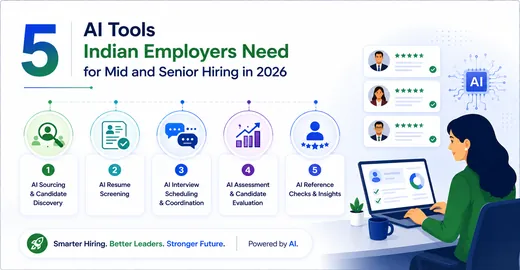
The biggest shift in the hiring tech stack over the past few years hasn't been a new category of tool. It's AI absorbing work that used to sit entirely with a recruiter: finding candidates who aren't applying, screening volume down to a workable list, and ranking that list by more than job title keywords. Hire22.ai is built around exactly that shift for mid and senior hiring in India. An employer posts a role through JobCoNCT, and SARA coordinates the process end to end. Hunter AI sources from more than 40 platforms, reaching passive candidates who aren't actively applying anywhere, which matters because the strongest senior candidates usually aren't the ones submitting applications. CoNCT AI then handles outreach directly by SMS, WhatsApp, email, and AI voice calls (no telecalling) to confirm interest. JoinX AI scores every responding candidate on skills fit, experience, CTC fit, location, notice period, and joining intent, producing the JoinX Score that ranks the shortlist employers review.
Employers typically get a ranked shortlist within 22 hours of posting, and both employer and candidate identities stay anonymous (see anonymous hiring) until the candidate accepts the JobCoNCT. Hire22.ai's role stops at the ranked shortlist: it doesn't interview, select, or hire on the employer's behalf. For executive-level searches specifically, see executive hiring.
Build vs Buy: When a Single Platform Beats a Stack of Point Tools
Assembling a stack from individually best-in-class tools makes sense when a team is large enough to have dedicated admins managing integrations, and when hiring volume justifies the extra configuration time. For most lean TA teams, and for most mid-senior hiring specifically, where role count is lower but stakes per role are higher, a consolidated platform covering sourcing through ranked shortlist tends to win on three counts:
- Less integration risk. Fewer handoff points between systems means fewer places for data to go stale or sync to silently fail.
- Faster time to value. No weeks-long implementation project before the first candidate gets sourced.
- Clearer cost structure. One subscription or package is easier to budget and justify than five smaller ones that each looked cheap in isolation but add up.
The trade-off is less granular customization than a fully assembled best-of-breed stack offers. For a team without the headcount to manage that complexity, that trade-off is usually the right one.
How to Evaluate and Choose Tools for Your Stack
- Map your actual hiring volume and role mix before shopping. A stack built for high-volume junior hiring looks very different from one built for lower-volume senior hiring with high per-hire stakes.
- Check how much hiring-manager time each tool asks for. If hiring managers are heavily involved, weight shareability and simplicity over configurability.
- Ask what happens to passive candidates. A tool that only works on inbound applicants misses most of the senior talent pool.
- Verify the pricing model up front. Per-resume or per-profile charges scale unpredictably with volume; flat packages are easier to budget against.
- Test the handoff between systems before committing. If sourcing, screening, and tracking live in different tools, confirm data actually flows between them without manual re-entry.
- Review whether scoring criteria are visible and explainable, not a black box; recruiters and hiring managers both need to understand why a candidate ranked where they did.
Common Mistakes When Building a Hiring Tech Stack
- Buying tools reactively, one problem at a time, instead of mapping the full funnel first and choosing deliberately.
- Over-indexing on features over fit. The tool with the most features isn't the right one if your team never uses most of them.
- Ignoring passive candidates entirely. A stack built only around inbound applications misses the majority of senior talent, who rarely apply on job boards.
- Underestimating integration overhead. Every additional point tool is another place for data to desync, and another login for a hiring manager who already has too many.
- No feedback loop. Without tracking which sourcing channels and scoring criteria actually produce good hires, a stack never improves. It just accumulates more tools.
What is the best recruitment tech stack for a small or lean team?
For lean teams, fewer systems that each do more tends to beat a wide stack of specialized point tools, because every additional system adds login and sync overhead a small team can't absorb during a busy hiring month. A consolidated platform covering sourcing, screening, and ranking in one place is usually the better fit than assembling five best-of-breed tools.
Which AI hiring tools work best when hiring managers are heavily involved?
Tools that produce a clean, easily reviewable ranked shortlist with explainable scoring work best, since a hiring manager who logs in occasionally needs to act quickly without learning a complex interface. Shareability and clarity of scoring matter more than deep configurability in this scenario.
What's the best tech stack for a recruitment agency?
Agencies generally need strong CRM capability for long-term candidate relationships across multiple clients, broad sourcing reach, and an ATS that cleanly segments pipelines by client. Because tooling cost sits against placement margin, fee structure and pricing predictability matter more for agencies than for in-house teams.
What are the core layers every hiring tech stack needs?
Sourcing, screening and assessment, candidate engagement, scheduling and coordination, analytics, and onboarding. A tool doesn't need to exist for every layer separately (a single platform can cover several of them), but every layer needs to be covered by something.
Should I buy a full stack of specialized tools or one consolidated platform?
It depends on team size and hiring volume. Larger teams with dedicated admin capacity can get more out of a fully assembled best-of-breed stack. Lean teams, and teams hiring mostly mid-senior roles where volume is lower but stakes are higher, usually get more value from a consolidated platform with less integration risk and faster time to value.
How does AI sourcing fit into a modern hiring tech stack?
AI sourcing tools find candidates who aren't actively applying, which matters because most strong senior candidates are passive. In a modern stack, AI sourcing typically feeds directly into AI screening and ranking, so a recruiter reviews a prioritized shortlist instead of starting from an empty pipeline.
What does Hire22.ai cover in a hiring tech stack?
Hire22.ai covers sourcing, outreach, and ranked shortlisting for mid and senior roles in India in one platform: Hunter AI sources from 40+ platforms including passive candidates, CoNCT AI handles outreach by SMS, WhatsApp, email, and AI voice calls, and JoinX AI produces a ranked shortlist by skills fit, experience, CTC fit, location, notice period, and joining intent, typically within 22 hours of posting. It does not replace interviewing or the final hiring decision, which stay with the employer.
How much should a recruitment tech stack cost?
Costs vary widely by vendor and pricing model. Flat package pricing is generally easier to budget than per-resume or per-profile charges, which scale unpredictably with hiring volume. Compare the total cost against what the equivalent manual sourcing and screening time, or an agency fee as a percentage of CTC, would otherwise cost.
Can a hiring tech stack reduce bias in recruitment?
It can help when it uses structured, skills-based scoring applied consistently to every candidate, and when identifying details are anonymized during initial screening. It won't eliminate bias on its own; the scoring criteria and training data still need regular review to confirm they aren't reproducing old patterns.
How do I know if my current hiring tech stack is working?
Track time-to-hire, cost-per-hire, offer acceptance rate, and how much manual reconciliation your team does between systems. If recruiters are regularly re-entering the same candidate data in two or three tools, that overhead is usually a sign the stack needs consolidating, not expanding.