A VP of Engineering is underperforming, and the board wants a replacement lined up before anyone tells her. A manufacturing group is planning succession for a Business Head who still has eighteen months left in the role, but the family wants an external option vetted quietly, just in case. A fintech is replacing its Head of Risk after a compliance scare, and the last thing they need is a LinkedIn rumour reaching the regulator before the new hire is even signed. These are not edge cases. They are the normal texture of leadership hiring in India, and in every one of them, the single biggest risk is not finding the wrong candidate. It is the search itself becoming visible to the wrong people.
Confidentiality at this level is not a nice-to-have. A leaked search can tank an incumbent's morale overnight, trigger resignations on the team that reports to them, spook investors mid-fundraise, or hand a competitor a very specific signal about where you think you're weak. And yet most hiring infrastructure in India (job boards, LinkedIn job slots, even a lot of retained search workflows) is built around visibility, not against it. This piece is about what genuine confidentiality in leadership hiring requires, why it's harder than people assume, and how a platform like Hire22.ai is structured around exactly this problem.
The Job Posting Is the Leak
Here's the part employers underestimate: you don't need a journalist or a disgruntled insider to blow up a confidential search. You just need to post the job. A "VP Finance, Series C fintech, Bangalore" listing on a job board is enough for anyone inside the company, anyone in the incumbent's network, or any competing recruiter watching the market to connect the dots within hours. Niche senior roles are specific by nature. There usually aren't more than a handful of companies in the city that fit the description.
LinkedIn makes it worse, not better. A hiring manager "open to work" signal, a recruiter posting "actively hiring for a Head of X," a flurry of profile views on a candidate's page right after they viewed your company page. These are all data points that a motivated observer (and incumbents tend to be motivated once they're suspicious) can stitch together. Add internal factors: the HRBP who mentions it to a peer, the recruitment agency briefing five sub-vendors to speed things up, the interview panel member who casually asks a common contact for a reference check before any offer exists. Every one of these is a plausible, well-intentioned leak point, and none of them require malice.
The uncomfortable truth is that a public job listing is not a precursor to disclosure. For a sufficiently narrow leadership role, the listing itself is the disclosure.
What Real Confidentiality Actually Requires
"Keep it confidential" is an instruction HR teams give constantly and rarely operationalise. Genuine confidentiality in a leadership search has a few concrete, non-negotiable components, not just good intentions:
- No public listing, anywhere. Not on your careers page, not on a job board, not as a "stealth" post with the company name blanked out, because savvy candidates and recruiters can often reverse-engineer a blanked listing from the specifics anyway.
- Private, direct sourcing to individual candidates. The search has to go to people, not to a public audience. That means identifying the right passive candidates and reaching out one-to-one rather than broadcasting and waiting for applications.
- The employer's identity stays hidden until both sides agree to proceed. This protects you if a candidate talks to their current employer, and it protects the candidate from being outed as "in the market" before they've decided anything.
- A tightly controlled internal communication loop. The fewer people inside your own company who know a search is live, the fewer chances for a leak. That usually means the hiring manager, one HR lead, and whoever ultimately approves the offer, not the wider interview panel, not finance, not the team the new hire will manage.
- Consent-based handling of candidate data. Confidential doesn't just mean "secret from the market." It also means the candidate's own data (their CV, their current compensation, the fact that they're exploring a move) is handled with explicit consent at every step, which in India now sits squarely under the Digital Personal Data Protection Act, 2023.
Most leadership searches fail at least one of these, usually the sourcing step, because reaching passive candidates privately at scale is genuinely hard to do manually. You either go wide (a listing, which breaks confidentiality) or go narrow (a handful of calls from your own network, which is slow and limited to who you already know).
How Hire22.ai's Anonymous JobCoNCT Model Is Built for Exactly This
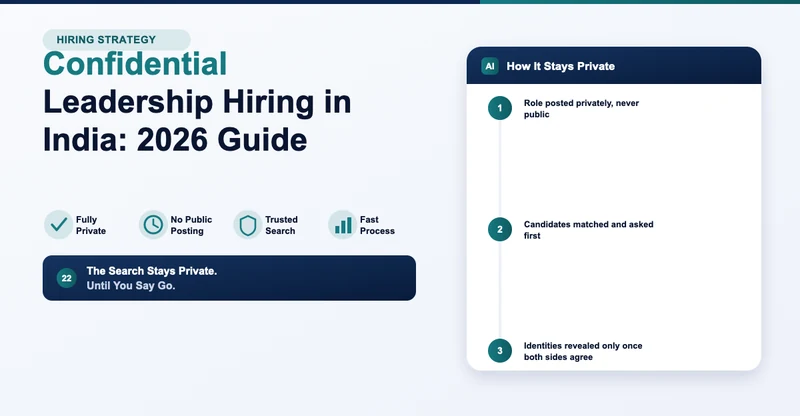
Hire22.ai was built around a mechanism designed to solve this specific tension: reach the right passive candidates without ever making the search public. Instead of posting a job, an employer creates a JobCoNCT: a private job invitation, not a listing. It never appears on a public board or careers page. There's nothing for anyone to stumble across.
SARA, the AI recruiting agent, coordinates the process end to end. Hunter AI searches more than 40 platforms and sources to find candidates who genuinely match the brief, including passive candidates who never applied anywhere and have no public "open to work" signal at all. This matters enormously for leadership searches, because the best replacement for a VP is almost never someone actively scrolling job boards; they're someone currently doing a similar job well somewhere else.
Outreach is handled by CoNCT AI, through SMS, WhatsApp, email, and AI voice calls, deliberately no telecalling, so there's no recruiter cold-calling a senior candidate's desk phone or leaving a voicemail that a colleague might overhear. CoNCT AI confirms genuine interest before anything moves forward. Then JoinX AI scores and ranks the responding candidates (skills fit, experience, CTC and compensation fit, location, notice period, and signals of actual joining intent), producing the JoinX Score that orders the shortlist. Most employers get a ranked shortlist within 22 hours of posting the JobCoNCT.
The part that makes this genuinely confidential rather than just "discreet": both the employer and the candidate stay anonymous throughout. The candidate sees enough about the role to decide if they're interested, without seeing your company name. You see a scored, anonymous profile without seeing the candidate's name or current employer. Identities are only revealed once the candidate accepts the JobCoNCT, at which point both sides have already opted in. Hire22.ai never interviews, selects, or makes the hiring decision; it delivers the shortlist, and your team runs the actual interviews and makes the call, exactly as you would with any search you ran yourself. This model is explained in more depth on the anonymous hiring page, and it's the same mechanism behind Hire22.ai's executive hiring work specifically.
Pricing is straightforward and has nothing to do with how sensitive the role is: the Trial Package is ₹2,999 + GST (list price ₹9,999) for 3 job postings over 3 months, a one-time offer for first-time employers, and the Starter Package is ₹60,000 + GST for 15 job postings and 2 sub-users over 6 months, with custom plans available for other volumes. There's no success fee and no per-profile charge. It's always free for candidates.
How to Keep a Leadership Search Confidential: Even If You're Not Using Hire22.ai
If you're running a confidential search through a retained search firm, your own network, or any other route, the same core discipline applies. A short checklist worth actually following:
- Write the brief, not the job ad. Internally, describe the role precisely enough for sourcing. Externally, strip out anything that makes the company instantly identifiable to anyone in your sector.
- Keep the internal circle to a named list, not a function. "HR knows" is not a control. Name the three or four people who know, and make sure everyone else (including the interview panel, if it's larger) only gets looped in once a shortlist exists.
- Put confidentiality in writing with every third party. Recruiters, search firms, panel members who aren't full-time staff: all of them sign something, not just get told verbally.
- Separate the comms channel. Don't run candidate conversations through the same calendar, email thread, or Slack channel used for day-to-day work where an assistant or a shared inbox might see it.
- Delay reference checks until there's real intent on both sides. Early reference checks are one of the most common accidental leaks. A well-meaning referee mentions the call to the wrong person.
- Decide in advance how and when the incumbent is told, if the search is a replacement. Don't let that conversation get forced by a leak; control its timing.
- Treat candidate data as regulated data, because it is. Under the Digital Personal Data Protection Act, 2023, you need a legitimate, consent-based basis for collecting and processing a candidate's personal information, even informally. Don't forward CVs around on email threads with no clear basis for who's allowed to see them.
None of this is exotic. It's mostly about reducing the number of humans who can accidentally talk, and reducing the number of places where candidate information sits unprotected. Hire22.ai's model essentially encodes this discipline into the platform itself, so you're not relying on every single person involved to remember to be careful.
If you want to see how this plays out for actual searches, the case studies page covers a few real hires made through the platform. And if you're a candidate exploring a move quietly rather than an employer, the same anonymity works in reverse: see anonymous job search on Hire22.ai.
Confidential leadership hiring isn't about secrecy for its own sake; it's about not letting the search itself damage the thing you're trying to protect, whether that's team stability, investor confidence, or a graceful exit for the person being replaced. If you're staring down a leadership change that genuinely cannot leak, post a confidential JobCoNCT on Hire22.ai and see the shortlist before anyone else even knows you're looking.
For more on the mechanics of structured leadership hiring in India, see how executive hiring platforms work in India and common leadership hiring mistakes. If the role you're backfilling is technical rather than purely managerial, hiring senior software engineers in India covers the adjacent ground.
Frequently Asked Questions: Confidential Leadership Hiring in India
How do I keep a leadership search confidential if I can't use a public job listing?
Replace the listing with direct, one-to-one outreach to specific candidates rather than a broadcast posting. Keep the internal circle who knows about the search to a small named list, put non-disclosure terms in writing with every recruiter or third party involved, and delay reference checks until there's genuine mutual interest. Platforms built for private sourcing, like Hire22.ai's JobCoNCT model, exist specifically because manual confidential sourcing at this level is slow and easy to get wrong.
What is a JobCoNCT and how is it different from a job posting?
A JobCoNCT is a private job invitation sent directly to matched candidates; it is never published on a job board, careers page, or any public listing. Unlike a job posting, which is visible to anyone searching, a JobCoNCT only reaches candidates that Hunter AI has identified as a genuine match, and even then the employer's identity stays hidden until the candidate accepts.
Can the incumbent in a role find out they're being replaced through a confidential search?
It's possible if confidentiality isn't managed carefully, which is exactly why the search method matters. A public listing, a recruiter briefing multiple agencies, or a loose internal circle of people who know are the most common ways an incumbent finds out prematurely. Private, direct sourcing with no public listing and a tightly controlled internal communication loop substantially reduces this risk, though no method can promise it never happens.
How does Hire22.ai keep both the employer and candidate anonymous?
The employer's identity is not shown to candidates until the candidate accepts the JobCoNCT, and the candidate's identity is not shown to the employer until that same acceptance. Before that point, the employer sees an anonymous, JoinX-scored profile, and the candidate sees enough about the role and compensation to decide if they're interested, without the company name. Both sides opt in before any identity is revealed.
Is candidate data handled legally and privately on Hire22.ai?
Candidate data on Hire22.ai is handled on a consent basis in line with the Digital Personal Data Protection Act, 2023. Candidates create profiles and express interest in specific JobCoNCTs voluntarily, and their identity is only shared with an employer once they've accepted an invitation. This is a meaningfully different data posture from scraping resumes off public boards or forwarding CVs over email without a clear consent trail.
Does Hire22.ai interview or select candidates on the employer's behalf?
No. Hire22.ai delivers a ranked, anonymous shortlist, typically within 22 hours of the JobCoNCT going out. The employer's own team conducts the interviews and makes the hiring decision, the same way they would with a search run entirely in-house. SARA coordinates the sourcing and outreach process, but the human judgment on who to hire stays with the employer throughout.
What does confidential leadership hiring cost on Hire22.ai?
Pricing doesn't change based on how confidential a search needs to be. First-time employers can use the Trial Package at ₹2,999 + GST (list price ₹9,999) for 3 job postings over 3 months. The Starter Package is ₹60,000 + GST for 15 job postings and 2 sub-users over 6 months, with custom plans for other volumes. There's no success fee and no per-profile charge, and it's always free for candidates.
Is confidential hiring only relevant for C-suite roles?
No. Confidentiality concerns show up at VP level, department head level, and in any role where the incumbent is still in place, where a planned succession hasn't been announced, or where the market knowing you're hiring would signal something you'd rather not signal, such as a strategy shift, a problem area, or a fundraise in progress. It's common at the top of an org chart, but it's not exclusive to it.