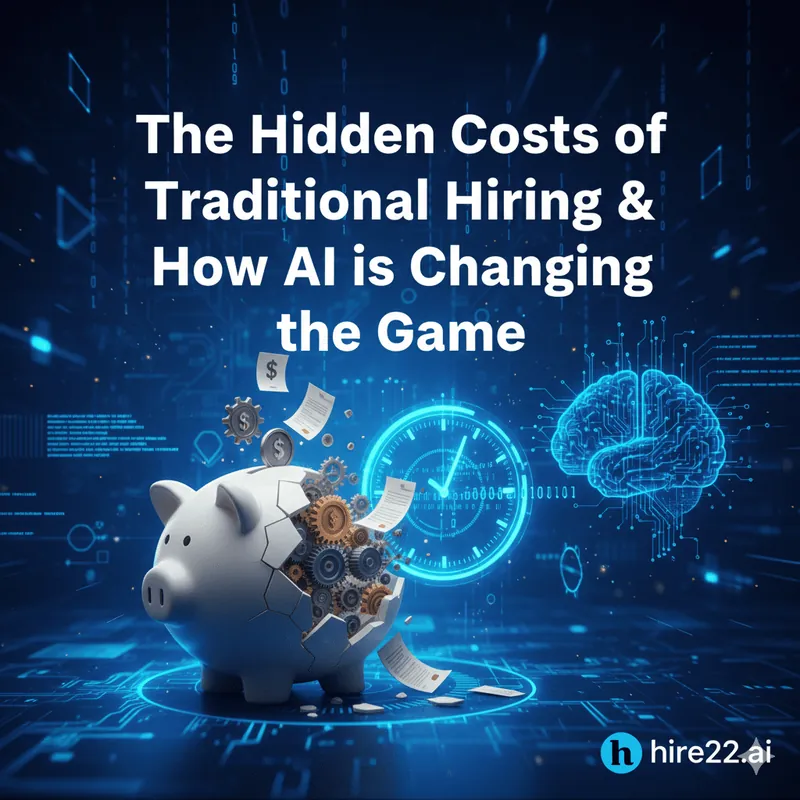
Most hiring budgets only track what's easy to see: job board invoices, agency fees, maybe a recruiter's salary allocated against open roles. What rarely shows up on that spreadsheet is the cost of the role sitting empty for ten weeks, the manager who spent three evenings sorting resumes instead of running the business, or the senior candidate who accepted a competing offer because your second interview round took too long to schedule. Those costs are real, they're often larger than the visible ones, and traditional hiring processes are built in a way that makes them almost impossible to avoid.
This is especially true for mid-level and senior hiring in India, where the pool of genuinely qualified candidates is smaller, those candidates are usually employed and not browsing job boards, and a wrong hire at that level is far more expensive to unwind than at the entry level.
What "cost per hire" doesn't capture
Ask most finance or HR teams what a hire costs and you'll get a number built from job posting fees, agency commission, and maybe background verification charges. That number is real, but it's only the visible layer. The bigger costs sit underneath it: the weeks a role stays vacant, the hours a hiring manager spends screening instead of managing, and the downstream damage of a hire who didn't work out. None of that shows up in a line item, which is exactly why it keeps getting ignored budget cycle after budget cycle.
The hidden costs of traditional hiring
Here's where the money and time actually leak out of a traditional hiring process.
1. Lost productivity from an open seat
Every day a mid or senior role stays vacant, someone else is covering for it: a manager doing two jobs, a team missing a decision-maker, a project waiting on sign-off. For individual contributor roles this is manageable for a short stretch. For manager and leadership roles, a prolonged vacancy can stall entire initiatives, and the cost compounds the longer the search drags on.
2. Spend spread across too many channels
Traditional hiring rarely relies on one source. A single open role might involve a premium job board listing, a LinkedIn Recruiter seat, an agency on retainer, and an internal referral push, each with its own cost and its own inbox to monitor. When the first round of applicants doesn't deliver a fit, the role gets re-posted, and the spend starts again. Multiply that across several open roles and recruiting spend becomes difficult to track, let alone optimize.
3. Hours lost to manual resume screening
For a single mid-senior opening, it's common to receive anywhere from dozens to a few hundred applications, and only a small fraction will be genuinely relevant. Someone still has to read through all of them, usually a hiring manager or recruiter whose time has a real cost attached to it. That's time not spent on strategy, team management, or actually interviewing the handful of candidates worth talking to.
4. The cost of a bad hire
A mis-hire at the senior level doesn't just mean redoing the search. It means retraining time, a dent in team morale, possible client or stakeholder impact if the role was client-facing, and in some cases, severance. There's no single agreed-upon multiplier for what this costs a company (it depends heavily on seniority, notice period, and how long the mismatch went unnoticed), but every HR leader who has been through it will tell you it's significantly more expensive than the hiring cost that got reported.
5. Candidate drop-off and damaged employer brand
Strong candidates, especially passive ones who weren't actively job-hunting, don't wait around through five interview rounds and slow feedback loops. They accept the offer that moved faster. Every drop-off at the senior level means restarting a search that was already difficult, and a pattern of slow, disorganized hiring quietly damages how your company is perceived among the exact candidates you most want to attract.
The cost of running hiring on disconnected tools
There's a second, less obvious cost: the overhead of juggling separate tools for each piece of the hiring workflow: one platform to post jobs, another to track applicants, a spreadsheet to manage the pipeline, WhatsApp or email for candidate outreach, and a different tool entirely for interview scheduling. Each tool solves one problem well and creates a new handoff point where information gets lost, status updates lag, and someone has to manually move candidates from one system to the next.
This is the same problem companies run into when they compare the long-term cost of maintaining several specialized software tools versus a single integrated platform for a given function. Each individual tool might look cheap on its own invoice, but the real cost is in the time spent stitching them together, the errors that creep in during manual handoffs, and the lack of a single source of truth for where every candidate actually stands. Consolidating onto one hiring platform has a short learning curve, but it removes those handoff costs permanently rather than trading one set of expenses for another.
How AI-driven hiring platforms change the cost equation
AI hiring platforms don't eliminate the cost of hiring; they change where that cost sits, moving it away from manual screening hours and toward a faster, more targeted process. Hire22.ai is built around a specific chain of steps designed to close the gaps listed above:
- The employer posts a role through JobCoNCT, which is picked up by SARA, the coordinating AI agent that manages the process end to end.
- Hunter AI sources candidates from 40+ platforms, including passive candidates who aren't actively applying anywhere: the people traditional job postings never reach.
- CoNCT AI handles outreach via SMS, WhatsApp, email, and AI voice calls, with no telecalling involved, which removes a major chunk of manual recruiter effort.
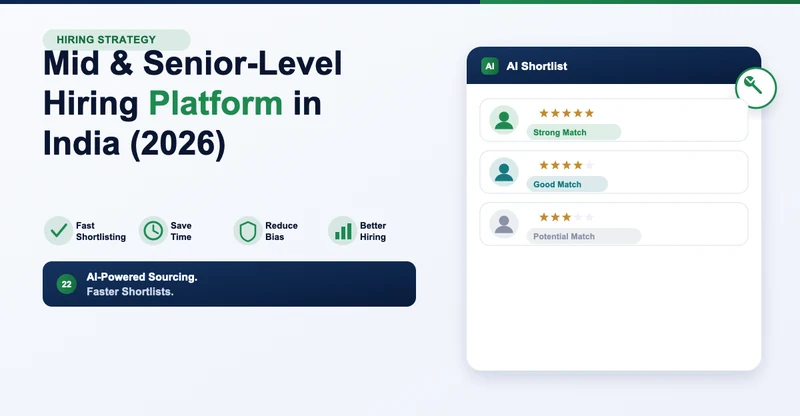
- JoinX AI produces a JoinX Score for each candidate, ranking them on skills fit, experience, CTC fit, location, notice period, and joining intent, so the employer sees a ranked shortlist instead of a raw stack of resumes.
Employers typically receive this ranked shortlist within 22 hours of posting, which directly addresses two of the biggest hidden costs above: the hours lost to manual screening, and the productivity lost while a role sits open. Both employer and candidate identities stay anonymous until the candidate accepts the JobCoNCT, which keeps the evaluation focused on fit rather than background. It's worth being clear about what the platform does and doesn't do: Hire22.ai shortlists and ranks candidates. It never interviews, selects, or hires on the employer's behalf. That decision stays with the hiring team.
Does this change for executive or highly specialized roles?
Hidden costs get worse, not better, as you move up the seniority ladder. An open CXO or VP seat often means decisions stall across an entire function, not just one team, and the pool of genuinely qualified people is small enough that most of them aren't actively browsing job boards at all. Traditional search for these roles usually means a retained search firm, a multi-month timeline, and a fee structure that's rarely transparent upfront. The same sourcing-and-ranking approach described above still applies, but reaching passive, currently-employed senior candidates matters even more at this level than it does for a mid-level individual contributor role. Executive hiring is one area where the cost of getting it wrong, and the cost of taking too long, are both higher than usual.
A simple way to calculate your true hiring cost
Before comparing platforms or deciding whether a change is worth it, it helps to put a number on what traditional hiring is actually costing you today. You don't need fabricated industry benchmarks for this, because your own numbers are more useful.
| Cost category | What to measure |
|---|---|
| Vacancy cost | Average days a role stays open × estimated daily cost of the gap (overtime, delayed projects, interim coverage) |
| Sourcing spend | Total spend across job boards, agency fees, and premium postings per role, including re-posts |
| Screening time | Hours spent by hiring managers and recruiters reviewing resumes and scheduling first-round calls, valued at their loaded hourly cost |
| Mis-hire risk | How many hires in the last year didn't work out within the first six months, and what it cost to replace them |
| Drop-off rate | How many senior candidates withdrew or accepted elsewhere mid-process, and how many extra search cycles that triggered |
Adding these up almost always produces a number noticeably higher than the "cost per hire" figure most teams report, which is the whole point of looking at hidden costs in the first place.
What switching to an AI hiring platform actually costs
Switching platforms is itself a cost, so it's worth being upfront about what that looks like. Hire22.ai's pricing is structured as flat packages rather than per-profile charges or a success fee: a Trial Package at ₹2,999 + GST (list price ₹9,999) covers 3 job postings over 3 months and is meant for first-time employers to evaluate the platform, and a Starter Package at ₹60,000 + GST covers 15 postings, 2 sub-users, and 6 months of access. There's no success fee and no per-profile charge on top of that. For a company currently paying for multiple job board listings, an agency retainer, and the hidden cost of recruiter hours on every single role, that's usually a straightforward comparison to run once you've worked out your own numbers from the table above.
What are the biggest hidden costs of traditional hiring?
The largest hidden costs are usually lost productivity while a role sits vacant, hours spent on manual resume screening, the cost of a mis-hire that doesn't work out, and candidate drop-off when strong applicants accept a faster-moving offer elsewhere. None of these typically appear in a standard "cost per hire" calculation, which is why total hiring costs are often underestimated.
How does AI actually reduce hiring costs?
AI reduces costs mainly by cutting the hours spent on manual screening and by shortening the time a role stays open. Platforms like Hire22.ai source and rank candidates automatically and typically deliver a shortlist within 22 hours, which reduces both the sourcing effort and the vacancy period that drive most hidden costs.
Is it expensive to switch from job boards and agencies to an AI hiring platform?
There's a short adjustment period, but the ongoing cost structure is usually simpler. Hire22.ai uses flat packages rather than per-profile charges or success fees, which makes it easier to predict and compare against what you're currently spending across job boards and agency retainers.
What's the real cost of a bad senior hire?
It varies by company and role, but it typically includes the original hiring cost, retraining or severance, the productivity lost while the mismatch went unnoticed, and the cost of running the search again. It's almost always higher than teams expect when they only track the initial hiring spend.
Does consolidating hiring tools onto one platform actually save money?
It can, mainly by removing the overhead of manually moving candidate information between separate sourcing, tracking, and outreach tools. The savings come less from any single tool being cheaper and more from eliminating the handoff errors and delays that happen when hiring runs across disconnected systems.
Why do senior candidates drop out of long hiring processes?
Senior candidates, especially passive ones who weren't actively looking, are usually weighing more than one option and don't have the patience for slow feedback loops or repeated interview rounds. A process that takes weeks to move from screening to offer frequently loses them to a competitor who moved faster.
Does Hire22.ai make the hiring decision for employers?
No. Hire22.ai sources, screens, and ranks candidates using the JoinX Score, but it never interviews, selects, or hires on the employer's behalf. The final interview and hiring decision always stays with the employer's team.
Is candidate identity visible before they accept the role?
No. Both the employer's and the candidate's identities stay anonymous until the candidate accepts the JobCoNCT, which keeps the early evaluation focused on skills and fit rather than background.
Traditional hiring looks affordable right up until you add up the vacancy time, the screening hours, the re-posted job ads, and the occasional bad hire. Those hidden costs are real, and they're exactly what an AI-driven process like Hire22.ai is designed to cut down on, not by promising a guaranteed outcome, but by sourcing wider, ranking faster, and getting a shortlist in front of you in hours instead of weeks. If you're trying to reduce time-to-hire for mid or senior roles in India, the math is worth running on your own numbers.