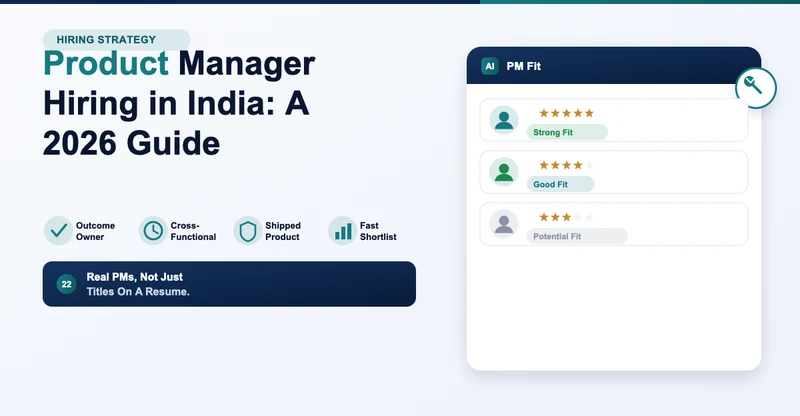
Six weeks into a product manager search, a 40-person fintech in Bangalore had interviewed eleven candidates and made an offer to none of them. The job description said "Senior Product Manager, Lending." The resumes that came back said something else: a business analyst who'd written PRDs for a vendor, a project manager who'd "driven" a mobile app launch by chasing engineering timelines, a growth marketer who called themselves a "product manager, growth" because that's what their LinkedIn headline needed to say to get recruiter attention. Two candidates in, the hiring manager realised the problem wasn't candidate quality. It was that "product manager" in India currently covers four or five genuinely different jobs, and almost nobody filtering resumes at the top of the funnel was screening for which one they actually needed.
This is not a rare story. It's close to the default experience of hiring a PM in India right now, and it gets worse, not better, the more senior the role is. This piece looks at why PM hiring is unusually hard to screen for here, what actually separates a strong senior PM from someone who's picked up the title, and where a platform like Hire22.ai can help, and where it can't substitute for your own judgment in the interview room.
Why "Product Manager" Means Five Different Jobs in India
In the US and parts of Europe, the PM title has had a couple of decades to settle into something closer to a shared definition. In India, the role scaled fast across very different company types at the same time (B2B SaaS, consumer apps, fintech, enterprise IT services, D2C) and each of those contexts grew its own flavour of "product manager" without much cross-pollination. The result is a title that's doing five jobs at once on any given job board.
A B2B PM at an enterprise SaaS company spends most of their time with sales engineers and customer success, translating a handful of large accounts' needs into a roadmap. A B2C PM at a consumer app is closer to a data scientist with taste: running A/B tests, reading funnel drop-off, arguing with design over a button colour because it moved activation by half a percentage point. A 0-to-1 PM at an early-stage startup is doing founder-adjacent work: talking to the first fifty customers themselves, writing the first version of the spec, sometimes writing some of the code. A PM on a scaled product at a company with ten million users is doing something almost opposite: protecting a stable system, running experiments carefully because a mistake now touches real revenue, and spending real time on technical debt tradeoffs with engineering leadership. And a "technical PM" or "platform PM" is often closer to an engineering-adjacent role entirely, reviewing API contracts and system design docs rather than user flows.
None of these people are wrong to call themselves a product manager. But a resume keyword match for "product manager" treats all five as interchangeable, and they're not. A strong 0-to-1 PM dropped into a scaled-product role can genuinely struggle, not because they're worse, but because the job is a different shape. This is the first and most basic screening failure in PM hiring in India: searching for a title instead of a scope.
Product Manager Hiring in India: The Mid-Level Search
Most searches for "product manager hiring India" are for the 3-7 year experience band: someone who can own a feature area or a smaller product line end to end, work with a design and engineering pod without constant supervision, and translate business goals into a roadmap without someone writing the roadmap for them. At this level, the biggest screening risk isn't scope mismatch, it's title inflation: candidates who held "associate product manager" or "product owner" roles that were really execution-heavy project coordination, not product decision-making.
The tell, in an interview, is usually in how someone answers "walk me through a feature you shipped that didn't work." A real mid-level PM has a specific answer: what the hypothesis was, what the data said, what they changed or killed. A relabelled business analyst or project manager usually answers with process: what Jira board it was tracked on, how the sprint went, who was late. That's not a character flaw, it's just a different job description wearing the same title, and it's exactly the kind of thing a resume scan won't catch but a structured interview will.
Senior Product Manager Hiring in India: What Actually Distinguishes the Real Ones
"Senior product manager hiring India" searches are a different animal, and the stakes of a bad screen are higher: a senior PM mis-hire usually costs six to twelve months of a product direction nobody is happy with, not just a bad quarter. A handful of things separate a genuinely strong senior PM from someone who's accumulated years in the title without the substance:
- Outcome ownership, not output listing. A strong senior PM talks in terms of a metric they moved and why (activation, retention, revenue per user, cost to serve), not a list of features they launched. If every answer in an interview is "we shipped X," push on what X actually changed.
- Cross-functional influence without formal authority. A senior PM doesn't manage engineering or design. They have to get both to move in a direction through argument, data, and trust, often with people more senior than them in the room. Ask for a specific instance where engineering or sales pushed back hard, and what the PM actually did, not what they wish they'd done.
- A real shipped-product track record, not a case-study portfolio. A polished deck walking through a hypothetical redesign of a well-known app is an interview-prep artifact, not evidence. The real signal is being able to describe, in specific and sometimes unflattering detail, a product they actually shipped, what broke, and what the post-mortem looked like.
- Judgment about what not to build. Anyone can describe a roadmap of things to add. Fewer people can describe a feature they killed, deprioritised, or talked a stakeholder out of, and explain why with something more rigorous than "we didn't have bandwidth."
- Comfort with ambiguity at the edges of their scope. Senior PMs regularly operate in situations where the brief is incomplete and the data is inconclusive. How someone talks about a decision they made with 60% confidence tells you more than how they talk about a decision the data made obvious.
None of this shows up reliably in a resume. It shows up in a structured interview built around specific past behaviour, and in reference checks that ask former cross-functional partners (not just former managers) what the person was actually like to work with.
Why Sourcing Is Half the Problem
Here's the part that makes PM hiring doubly hard in India: the strongest senior PMs, the ones with a real shipped-product track record at a company that's actually scaled, are almost never the ones actively applying. They're busy, usually well compensated, and not browsing job boards. If your sourcing strategy is "post the role and wait," you are, by construction, selecting from the pool of PMs who are currently job-hunting, which skews toward people between roles or looking to leave for reasons worth probing, not toward the strongest performers in the market.
This is where Hunter AI does work that a job posting structurally can't. Instead of waiting for applications, it searches more than 40 platforms and sources to find candidates who match the brief on scope, industry, and stage, including passive PMs who aren't job-hunting at all. An employer posts a JobCoNCT (a private job invitation, not a public listing) and SARA, the AI recruiting agent, coordinates the process from there. CoNCT AI handles outreach by SMS, WhatsApp, email, and AI voice calls (no telecalling), and confirms the candidate is genuinely interested before anything moves forward.
The screening problem described above (title inflation, scope mismatch, keyword-matched resumes that don't reflect real product ownership) is exactly what JoinX AI is built to cut through. It scores and ranks candidates on skills fit, experience depth, compensation fit, location, notice period, and joining-intent signals, not just whether "product manager" appears on a resume. Most employers get a ranked shortlist within 22 hours of posting a JobCoNCT. Both employer and candidate stay anonymous until the candidate accepts, which matters particularly for PM searches, since a senior PM quietly exploring a move usually doesn't want their current employer to find out from a job board.
Worth being direct about what this doesn't replace: Hire22.ai surfaces and ranks candidates who are a strong fit on paper and genuinely interested. It doesn't run the interview that distinguishes outcome ownership from output listing, and it shouldn't; that judgment call stays with your team. It delivers the shortlist; your panel still has to ask the "walk me through a feature that didn't work" question and listen carefully to the answer.
A Practical Screening Checklist Before You Interview
- Write the scope down before you write the title. B2B or B2C? 0-to-1 or scaled? Technical depth required or not? A title alone will attract the wrong half of your funnel.
- Ask for one shipped product, not a portfolio. One real story told in depth beats five case-study slides.
- Probe the failure, not just the win. What they killed or got wrong tells you more about seniority than what worked.
- Check who they influenced, not who they managed. PMs rarely have direct authority, so ask who pushed back and what happened next.
- Reference-check a cross-functional partner, not just a manager. An engineering lead or design partner will tell you things a manager reference won't.
If you're building out a broader senior hiring process alongside this, how a mid/senior hiring platform works in India and what a leadership hiring platform actually does cover adjacent ground worth reading. When you're ready to source for a role rather than keep sifting inbound applications that don't match the scope you actually need, post a JobCoNCT on Hire22.ai and see a ranked, anonymous shortlist within hours instead of weeks.
Frequently Asked Questions: Product Manager Hiring in India
Why is product manager hiring harder to screen than most other mid/senior roles in India?
The title covers several genuinely different jobs (B2B versus B2C, 0-to-1 versus scaled product, technical PM versus growth PM) and India's PM title inflation means project managers, business analysts, and product owners often use "product manager" interchangeably on resumes. A keyword match on the title alone can't tell these apart; you need to screen for scope and real decision-making, not the label.
What's the difference between hiring for "product manager" versus "senior product manager" in India?
Mid-level PM hiring (roughly 3-7 years) mostly needs to screen out title inflation: candidates whose prior role was closer to project coordination than real product ownership. Senior PM hiring needs to go further and verify outcome ownership, cross-functional influence without formal authority, and a real shipped-product track record, since a senior mis-hire costs significantly more time and direction to recover from.
How do I tell a real product manager apart from a relabelled business analyst or project manager?
Ask them to walk through a feature that didn't work and listen to how they answer. A real PM talks about the hypothesis, the data, and what they changed or killed. Someone whose role was really process coordination tends to answer in terms of timelines, sprint boards, and who was late: process, not product decisions.
Why don't the strongest senior PMs show up when I post a job?
The strongest senior PMs with a real shipped-product track record are usually employed, well compensated, and not actively browsing job boards. Posting a job and waiting for applications selects from the pool of PMs currently job-hunting, which skews toward people between roles rather than toward the strongest performers in the market. Reaching the rest requires active, passive-candidate sourcing rather than a listing.
How does Hire22.ai help with PM hiring specifically?
Hunter AI searches more than 40 platforms and sources to find candidates matching the brief, including passive PMs who aren't actively applying. JoinX AI then scores and ranks responding candidates on skills fit, experience depth, compensation fit, location, notice period, and joining-intent signals, rather than a simple keyword match on the title. Most employers get a ranked shortlist within 22 hours of posting a JobCoNCT.
Does Hire22.ai interview or evaluate product sense on the employer's behalf?
No. Hire22.ai delivers a ranked, anonymous shortlist of candidates who match the role on fit signals. It does not conduct the interview or judge product sense, outcome ownership, or cross-functional influence; that evaluation stays with the employer's own hiring team, exactly as it would with any search run in-house.
What should a PM job description include to attract the right candidates, not just the most applicants?
Be specific about scope rather than relying on the title alone: B2B or B2C, 0-to-1 or scaled product, how much technical depth is required, and what metric the role is actually accountable for. A vague "senior product manager" posting attracts a wide and poorly matched pool; a scoped one filters itself before you ever open a resume.
What does it cost to hire a product manager through Hire22.ai?
First-time employers can use the Trial Package at ₹2,999 + GST (list price ₹9,999) for 3 job postings over 3 months. The Starter Package is ₹60,000 + GST for 15 job postings and 2 sub-users over 6 months, with custom plans available for other volumes. There's no success fee and no per-profile charge, and it's always free for candidates.