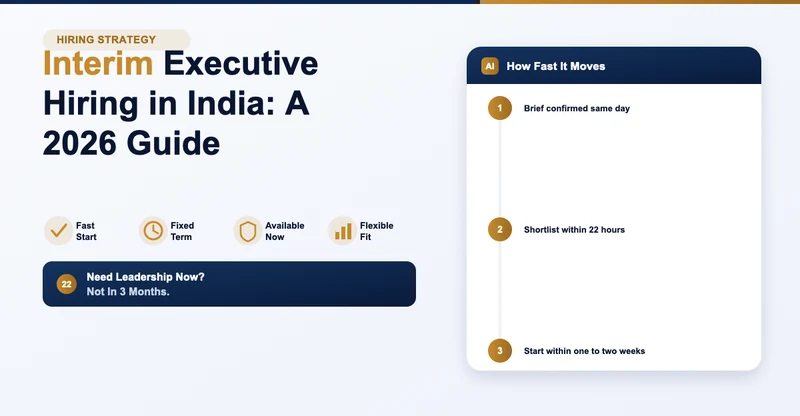
A CFO resigns on a Thursday, effective immediately, over a disagreement with the founder that nobody saw coming. The board has a quarter-end close in five weeks, an investor update due in six, and a banking relationship that needs a signatory the bank actually recognises. A permanent search for a CFO, done properly, takes three to six months even when it goes well. Nobody in that boardroom has three to six months. What they need is someone credible enough to sit in the seat, sign what needs signing, and keep the finance function from stalling, while a proper search runs in the background. That is the specific, narrow problem interim executive hiring solves, and it is genuinely a different hiring motion from a normal leadership search, not just a faster version of one.
This piece is about when interim executive hiring actually makes sense in India, how it differs from a permanent search in practice (speed, pricing, and risk all work differently), and where a sourcing platform like Hire22.ai can realistically help, without overstating the fit. Worth saying upfront: Hire22.ai's core model is built around permanent mid and senior hiring. Its relevance to interim hiring is real but partial, and this piece tries to be honest about where that line sits.
When Interim Executive Hiring Actually Makes Sense
Interim hiring isn't a budget-friendly substitute for a permanent search. It's a response to a specific kind of urgency that a permanent process, by its nature, can't move fast enough to cover. A few situations where it genuinely fits:
- A sudden, unplanned departure at CXO level. Resignation with immediate effect, a termination for cause, a medical emergency: any scenario where the seat is empty today and a permanent replacement realistically can't be in place for months.
- Bridging a leadership gap during an active search. Even a well-run executive search takes time to get right, and rushing it to avoid a vacancy is how companies end up with the wrong permanent hire. An interim leader buys the search the time it needs without the business running leaderless in the meantime.
- M&A integration periods. Post-acquisition, there's often a window where a specific, time-bound leadership mandate (stabilise two finance teams into one, align two sales organisations) is a defined project with a natural end date, not an open-ended role.
- A specific turnaround or transformation mandate. Some situations call for a leader brought in explicitly to fix one thing (a troubled factory, a compliance remediation, a cost-reduction programme) and then step back once it's done. The mandate itself is time-bound by design.
- Maternity, medical, or extended leave coverage at the top. A CXO on a few months of leave still needs someone with real decision-making authority in the seat, not a committee of direct reports making calls by consensus.
The common thread is a defined start and a reasonably defined end. If you're reaching for "interim" because you're unsure whether you want the role permanently, that's usually a sign you need to settle the organisational design question first. Interim hiring works best when the need is urgent and time-bound, not when the role itself is undecided.
How It's Genuinely Different From a Permanent Executive Search
It's tempting to think of interim hiring as "the same search, just faster." It isn't. A few things actually work differently, not just quicker:
- Speed and availability outrank long-term culture fit. A permanent search weighs culture fit and multi-year alignment heavily, because the hire is meant to stay for years. An interim search weighs something closer to "can this person be credible starting next week, for a defined number of months." Someone who'd be a mediocre long-term fit can still be an excellent interim leader if they're decisive, experienced in exactly this situation, and available now.
- Pricing works on a different model entirely. A permanent search fee is typically a percentage of the hire's annual CTC, paid on joining. Interim engagements are usually priced as a day rate or a fixed-term retainer instead, because you're paying for availability and time, not a long-term placement. Rates vary enormously by function and seniority, so treat any figure you hear as a starting point for negotiation, not a benchmark.
- The sourcing pool is different. Permanent searches draw on people looking to make a career move. Interim searches draw on a narrower pool: semi-retired executives, portfolio operators between board roles, and specialist interim-management firms that maintain a bench of exactly these profiles.
- Onboarding is compressed. A permanent hire gets weeks to ramp up. An interim leader is often expected to contribute meaningfully within days, so vetting has to confirm they can operate at speed in an unfamiliar organisation, not just that they're qualified on paper.
The Risks Worth Planning For
Interim hiring solves a real problem, but it introduces its own risks, and most of the bad outcomes with interim leaders trace back to one of these not being managed upfront.
The biggest one is authority. An interim CXO doesn't automatically carry the informal authority a permanent leader builds over months: the trust of direct reports, the credibility with the board, relationships with key clients. If the board or founder doesn't explicitly and visibly back the interim leader's decisions early on, the organisation can quietly route around them, waiting out the clock until the "real" leader arrives.
The second is handover and succession. An interim engagement that ends without a deliberate handover plan (documented decisions, context transferred to the permanent hire, relationships properly introduced) can undo much of the stabilisation achieved. Define what a good handover looks like, and who owns it, before the engagement starts.
The third is scope creep in the other direction: an interim engagement that quietly becomes permanent by inertia, without anyone making an actual decision to make it so. If the interim leader is working out well, that can be a legitimate outcome, but it should be a deliberate choice with its own negotiation, not something that happens by default because nobody got around to finishing the permanent search.
Where Hire22.ai Fits, and Where It Doesn't
It's worth being straightforward here rather than stretching the pitch. Hire22.ai's core mechanism (an employer posts a JobCoNCT, a private job invitation, and SARA coordinates the process while JoinX AI scores and ranks responding candidates) is built around permanent mid and senior hiring. It wasn't designed around day-rate engagements, fixed-term contracts, or the specialised interim-management bench that firms built specifically for this niche maintain.
Where it can genuinely help, even for an interim need, is the sourcing problem underneath both kinds of search: finding qualified, available people quickly, including ones who aren't actively looking. Hunter AI searches more than 40 platforms and sources for candidates matching a brief, including passive candidates who never applied anywhere, and a semi-retired executive open to a defined-term engagement is exactly the kind of person who looks passive from the outside but might say yes to the right opportunity. CoNCT AI handles outreach by SMS, WhatsApp, email, and AI voice calls (deliberately no telecalling) and confirms real interest before anything moves forward.
What it doesn't do is manage the parts that make interim hiring genuinely distinct: structure a day-rate contract, negotiate a fixed-term retainer, or vet someone specifically for "can you be credible by next Monday" the way a specialist interim-management firm's process is built to do. Both employer and candidate stay anonymous until a candidate accepts a JobCoNCT, which helps if discretion matters, but the contracting afterward is still something the two sides work out directly. For most urgent, short-notice CXO gaps, the realistic move is broad sourcing to surface names fast, while running final vetting and contracting through whatever process fits a time-bound executive engagement, which may well mean a specialist interim firm rather than a standard JobCoNCT flow.
If the underlying need turns out to be a permanent leadership hire rather than a bridge, the mechanism is a closer fit; see Hire22.ai's executive hiring page, and how a CXO hiring platform works in India for the permanent-search version of this same problem. Hire22.ai's own pricing (the Trial Package at ₹2,999 + GST for 3 job postings over 3 months, or the Starter Package at ₹60,000 + GST for 15 job postings over 6 months) is built around that permanent-hiring volume model, not a day-rate or per-engagement structure, which is itself a sign of where the platform's core strength sits.
A Practical Starting Checklist
- Define the mandate and the end date before you start sourcing. "Interim CFO until we close a permanent search" is a mandate. "Interim CFO, indefinitely" usually isn't; it's a permanent role avoiding a decision.
- Get visible, explicit backing from the board or founder on day one. The interim leader's authority needs to be stated out loud to the organisation, not assumed.
- Decide the pricing model upfront. Day rate or fixed-term retainer, and over what period: settle this before the search starts, not mid-negotiation with a candidate who's already interested.
- Plan the handover from the start, not at the end. Decide what gets documented and who the interim leader needs to introduce to whoever comes next.
- Run the permanent search in parallel, genuinely. An interim hire should reduce the pressure on the permanent search's timeline, not become a reason to deprioritise it.
For the permanent search running alongside an interim bridge, what a leadership hiring platform actually does and mid and senior hiring platforms in India are worth reading together. When you're ready to source candidates (interim bridge or permanent replacement), post a JobCoNCT on Hire22.ai and see a ranked, anonymous shortlist of available people within hours.
Frequently Asked Questions: Interim Executive Hiring in India
What is interim executive hiring and how is it different from a permanent search?
Interim executive hiring brings in a senior leader on a fixed-term or defined-mandate basis, to cover a sudden departure, bridge a gap during a permanent search, or run a specific turnaround, rather than hiring someone for an open-ended, long-term role. It prioritises speed and availability over long-term culture fit, and is usually priced as a day rate or fixed-term retainer rather than a percentage-of-CTC placement fee.
When does interim executive hiring actually make sense?
It fits situations with genuine urgency and a defined endpoint: a sudden CXO departure, bridging a leadership gap while a permanent search runs, M&A integration periods, a specific turnaround or transformation mandate, or covering maternity or medical leave at the top. If the role itself is undecided rather than the timeline being urgent, that's usually a sign to resolve the organisational design question first.
How is interim executive pricing different from a permanent executive search fee?
Permanent executive search fees are typically a percentage of the hire's annual CTC, paid on joining. Interim engagements are usually priced as a day rate or a fixed-term retainer covering the engagement's duration, reflecting that you're paying for availability and time rather than a long-term placement. Rates vary significantly by function and seniority, so treat any figure you hear as a starting point for negotiation rather than a fixed benchmark.
What are the biggest risks with bringing in an interim executive?
The main risk is authority: an interim leader doesn't automatically carry the informal trust and credibility a permanent leader builds over time, so the board or founder needs to visibly back their decisions from day one or the organisation may quietly wait out the clock. The second risk is a weak handover when the engagement ends, which can undo the stabilisation the interim leader achieved if it isn't planned from the start.
Can an interim executive engagement become permanent?
It can, and sometimes should, if the interim leader is working out well. But it should be a deliberate decision with its own negotiation on terms, compensation, and mandate, not something that happens by default because the permanent search was never finished. Treat it as a conscious choice, not an inertia outcome.
Is Hire22.ai built for interim executive hiring?
Not primarily. Hire22.ai's core model (JobCoNCTs, SARA coordinating the process, JoinX AI scoring candidates) is built around permanent mid and senior hiring. It can still help with the sourcing problem underneath an interim search, particularly surfacing available, qualified people who aren't actively job-hunting, through Hunter AI's search across 40+ platforms. But it doesn't structure day-rate contracts or replace a specialist interim-management firm's vetting process for short-notice executive availability.
Who typically takes on interim executive roles in India?
The pool is narrower and different from typical job-seekers: semi-retired executives, portfolio operators who deliberately work between board or advisory roles, specialists who've built a practice around turnaround or transformation mandates, and people between permanent roles who are open to a defined-term bridge. Specialist interim-management firms often maintain a bench of exactly these profiles.
Should I run a permanent search at the same time as an interim hire?
Yes, generally. An interim hire is meant to buy time for a permanent search to be done properly, not to replace it. Running the permanent search in parallel, with real intent, avoids the common failure mode where an interim engagement quietly drifts into a permanent one by default rather than by decision.