A Series B founder we'll call it typical gets three quotes for a VP Sales search. One search firm says 25% of CTC, payable half upfront. Another says a flat retainer of ₹4 lakh regardless of outcome. A third, a boutique shop that specialises in his sector, won't even give a number until he signs a mandate letter. He's trying to put a hiring budget together for the board deck due Friday, and none of these numbers reconcile with each other.
This happens constantly in Indian mid-market hiring. Executive search pricing isn't published anywhere, it varies by firm, by city, by how badly the agency wants the mandate that week, and most HR heads only learn the real cost structure after they've already signed something. This guide lays out what search firms actually charge in India, what pushes the number up or down, the costs that don't show up in the headline fee, and how the economics change if you're hiring senior people more than once a year.
How Search Firms Actually Charge: Retained vs. Contingency
There are two dominant commercial models in Indian executive search, and the difference matters more than most employers realise when they're comparing quotes.
Contingency search is the more common model for Director and VP-level roles. The firm gets paid only if you hire their candidate. The standard, public-market fee for contingency search in India runs 8.33% to 16.67% of the hired candidate's annual CTC, a range you'll see quoted by most agencies, often expressed as "one month's salary" at the low end and "two months" at the high end. On a ₹40 lakh CTC hire, that's anywhere from roughly ₹3.3 lakh to ₹6.7 lakh, and the firm usually isn't working exclusively for you; they may be running the same mandate for two or three other clients, or pitching the same candidates to a competitor down the street.
Retained search is the model for CXO, board-level, or highly confidential mandates. You pay a portion upfront (commonly a third at signing, a third at shortlist, a third on joining) regardless of whether the hire closes. Total fees here are often cited in the broad range of 25-33% of CTC or more, because you're paying for exclusivity and the firm's full attention, not just a result. This is the model boutique executive search firms use, and it's also where the biggest budgeting surprises happen, because the firm gets paid win or lose.
Neither model is "wrong." A confidential CEO replacement genuinely needs a retained search with a dedicated consultant and real discretion. A VP Marketing hire for a 200-person company usually doesn't. The mismatch, paying retained-search money for a role that didn't need that level of exclusivity, is where most of the budget overruns in Indian senior hiring actually come from. Our comparison of recruitment agency alternatives breaks this down further if you're weighing agency routes against platform-led hiring.
What Pushes the Fee Up (and What Brings It Down)
Four variables move the number more than anything else, and none of them are secret, agencies just don't volunteer them unprompted.
- Seniority. A Manager-level hire and a CXO-level hire are not the same search, even at the same fee percentage, because the percentage is applied to a much larger CTC base. A 12% fee on a ₹25 lakh Manager hire is ₹3 lakh. The same 12% on a ₹1.2 crore CXO hire is ₹14.4 lakh. Seniority also tends to push the percentage itself up, not just the base.
- Confidentiality. If the incumbent doesn't know they're being replaced, or the hire can't be announced until a board decision is finalised, the search has to run through private, anonymous outreach rather than any public posting. That constraint is real work, and firms price it in, often with a premium of several percentage points over a standard open search.
- Exclusivity. Giving one firm exclusive rights to the mandate usually gets you a better rate and more attention than running the same role through three contingency firms simultaneously. Non-exclusive mandates sometimes carry a slightly higher percentage per firm, because each one knows the odds of actually closing the placement are lower.
- Urgency. A "need this closed in three weeks" mandate costs more than a role with a comfortable 10-week runway, because the firm has to reallocate consultant time away from other searches. Rush fees aren't always itemised separately. They just show up as a higher base percentage.
The practical takeaway: before you ask "what will this cost," figure out where your role actually sits on these four dimensions. A non-confidential, non-exclusive, non-urgent Director hire should land at the low end of the contingency range. Stack two or three of the expensive factors together and you're in retained-search territory whether you meant to be or not.
The Costs That Don't Show Up in the Headline Number
The percentage quoted on the first call is rarely the full economic picture. A few things to ask about explicitly before signing anything:
- Advance or retainer payments. Retained search almost always asks for a portion upfront, sometimes 30-40% of the estimated total fee before any candidate has even been contacted. If the search stalls or the role gets shelved, that money is usually gone.
- Replacement guarantees (and what voids them). Most firms offer a guarantee window (commonly 60-90 days) where they'll re-run the search free if the hire doesn't work out. Read the fine print: many guarantees are voided if the candidate resigns rather than being let go, or if the role scope changed after hiring. A guarantee that excludes the most common failure mode isn't much of a guarantee.
- CTC definition disputes. Fees are calculated on annual CTC, but "CTC" itself is negotiable: does it include a joining bonus, ESOPs, variable pay that hasn't vested, or relocation? Agencies have an incentive to define it broadly since the fee is a percentage of it. Get this nailed down in writing before an offer is extended, not after.
- Running multiple firms in parallel. If you engage two or three contingency firms for the same role without clear terms, you can end up in a dispute over who "sourced" a candidate first, especially if the candidate also applied independently or through LinkedIn. This is a genuinely common and avoidable source of friction.
None of this means traditional search is a bad choice. For genuinely confidential, board-level, or hard-to-define mandates, it's often the right one. It means the number on the first call is a floor, not the full budget line.
| Model | Typical cost | Paid even if no hire? | Best suited for |
| Contingency search | 8.33%–16.67% of CTC | No | Director/VP roles, moderate urgency, non-confidential |
| Retained search | 25–33%+ of CTC, staged | Partially (upfront portions non-refundable) | CXO, board-level, highly confidential mandates |
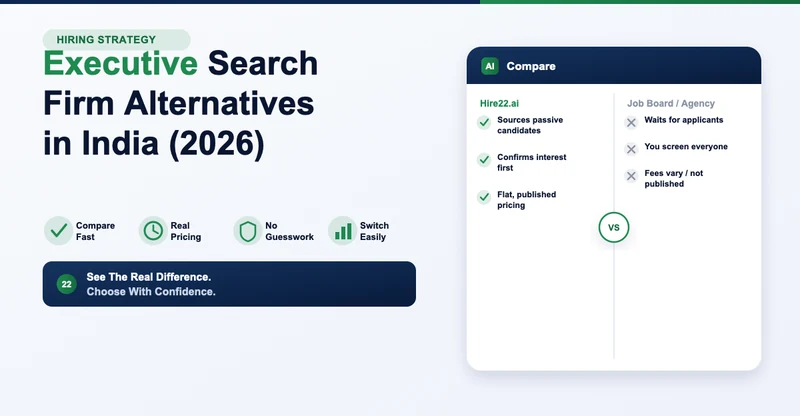
| Flat-fee AI platform (Hire22.ai) | Fixed package price, independent of CTC | No success fee at all | Companies hiring senior roles repeatedly through the year |
Where a Flat-Fee Platform Changes the Math
Here's the thing about percentage-of-CTC pricing: it scales with seniority, not with effort. A search for a ₹1 crore CTC role and a search for a ₹45 lakh CTC role might involve roughly the same sourcing and screening work, but the fee on the first one can be two or three times higher purely because of the base it's calculated against. For a company hiring senior talent more than once or twice a year, that compounding adds up fast, and it adds up regardless of whether the agency's work this time was easy or hard.
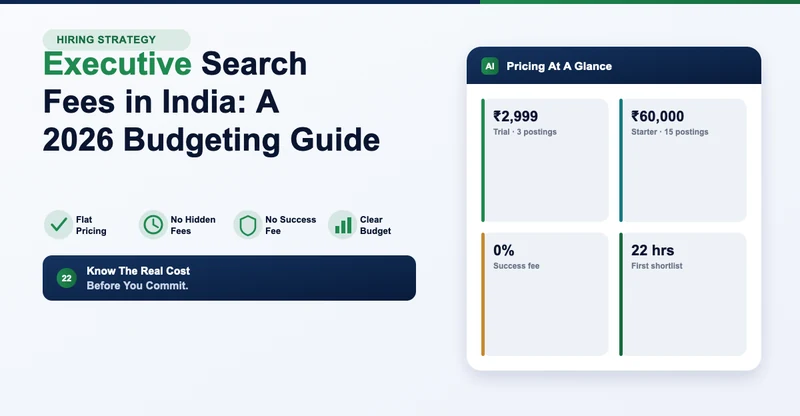
Hire22.ai, built by the Freshersworld team, runs on a different model entirely: fixed package pricing with no success fee and no per-profile charge, so the cost of your search doesn't move with the candidate's salary. The Trial Package is ₹2,999 + GST (list price ₹9,999) for 3 job postings over 3 months, a one-time offer for employers hiring on the platform for the first time. For ongoing volume, the Starter Package is ₹60,000 + GST for 15 job postings and 2 sub-users over 6 months, with custom Starter plans available for other volumes. Full details are on the pricing page.
The mechanism behind it is built specifically for mid and senior roles, not entry-level volume hiring. You post a JobCoNCT (a private job invitation, not a public listing), and SARA, the AI recruiting agent, coordinates the process from there. Hunter AI searches more than 40 platforms and sources for matching candidates, including passive professionals who haven't applied anywhere. CoNCT AI handles outreach through SMS, WhatsApp, email, and AI voice calls (no telecalling involved) and confirms candidate interest before you ever see a profile. JoinX AI then scores and ranks everyone on skills fit, experience, compensation fit, location, notice period, and joining-intent signals, the JoinX Score. Most employers get a ranked shortlist within 22 hours. Both sides stay anonymous until the candidate accepts the JobCoNCT, which covers a lot of the confidentiality problem that normally pushes people toward expensive retained search. The platform never interviews or selects on your behalf; your team still runs the interviews and makes the call, and it's always free for candidates.
For a CEO-level or genuinely sensitive board mandate, a retained search firm with a dedicated consultant is still often the right tool, and we're not going to pretend otherwise. But for the Director-to-VP layer that makes up most senior hiring volume (where the real cost driver has been the percentage-of-CTC model stacked with urgency and confidentiality premiums), a flat-fee, confidential-by-default platform changes the budgeting conversation from "what percentage will they charge this time" to "what's the fixed cost of running this search." See our executive hiring page and the real case studies for how this plays out in practice.
Budgeting for a Senior Search: A Simple Framework
If you're building a hiring budget line and want a sanity check before you accept any quote, walk through three questions. One: does this role genuinely need confidentiality, or are we defaulting to it out of habit? Two: is this a one-off hire, or will we be filling similar seniority roles again this year? Three: do we actually need exclusivity, or are we paying an exclusivity premium for a role that would get filled just as well through parallel channels?
A single, highly confidential CXO replacement probably justifies retained search economics. A VP or Director role you're filling for the third time this year, with no particular confidentiality constraint, is exactly the scenario where flat-fee pricing starts to beat percentage-of-CTC math, because the cost doesn't climb every time the CTC does. Our guide to executive hiring platforms in India and the related piece on hiring senior software engineers in India go deeper into platform selection if fee structure is only one part of your decision.
Whatever you decide, get the fee structure, the CTC definition, and the guarantee terms in writing before the search starts, not after you've already seen a shortlist you like.
Budgeting a senior hire and want to see what a fixed-cost, 22-hour shortlist actually looks like? Post your role on Hire22.ai →
Frequently Asked Questions
How much does an executive search cost in India?
For contingency search, the public-market standard is 8.33% to 16.67% of the hired candidate's annual CTC. For retained search (typically used for CXO or confidential mandates), total fees are often cited in the 25-33% or higher range of CTC, paid in staged instalments regardless of outcome. A flat-fee AI platform like Hire22.ai sits outside this percentage model entirely, with fixed package pricing starting at ₹2,999 + GST for first-time employers.
What's the difference between retained and contingency search fees?
Contingency fees are paid only on a successful hire, usually 8.33%-16.67% of CTC, and the firm may be running the same mandate for other clients simultaneously. Retained fees are paid in staged instalments: often a third at signing, a third at shortlist, a third on joining, whether or not the search succeeds, in exchange for exclusivity and a dedicated consultant.
Why do two search firms quote such different fees for the same role?
Usually because they're pricing different things: one may be quoting contingency terms, the other retained; one may be building in a confidentiality or urgency premium the other isn't; and "CTC" itself can be defined differently (with or without ESOPs, bonuses, or variable pay). Always ask what the percentage is calculated against before comparing numbers.
Are there hidden costs beyond the agency's headline fee?
Often, yes. Watch for non-refundable advance payments on retained mandates, replacement guarantees that are voided by common scenarios like candidate resignation, and disputes over CTC definition that inflate the fee base after an offer is made. These should all be clarified in writing before the search begins.
Does confidentiality always require a retained search firm?
Not necessarily. Traditional confidential search relies on a consultant manually protecting employer and candidate identity, which is part of why it's priced at a premium. Platforms built around anonymous-by-default hiring, where both employer and candidate stay anonymous until the candidate accepts an invitation, can offer a similar confidentiality outcome without the retained-search price tag, which is worth checking for roles that don't also need board-level discretion.
Is a flat-fee hiring platform cheaper than a search firm for every role?
Not for every role. A highly sensitive CEO or board-level search with complex stakeholder management often still justifies a retained search firm's involvement. But for the Director-to-VP layer that makes up most senior hiring, where cost under the percentage-of-CTC model scales with salary rather than effort, a fixed-price platform typically works out cheaper, especially for companies hiring senior talent more than once a year.
What does Hire22.ai charge for senior hiring?
Hire22.ai uses fixed package pricing with no success fee and no per-profile charge. The Trial Package is ₹2,999 + GST (list price ₹9,999) for 3 job postings over 3 months, available once for first-time employers. The Starter Package is ₹60,000 + GST for 15 job postings and 2 sub-users over 6 months, with custom plans available for other volumes. Full details are on the pricing page.
How long does an executive search take in India?
Contingency search for Director/VP roles typically produces a first shortlist in 2-4 weeks, with the full cycle to offer acceptance running 6-12 weeks. Retained CXO searches usually take 10-16 weeks given their confidential, passive-candidate-first approach. AI-driven platforms can compress the shortlist stage considerably: Hire22.ai's Hunter AI and JoinX AI typically return a ranked shortlist within 22 hours of posting a JobCoNCT, though the interview and decision stages still depend on the employer's own process.