A mid-size fintech in Gurugram signed on with a retained executive search firm to fill a VP Sales seat. The retainer was paid upfront, the firm promised a shortlist in three weeks, and six weeks in, two candidates had been presented, both of whom the hiring manager had technically already heard of. The final invoice, once the hire was made, came to roughly 15% of the candidate's annual CTC. Nobody on the HR side was shocked by the number (they'd budgeted for it), but it did prompt the obvious question internally: is this the only way to do this?
It isn't, and increasingly, Indian companies at every stage (from funded startups to large enterprises) are asking the same question. This piece walks through what executive search firms actually do, why companies go looking for alternatives, and the real categories of alternatives that exist today. If you want the detailed, feature-by-feature comparison against traditional recruitment agencies, we've built that separately at /compare/recruitment-agency-alternative. This article is the broader context around that decision, not a repeat of it.
What an Executive Search Firm Actually Does
It's worth being fair to the model before picking it apart. A retained executive search firm assigns a dedicated consultant (or small team) to a mandate, typically a CXO, board, or other senior leadership search. The consultant builds a longlist through their own network and research, approaches candidates directly and confidentially, manages the back-and-forth on compensation and references, and stays accountable to the client until the role closes.
For the right mandate (a confidential CEO transition, a board-level independent director search, a CFO replacement where the market absolutely cannot know the current CFO is leaving before the company is ready to announce it), this model genuinely earns its fee. The consultant's network and discretion are the product.
Where it starts to strain is everywhere below that tier: VP and Director-level functional hiring, roles that recur a few times a year, and searches where the company has a reasonably clear idea of what "good" looks like and just needs access to the right candidates faster than their own network allows.
Why Companies Go Looking for Alternatives
Cost. Traditional executive search and recruitment agency fees in India typically run in the range of 8.33% to 16.67% of the hired candidate's annual CTC, charged as a contingency or retainer fee. On a ₹40 LPA hire, that's anywhere from roughly ₹3.3 lakh to ₹6.7 lakh, for one role. Run that across five or six leadership hires a year and the number stops being a rounding error on the HR budget.
Turnaround time. Retained search is deliberate by design (that's partly what you're paying for), but "deliberate" often means 8-14 weeks from kickoff to a signed offer. For companies that need to backfill a departing Director or scale a team against a hiring plan with a deadline, that timeline doesn't always fit.
Limited visibility into the process. Once a search firm takes a mandate, the company is largely dependent on the consultant's own network and judgment about who gets approached. There's often no way to see the broader pool the firm considered and chose not to present; you're seeing the output, not the funnel.
Confidentiality concerns, in both directions. Search firms are generally good at keeping the employer's identity quiet. But candidates have raised a different concern for years: once a recruiter has your profile, you don't always know how many other mandates they're quietly shopping it against, or how discreetly your current employer relationship is actually being handled.
Multiple firms competing on the same contingency mandate. In non-retained, contingency-based search (more common for Director and VP roles than true CXO retained search), it's routine for two or three agencies to be working the same role simultaneously, which can mean candidates get approached about the same job from multiple directions, which looks disorganised to the candidate and reflects on the employer.
The Real Categories of Alternatives
"Alternative to executive search" isn't one thing. In practice, companies tend to land in one of three buckets.
1. In-house sourcing
Building out an internal talent acquisition function that owns leadership sourcing directly, usually a senior TA lead or two with their own LinkedIn Recruiter seats and a defined outbound process. This works well for companies hiring leadership roles often enough to justify the headcount, and it keeps institutional knowledge about past candidates and searches inside the company rather than with an external firm. The tradeoff is ramp time (a new in-house TA lead needs months to build network depth a search consultant already has) and the fact that it's still a fixed cost even in quarters with no open leadership roles.
2. AI-driven hiring platforms
Platforms that use AI to source, screen, and rank candidates (including passive candidates who aren't actively job-hunting) without charging a commission tied to the candidate's CTC. Hire22.ai sits in this category. The pitch here is speed and cost predictability: you pay a flat package price regardless of the final candidate's compensation, and the sourcing happens continuously rather than depending on one consultant's calendar. The tradeoff, fairly stated, is that for a genuinely confidential board-level search, a platform-first approach usually isn't the right tool on its own. See the next section.
3. Hybrid approaches
Many companies, especially larger ones, don't pick one model exclusively. A common pattern: use an AI platform or in-house sourcing for the steady flow of VP/Director hiring, and reserve a retained search firm specifically for the rare CEO, CFO, or board-level mandate where confidentiality and network depth at the very top of the market genuinely matter more than cost or speed. This isn't indecision; it's matching the tool to the mandate.
When Each Approach Actually Makes Sense
Use a retained executive search firm when: the role is CEO, CFO, CHRO, or board-level; the search must stay confidential even internally for a period; or the candidate pool is so thin that a consultant's personal network is genuinely the only route in.
Use an AI-driven platform like Hire22.ai when: you're hiring VP, Director, or Head-of-function roles with some regularity; cost predictability matters more than a dedicated human consultant; and you want visibility into a scored, ranked shortlist rather than a curated handful of names.
Build in-house sourcing when: leadership hiring is frequent enough (multiple roles a year, ongoing) that the fixed cost of a TA hire pays for itself, and you want long-term control over your own talent pipeline and employer brand in the market.
For a full side-by-side on cost, turnaround, and features against traditional agencies specifically, our detailed comparison at /compare/recruitment-agency-alternative goes through it feature by feature. It's worth reading before you commit either way.
How Hire22.ai Works as an Alternative
Hire22.ai is an AI hiring platform for mid and senior roles in India, built by the Freshersworld team. The employer posts a JobCoNCT (a private job invitation rather than a public listing) and SARA, the AI recruiting agent, coordinates the process from there. Hunter AI searches across 40+ platforms and sources, including passive candidates who've never applied anywhere, which addresses the "limited visibility" concern directly. You're not depending on one consultant's personal shortlist.
CoNCT AI handles outreach (SMS, WhatsApp, email, and AI voice calls, explicitly no telecalling) to confirm candidate interest, and JoinX AI scores and ranks every interested candidate on the JoinX Score: skills fit, experience, CTC/compensation fit, location, notice period, and joining-intent signals. Most employers get a ranked shortlist within 22 hours.
On confidentiality: both employer and candidate stay anonymous until the candidate accepts the JobCoNCT, which handles the discretion concern without relying on a recruiter's judgment call about who to tell what. And to be clear on scope: Hire22.ai never interviews, selects, or hires on the employer's behalf. It delivers the ranked shortlist; your team runs the interviews and makes the decision.
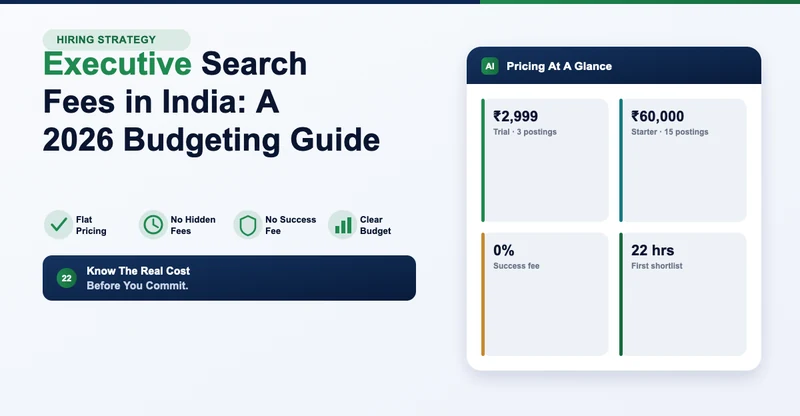
On cost, there's no success fee tied to CTC and no per-profile charge. First-time employers can start with the Trial Package at ₹2,999 + GST (list price ₹9,999) for 3 job postings over 3 months. Beyond that, the Starter Package is ₹60,000 + GST for 15 job postings and 2 sub-users over 6 months, with custom Starter plans for other volumes, full details on the pricing page. For how this plays out on real mandates, see our case studies, including a Senior Investment Professional hire, a ServiceNow Developer hire, and an Agentic AI Engineer hire.
This approach sits well alongside functional leadership hiring specifically (see our guide on building a leadership hiring process for VP and Director roles) and complements, rather than replaces, dedicated search for true CXO mandates, which is covered separately on our executive hiring page.
If you're weighing search firm fees against a faster, flat-cost alternative for your next leadership hire, see the shortlist for yourself. Post your role on Hire22.ai →
Frequently Asked Questions
What do executive search firms typically charge in India?
Traditional executive search and recruitment agency fees in India typically run 8.33% to 16.67% of the hired candidate's annual CTC, charged as a contingency or retainer fee. On a ₹40-50 LPA leadership hire, that works out to several lakhs of rupees for a single placement.
Is Hire22.ai a direct replacement for a retained executive search firm?
For VP, Director, and Head-of-function roles, yes, it's built specifically for that layer. For true CXO or board-level mandates requiring deep confidentiality and a consultant's personal network, many companies still use retained search, sometimes alongside an AI platform for their other leadership hiring. See our detailed comparison at /compare/recruitment-agency-alternative for the full picture.
What's the main difference between an AI hiring platform and a traditional search firm?
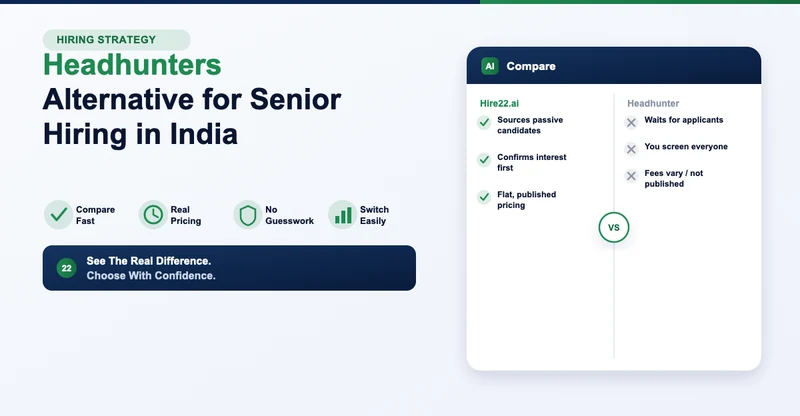
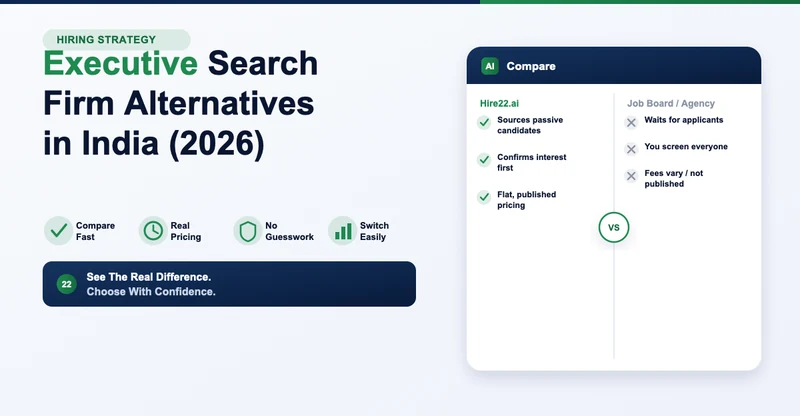
A search firm assigns a human consultant who sources from their own network and charges a fee tied to the candidate's CTC. An AI platform like Hire22.ai sources continuously across 40+ platforms using Hunter AI, scores candidates algorithmically through JoinX AI, and charges a flat package price with no success fee or per-profile charge.
Can an AI hiring platform reach passive candidates the way a search firm does?
Yes. Hunter AI searches across 40+ platforms and sources specifically to find passive candidates (people who haven't applied anywhere), which is the same category of candidate a search consultant's personal network is meant to reach, just sourced algorithmically rather than through one person's contacts.
Is building an in-house talent acquisition team cheaper than using a search firm?
It can be, but only if leadership hiring volume is high enough to justify the fixed headcount cost. For companies hiring one or two leadership roles a year, the fixed cost of an in-house TA lead often doesn't pencil out compared to a flat-fee platform or an occasional search firm engagement.
How fast is an AI-driven alternative compared to a traditional search firm?
Most employers on Hire22.ai receive a ranked shortlist from JoinX AI within 22 hours of posting a JobCoNCT. A retained search firm's typical timeline to first shortlist runs several weeks, given the process of building a longlist and approaching candidates individually. The full hiring cycle (interviews, references, offer) still takes time either way.
Does an AI hiring platform protect confidentiality the way a search firm does?
On Hire22.ai, both employer and candidate identities stay anonymous until the candidate accepts the JobCoNCT invitation, which addresses the confidentiality concern without depending on a recruiter's individual discretion. For searches requiring confidentiality even at the board level before any candidate contact, a retained firm's bespoke process may still be the better fit.
Does Hire22.ai charge based on the candidate's final salary, like a contingency recruiter?
No. There's no success fee tied to CTC and no per-profile charge. Pricing is a flat package: a Trial Package at ₹2,999 + GST for first-time employers covering 3 job postings over 3 months, or a Starter Package at ₹60,000 + GST for 15 job postings and 2 sub-users over 6 months.