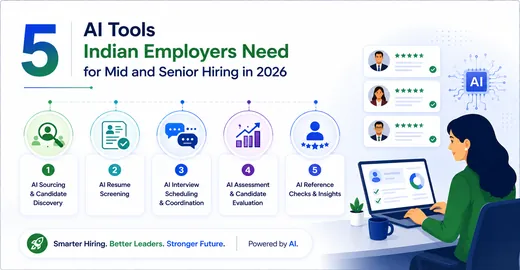
Indian employers hiring mid and senior talent (roughly ₹10 to 50 LPA) need AI tools in five categories: passive talent sourcing, screening and ranking, candidate engagement, structured assessment, and hiring analytics. Start with the first two.
Senior hiring's main problem is too few relevant candidates rather than too many applications, so tools built for volume screening often add little. Pick tools that reach passive people and rank on intent to join.
This guide explains why senior hiring needs different tools, what each category does, examples of tools in each, and a sensible order to adopt them. For the sourcing category, see the AI hiring agent overview.
Why does mid-senior hiring need different AI tools?
| Volume hiring (freshers, junior) | Mid-senior hiring (₹10–50 LPA) |
| Too many applications | Too few relevant ones; most good people are passive |
| Need: filter and rank large inbound pools | Need: find passive people who won't apply |
| Keyword filters work adequately | Keywords miss scope, depth and intent |
| Bulk communication is acceptable | Outreach must be personal and private |
| Offer drop-outs are a smaller risk | Offer drop-outs during notice periods are a major risk |
Ask which tool solves your specific problem, not which tool is "best". For mid-senior hiring, the problem is usually passive reach, shortlist quality and offer acceptance.
What are the five categories of AI hiring tools?
1. Passive talent sourcing and matching
The most important category for senior roles. These tools search for matching people beyond your applicants.
- Hire22.ai: built for mid-senior hiring in India. Hunter AI searches the Hire22 database and the web, CoNCT AI checks interest over SMS, WhatsApp, email and AI voice calls, and a ranked shortlist typically arrives within 22 hours. Less suited to high-volume fresher hiring.
- LinkedIn Recruiter: search and InMail outreach across a very large professional network. Response rates fall for in-demand senior people who receive many messages.
- Naukri Resdex: the largest Indian resume database, strongest for candidates who have updated their profiles recently.
- Instahyre: AI-assisted matching for tech, product and data roles.
2. Screening and ranking
These tools score candidates against the role and return a ranked list. For senior roles, scoring must go beyond keywords to scope, career path, CTC fit and likelihood of joining.
- Hire22's JoinX Score: ranks interested candidates on 200+ parameters, including intent to join.
- ATS-based AI screening: most mainstream ATS tools now parse and rank inbound applications. They are useful for volume but limited to people who apply.
- Enterprise talent intelligence platforms: skills-based matching and internal mobility for large companies and GCCs, usually with longer set-up and enterprise contracts.
3. Candidate engagement
Tools that handle first contact, interest checks, reminders and status updates. They keep candidates from going cold between stages. For senior roles, keep the substantive conversations personal.
4. Structured assessment
Work samples, case exercises and technical tests scored on consistent criteria. The Schmidt and Hunter meta-analysis found work samples and structured interviews among the strongest predictors of job performance. Coding platforms suit engineering roles; case-based exercises suit business roles.
5. Hiring analytics
Dashboards tracking time-to-hire by stage, source effectiveness, offer acceptance and 90-day retention. They show which other tools are earning their place. Our guide to HR metrics covers what to track.
In what order should you adopt these tools?
- Sourcing and ranking first. They fix the biggest senior-hiring bottleneck.
- Assessment next, so faster shortlists don't lead to faster mistakes.
- Engagement, once volume makes manual follow-up hard.
- Analytics throughout, starting with a simple baseline before any tool goes live.
Fewer, connected tools usually beat one tool per category. Check that each one feeds your ATS or tracker, so data isn't copied by hand.
What does a sensible starter stack look like?
Keep it small. For a mid-size Indian company hiring ten to thirty mid-senior roles a year, a realistic starting point is one sourcing and ranking platform, the ATS or tracker you already use, a structured interview scorecard and a simple monthly report on time-to-hire and offer acceptance.
That combination covers the two biggest bottlenecks without adding systems your team has to maintain. Add assessments next. Add engagement tools only when follow-up becomes the problem.
What should you check before buying any AI hiring tool?
- Where its candidates come from, and whether it reaches passive people.
- What its score is built from, and whether you can see why someone ranked where they did.
- Total cost, including per-profile or success fees.
- How it handles candidate data under the Digital Personal Data Protection Act, 2023.
- Whether it stops at a shortlist or claims to make decisions.
Hire22 stops at an interview-ready shortlist; your team interviews and decides. Pricing is a flat package per job posting; see pricing. The need is clear: 82% of Indian employers reported difficulty finding skilled talent in ManpowerGroup's 2026 survey. Related reading: best AI recruitment platform in India.
Try AI sourcing and ranking on one senior role
Frequently Asked Questions
Which AI tool should we adopt first for senior hiring?
A sourcing and ranking tool that reaches passive candidates, because the main senior-hiring problem is finding the right people, not filtering applicants.
Is an ATS with AI screening enough?
For volume hiring, often yes. For senior roles, it only sees people who apply, so add a sourcing tool.
Are AI hiring tools affordable for mid-size companies?
Many are. Flat-priced platforms often cost less than one agency fee for a senior hire.
How do we know a tool is working?
Compare time to shortlist, interview-to-offer ratio, offer acceptance and 90-day retention against the same numbers from your last few hires before the tool.
Do AI tools decide who we hire?
They shouldn't. Use them to find and rank candidates; keep interviews and decisions with people.