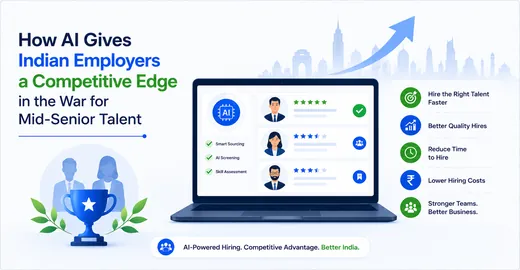
AI gives Indian employers five advantages in the competition for mid and senior talent. Speed means shortlists in about a day instead of weeks. Reach means access to passive candidates job boards never show. Intent scoring tells you who is likely to join before interviews. Shortlisting on skills before names and colleges reduces prestige bias. And capacity lets one recruiter cover far more roles. With 82% of Indian employers reporting difficulty finding skilled talent, these advantages decide who gets the best people.
This guide covers the state of the talent market, the five advantages, how they differ by sector, and where human judgement still wins. For our approach, see the AI hiring platform for mid and senior roles.
What does the Indian talent market look like in 2026?
In ManpowerGroup's 2026 Talent Shortage Survey, 82% of Indian employers said they struggle to find the skilled talent they need. The shortage is sharpest in specialist areas such as AI engineering, EV and software-defined vehicles, risk and compliance, and growth marketing.
Replacement hiring adds pressure. Taggd's India Decoding Jobs 2026 found that 60% of hiring is for replacement positions. Many companies are therefore refilling roles while also trying to grow, and HR teams feel both pressures at the same time, usually without extra recruiters.
The advantage doesn't go to the biggest hiring budget; it goes to the employer whose process finds the right people first and gets a written offer out before anyone else.
What are the five advantages AI gives employers?
1. Speed
Strong mid-senior candidates usually have several conversations running. AI removes the two slowest steps, waiting for applications and reading CVs by hand. On Hire22, a ranked shortlist typically arrives within 22 hours of posting.
2. Access to passive talent
Most experienced professionals are employed and not browsing job boards. Platforms that search beyond applicants, and approach people privately, reach the much larger passive market. On Hire22, Hunter AI searches the Hire22 database and the web, and CoNCT AI reaches out by SMS, WhatsApp, email and AI voice calls to see who is interested.
3. Intent scoring
Some verbal acceptances never turn into joiners, because counter-offers and competing offers arrive during long notice periods. Ranking candidates on likelihood of joining, as well as fit, puts interview time where it is most likely to pay off. Hire22's JoinX Score includes intent among 200+ parameters.
The edge has limits. Niche roles can still take longer to shortlist, and a slow offer process will lose candidates however fast you find them.
4. Less prestige bias
Filtering for the same few colleges and employer brands means competing with everyone for the same small group. Reviewing skills and experience before identity widens the pool. On Hire22, candidates' names and details stay hidden until they accept. Tier-2 cities are a growing source of experienced talent too, and wider sourcing reaches them.
5. More capacity per recruiter
Indian HR teams often carry many open roles per recruiter. Automating sourcing, outreach and first-round ranking lets one recruiter handle far more searches without dropping candidates or letting replies go unanswered for days.
What does a fast employer do differently?
Speed is mostly process, not technology. Fast employers agree the CTC band with finance before the role is posted, block interview slots on posting day, run three focused rounds instead of five, and send a written offer within a day or two of the final interview.
Then they stay close during the notice period, because a short weekly call, an early introduction to the team and a clear first-month plan keep the candidate committed when the counter-offer arrives. AI shortens sourcing. These habits protect the rest of the timeline.
How does the advantage differ by sector?
| Sector | Main pressure | Where AI helps most |
| Technology and AI engineering | Extreme scarcity of specialists | Passive sourcing and speed |
| BFSI | Candidates won't apply publicly to rivals | Private, anonymous outreach |
| D2C and e-commerce | High attrition, constant replacement hiring | Speed and intent scoring |
| Startups (Series A–B) | Weaker brand than large employers | Reaching people directly with a specific pitch |
| Manufacturing and auto | Leaders embedded in local industrial clusters | Private sourcing beyond portals |
Where does human judgement still win?
| AI does well | People do better |
| Finding passive talent | Judging culture and team fit |
| Ranking on fit and intent | Spotting leadership potential |
| Applying criteria consistently | Persuading a hesitant candidate |
| First contact at scale | Negotiating the offer and closing |
Hire22 stops at the shortlist; your team interviews and decides. Use structured interviews. The Schmidt and Hunter meta-analysis found them far more predictive than unstructured ones. Packages are flat, with no success fee; see pricing.
Related reading: how to reduce time-to-hire in India and the future of AI recruitment in India.
Get to the best candidates first
Frequently Asked Questions
What is the war for talent in India?
Intense competition among employers for a limited pool of skilled, experienced people, especially in specialist tech, BFSI and growth roles.
How does AI help win it?
By finding passive candidates, confirming interest quickly, ranking on intent to join and freeing recruiters to focus on interviews and closing.
Can startups compete with big brands for senior talent?
Yes, on speed, scope and a direct, specific pitch. Reaching candidates privately with a clear brief often matters more than brand recognition.
Does AI reduce hiring bias?
It can, when candidates are first reviewed on skills with identity hidden. It can also repeat bias if trained on skewed history, so review outcomes regularly.
What should HR not hand over to AI?
Judging culture fit and leadership potential, persuading candidates, negotiating offers and making the final decision.