Arjun is the co-founder of a 90-person B2B SaaS company that just crossed its first real revenue milestone and needs to scale from founder-led sales to an actual sales organization. The board wants a VP Sales in place before the next quarter starts. Arjun has interviewed six candidates in five weeks. All six had impressive titles at recognizable companies. Two couldn't give him a straight answer on what their actual quota was versus their team's. One had clearly never carried an individual number himself and had only ever managed people who did. By week six, Arjun has realized the real problem isn't finding people who look like VP Sales on paper. The role sits at the intersection of two things that are genuinely hard to verify from a resume: can this person actually carry a number, and can they lead a team that carries one too.
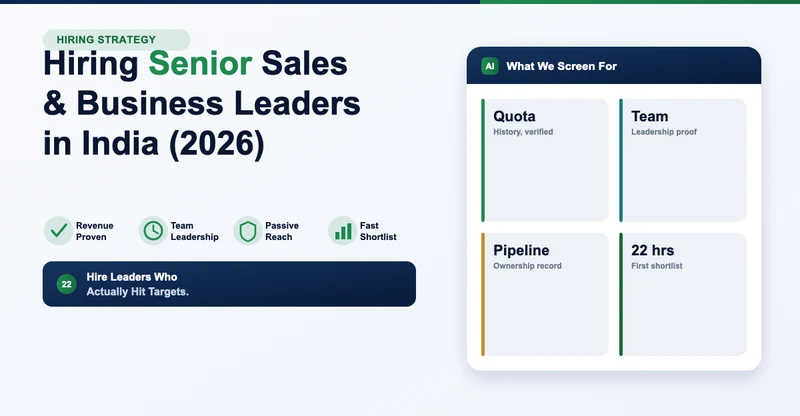
That same tension (proven revenue ownership plus proven people leadership) runs through almost every senior sales and business leadership hire in India right now. This guide covers five roles where it shows up differently: VP Sales, Regional Sales Manager, Senior Sales Manager, Business Head, and Marketing Head.
Hiring a VP Sales in India
The single biggest red flag in a VP Sales search is a candidate whose seniority comes entirely from tenure or team size, with no clean track record of hitting a number themselves, at a comparable deal size and company stage to yours. A VP Sales who scaled a team selling ₹2 lakh annual contracts at a consumer SaaS company is solving a very different problem than one who closed ₹50 lakh enterprise deals with six-month sales cycles. A title match between the two tells you almost nothing about fit.
What actually matters: ask for their last three years of quota attainment, not just the headline number but the context: was the target set realistically, did the whole team hit it or just them, and what happened in the one year (there's almost always one) they missed it. A VP Sales candidate who can talk honestly about a missed target and what they changed afterward is a better signal than one who claims a clean streak. Also worth probing directly: have they actually built a sales process and hired a team from a standing start, or did they inherit a functioning machine and keep it running? Those are different skills, and your company needs to know which one it's hiring for.
Hiring a Regional Sales Manager in India
A Regional Sales Manager role fails quietly more often than it fails loudly, and the reason is usually a mismatch between market knowledge and team leadership that doesn't show up until six months in. Someone can have deep, genuine knowledge of a specific region (the distributor relationships in Tier 2 Maharashtra, the buying cycles in South Indian enterprise accounts) and still be a weak people manager who can't get a five-person regional team to perform consistently. The reverse happens too: a strong manager parachuted into a region they don't actually know, burning months rebuilding relationships a local candidate would have walked in with.
The fix is to evaluate the two things separately rather than letting a strong answer on one compensate for a weak answer on the other. Ask specifically about the region: named accounts, named competitors, how pricing actually works on the ground there, not textbook market sizing. Then separately ask about their team: how they've structured territory assignments, how they've handled an underperforming rep in that specific region, and whether their past reports have followed them to a new company. A regional hire who's strong on one dimension and weak on the other is usually not worth the gamble, however good the interview conversation feels.
Hiring a Senior Sales Manager in India
This is the role most often filled too quickly, because the bar looks deceptively low: "senior" and "a few years managing a small team" sound sufficient, but the actual job needs both an individually credible quota history and the beginnings of real team leadership, and a lot of candidates have only one of the two. Someone who was a strong individual contributor and got promoted into managing two or three former peers hasn't necessarily learned to manage; someone who's managed a team for years but whose own closing track record is thin can struggle to coach reps credibly when a deal stalls.
Look for candidates who can speak fluently about both halves: their own closing history in specific, checkable terms, and at least one concrete example of coaching a struggling rep back to performance rather than just replacing them. Senior Sales Managers at this level are almost always employed and performing reasonably well. They're not the ones flooding your inbox after a job posting, which is usually a sign to look elsewhere rather than default to whoever applied fastest.
Hiring a Business Head in India
A Business Head hire is really a CXO-adjacent hire wearing a different title, and treating it like a senior sales role is the most common mistake companies make here. The job usually carries full P&L ownership (not just a revenue target, but accountability for cost, margin, and resourcing decisions across the business unit) plus cross-functional leadership over sales, operations, and sometimes product or marketing within that unit. That's a materially different evaluation than "can they sell," and it needs to be run that way.
Ask for specifics on P&L ownership: did they actually own the cost side of the business, or just the revenue line while someone else managed the budget? Ask how they've led functions outside their own background (a sales-background Business Head managing an operations team, for instance) and what that cross-functional friction actually looked like. Because this hire sits close to board-level visibility and often involves a confidential replacement rather than a net-new role, it's worth reading our broader guide on CXO hiring in India, which covers the same confidentiality and small-pool problems that apply here almost identically.
Hiring a Marketing Head in India
Marketing Head searches used to be won almost entirely on brand instinct and creative judgment. That's changed. Boards and CEOs increasingly expect a Marketing Head to show ROI literacy alongside brand sense: can they explain what a campaign actually returned, not just what it felt like, and can they hold a demand-gen number the way a sales leader holds a quota. A candidate who's brilliant at brand storytelling but can't walk you through a CAC or pipeline-contribution number for their last major campaign is now a bigger risk than it used to be, especially at a company where marketing is expected to drive measurable pipeline rather than just awareness.
The other half of the evaluation is the same team-leadership question that runs through every role in this guide: has this person actually built and run a marketing team, hired specialists across brand, content, and performance channels, and kept them long enough to see a strategy through? A Marketing Head who's only ever run agency relationships without building an in-house team is solving a different problem than one who's done both, and your company needs to know which gap you're actually hiring to fill.
Why Passive Sourcing Matters More Than Screening Volume Here
Across all five of these roles, the practical hiring problem is the same one Arjun ran into: the strongest candidates are almost always employed, performing well, and not browsing job boards. A VP Sales candidate who's currently hitting their number has no reason to post a resume publicly. A Business Head quietly exploring a move because their current company's growth has stalled is actively avoiding anything that could get back to their own board. Screening more applicants faster doesn't solve this; it just processes a pool that was never going to contain the person you actually need.
Hire22.ai, built by the Freshersworld team as an AI hiring platform for mid and senior roles in India, is built around reaching exactly this group, confidentially. You post the role as a JobCoNCT (a private invitation rather than a public listing) and SARA, the AI recruiting agent, coordinates the search. Hunter AI searches more than 40 platforms and sources for matching candidates, including passive professionals who've never applied anywhere, which, for VP Sales and Business Head searches especially, describes most of the people worth talking to. CoNCT AI then reaches out through SMS, WhatsApp, email, and AI voice calls (no telecalling) and confirms genuine interest before anyone appears on your shortlist, and JoinX AI scores and ranks every confirmed candidate on skills fit, experience, CTC and compensation fit, location, notice period, and joining-intent signals. Most employers get a ranked shortlist within 22 hours.
Both employer and candidate stay anonymous until the candidate accepts the JobCoNCT. That matters more for these roles than most: a currently-employed VP Sales candidate can review your anonymized brief (revenue scale, team size, comp band, sector) and decide whether to engage without their current employer or their own sales team catching wind of it. A company quietly replacing a Business Head can run the entire search without the market or its own board finding out before there's someone ready to start. More on how that structure works on the hire anonymously page, and for leadership-level searches specifically, our executive hiring page covers the broader process in more depth.
To be clear about what this doesn't do: Hire22.ai never interviews, selects, or hires on your behalf. It delivers the ranked, anonymous shortlist. The quota verification, the P&L deep-dive, and the reference calls with people who actually reported to this person stay with your team, as they should for a hire this central to your revenue line. Real outcomes from this process on other senior searches are on the case studies page.
On cost, there's no success fee, no per-profile charge, and no credit system. First-time employers can start with the Trial Package: ₹2,999 + GST (list price ₹9,999) for 3 job postings over 3 months. Beyond that, the Starter Package is ₹60,000 + GST for 15 job postings and 2 sub-users over 6 months, with custom Starter plans available for other volumes. Full detail is on the pricing page, and our broader look at hiring mid and senior talent in India covers how this plays out across seniority levels generally, not just sales and leadership roles.
If you've got a VP Sales, Business Head, or Marketing Head search stuck in the same spot Arjun's was, the fastest way to find out if this fits is to run one JobCoNCT against your current pipeline and compare the shortlists. Post your role on Hire22.ai →
Frequently Asked Questions
What should I verify most carefully when hiring a VP Sales in India?
Their actual track record of hitting targets at a comparable company size and deal size to yours, not just a senior title. Ask for three years of quota attainment with real context (including the year they missed, if there was one) and whether they've actually built a sales process and team from scratch versus inherited one that was already working.
How is hiring a Regional Sales Manager different from a general sales leadership hire?
It requires two things evaluated separately: genuine knowledge of that specific region's accounts, competitors, and buying cycles, and real team leadership ability. A candidate strong in one and weak in the other is a common and underrated risk; evaluating both dimensions independently, rather than letting a strong answer on one compensate for the other, catches this before an offer goes out.
What's the difference between a Senior Sales Manager and a VP Sales hire?
A Senior Sales Manager needs an individually credible quota history plus early-stage team leadership (coaching a small team, not building an organization from scratch). A VP Sales needs a proven track record of building and scaling a sales function at a comparable company stage and deal size. The two roles get confused often because titles vary widely across companies, so it's worth evaluating scope directly rather than trusting the job title alone.
Why is hiring a Business Head treated as closer to a CXO search?
Because the role usually carries full P&L ownership (cost, margin, and resourcing decisions, not just a revenue target) plus cross-functional leadership across sales, operations, and sometimes product or marketing. That scope, and the fact that many Business Head searches are confidential replacements, makes the hiring problem closer to a CXO search than a senior sales hire, with the same small-pool and confidentiality challenges.
What's changed in how companies evaluate Marketing Head candidates?
ROI literacy now matters alongside brand and creative judgment. Boards and CEOs increasingly expect a Marketing Head to explain what a campaign actually returned (CAC, pipeline contribution), not just describe it qualitatively. The other main evaluation point is whether they've actually built and retained an in-house marketing team, versus only managed agency relationships.
Why don't the best sales and business leadership candidates apply to job postings?
They're almost always employed and performing reasonably well, which means they have no reason to post a resume publicly, and often strong reasons not to: a current employer or team finding out they're exploring a move can create real friction. Reaching them usually requires a direct, confidential approach rather than waiting for applications on a public listing.
How does Hire22.ai keep a confidential sales or business leadership search private?
Roles are posted as a JobCoNCT (a private invitation, not a public listing) and both employer and candidate identities stay hidden until the candidate accepts it. A candidate can review an anonymized brief without their current employer or team knowing, and a company can run the entire search without the market or its own board finding out before there's someone ready to start.
Does Hire22.ai make the final hiring decision for these roles?
No. Hire22.ai never interviews, selects, or hires on an employer's behalf. It delivers an anonymous, ranked shortlist of candidates who've already confirmed genuine interest through CoNCT AI outreach. Your team runs the quota verification, P&L review, reference checks, and final interviews, and makes the hiring decision.