India is routinely cited as one of the fastest adopters of workplace AI anywhere in the world. Walk into most mid-sized Indian companies, though, and you'll find the same pattern: leaders have signed contracts with AI recruitment vendors, recruiters have platform logins, and the actual hiring process hasn't changed much at all.
That gap between adoption and integration is where most Indian HR teams are stuck in 2026. Without a structured competency framework, clear role expectations, and a vendor evaluation process built around outcomes rather than features, the tools underperform and the investment stalls.
This guide is written for HR leaders and CHROs who want to move from AI adoption to AI integration: the specific competencies a recruiting team needs in 2026, a framework for evaluating AI recruitment vendors, a 30-60-90 day rollout plan, and a way to measure whether the investment is producing outcomes that matter.
| In this guide | Why AI competency is different from AI adoption | A 5-level AI maturity framework for Indian HR teams | 8 core competencies recruiters need in 2026 | How to evaluate AI recruitment vendors | A 30-60-90 day rollout plan | How to measure AI HR ROI |
The AI Adoption Gap in Indian HR: Why Most Teams Are Stuck
Three patterns, repeated across Indian HR teams, explain why tools get adopted without ever getting embedded.
Pattern 1: Tool purchase without process redesign
The most common pattern is buying an AI recruitment platform and using it as a slightly faster version of the existing process. The platform gets used for job-board posting. The recruiter still manually screens whatever it returns. Interview scheduling still happens over email. The tool adds cost without changing outcomes, because the workflow it was meant to replace was never actually changed.
Pattern 2: A skill gap between tool capability and team competency
Using an AI tool is straightforward. Evaluating its output critically (identifying when it's wrong, understanding why a shortlist is misaligned, adjusting the inputs to improve it) takes a level of analytical judgment most recruiter training programmes have never addressed.
Pattern 3: Vendor selection based on features, not outcomes
Many HR leaders choose AI recruitment tools based on demo impressions and feature lists rather than measurable outcome criteria. A platform that scores well on interface and automation features but poorly on talent-pool depth for your actual roles will consistently underperform, regardless of how capable the recruiter using it is. Vendor selection is a competency in itself, and one most HR teams have never been formally trained in.
A 5-Level AI Maturity Framework for Indian HR Teams
Before building competencies, it helps to know where your team currently sits.
| Level | Stage | What It Looks Like |
| 1 | Unaware | No AI tools in use. All hiring is manual: job boards, manual CV screening, email scheduling. |
| 2 | Experimenting | A tool or two purchased, used inconsistently, with the underlying process unchanged and no AI-specific outcomes measured. This is where most Indian HR teams sit in 2026. |
| 3 | Integrating | AI tools used across most hiring workflows. Job briefs written for AI platforms. Manual screening largely replaced. Metrics tracked by source, AI versus traditional. |
| 4 | Optimising | AI outputs reviewed and refined based on data. Job briefs iterated on shortlist quality. Vendor performance tracked regularly. Retention compared by source. |
| 5 | Leading | AI embedded across the full talent lifecycle: sourcing through onboarding to retention signals. The CHRO reports AI ROI to the board and HR leads AI governance for the organisation. |
The practical goal for most Indian HR teams in 2026 is moving from Level 2 to Level 3: specific competencies in the team, a structured vendor evaluation process, and a rollout plan with clear milestones.
The 8 Core AI Competencies Your Recruiting Team Needs
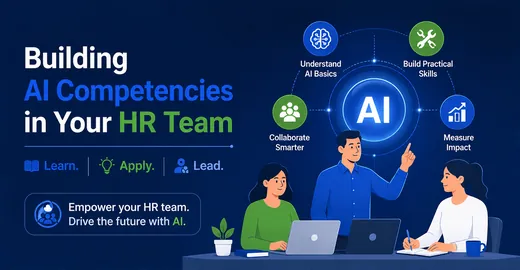
AI competency in a recruiting team isn't about coding or understanding the algorithms underneath. It's a specific set of practical skills that let a recruiter use AI tools effectively, critically, and accountably.
Tier 1: foundation competencies (every recruiter)
1. AI tool literacy
Operating the tools in your stack at a functional level, understanding what each does and doesn't do, and navigating the interface without IT support for routine tasks. This is table stakes; without it, nothing else matters. What good looks like: a recruiter can independently post a role, review an AI-generated shortlist, send outreach, interpret the fit score, and pull pipeline metrics without assistance.
2. Skills-based job brief writing
Translating a hiring manager's vague requirements into a structured, skills-specific brief that produces accurate shortlists. This is one of the highest-impact competencies, because shortlist quality is directly determined by brief quality. What good looks like: a brief for "senior product manager" that specifies product stage, team size managed, stakeholder complexity, technical depth required, and success metrics at 90 days: a structured capability statement, not a list of buzzwords.
3. Shortlist quality evaluation
Reviewing an AI shortlist critically instead of passively accepting it: understanding why candidates were ranked as they were, spotting patterns that suggest the brief was too broad or too narrow. What good looks like: a recruiter notices most of a shortlist comes from one sector background, recognises the brief is over-indexed on that signal, and adjusts it before proceeding.
Tier 2: intermediate competencies (senior recruiters and TA leads)
4. Data interpretation and funnel analysis
Reading hiring funnel data, spotting conversion problems at specific stages, and adjusting process based on data rather than instinct: tracking shortlist-to-interview, interview-to-offer, and offer acceptance separately by source, role, and department. What good looks like: a TA lead notices a business unit's shortlist-to-interview conversion has dropped, traces it to a role scope change that was never reflected in the brief, and fixes the brief rather than blaming the candidates.
5. AI vendor evaluation
Assessing AI recruitment tools against structured outcome criteria rather than demo impressions: running structured pilots, defining success metrics before the trial, deciding on measured outcomes rather than feature lists or price alone.
6. Bias identification in AI outputs
Recognising when a shortlist reflects a bias in the input data or the brief itself, and escalating it. In India's regulatory environment, this has moved from a nice-to-have to something closer to a compliance requirement under the DPDP Act. What good looks like: a recruiter notices shortlists for a role consistently exclude candidates from certain institutions, traces it to a brief that over-weights institutional signals, and gets it revised.
Tier 3: strategic competencies (HR leaders and CHROs)
7. AI governance and accountability
Establishing and maintaining clear policies for how AI tools are used in hiring, ensuring human review at the right points, maintaining audit trails of criteria and methodology, and being able to answer a candidate or regulator who asks how a decision was made.
8. AI ROI measurement and board reporting
Connecting AI investment to measurable business outcomes and presenting it to leadership in terms a CFO understands. This is the competency that determines whether AI adoption survives the next budget cycle. A CHRO who can show real, rupee-denominated results from their own hiring data (not an industry-wide percentage) is the one whose AI budget doesn't get cut when conditions tighten.
How to Evaluate AI Recruitment Vendors: A Structured Checklist
Vendor selection is where most HR leaders lose value before they've even started implementing. Use this checklist against outcome criteria, not feature claims, before signing anything.
| Evaluation Criterion | Questions to Ask the Vendor |
| Mid-senior talent pool depth | How many verified mid and senior professionals do you have in my target sector and city? Can you show me a sample shortlist for a role I define before I sign up? |
| Matching transparency | What does your matching evaluate? Which demographic signals are explicitly excluded? Can you explain why a specific candidate ranked high or low? |
| Anonymous hiring | Can candidates be shortlisted without revealing identity to the employer? When are details revealed, and is that consent-based and documented? |
| Shortlist turnaround | What is your committed turnaround from posting to first shortlist? Guaranteed or best-effort? |
| Intent/fit signal | Do you predict likelihood to accept alongside job fit, or only job fit? |
| Pricing structure | Is pricing per job posting, per profile, or per hire? Are there hidden per-resume-view charges? What are the exit terms? |
| DPDP compliance | How is candidate consent obtained and documented? Can candidates access and delete their data? Is there a data processing agreement? |
| ATS integration | Which ATS systems do you integrate with today, and what does the sync process look like for mine? |
| Pilot terms | Can I run a short pilot on a couple of real roles before committing to an annual contract? |
| Bias audit | Has the matching approach been externally reviewed for bias? What changed as a result? |
For Hire22.ai specifically: anonymous hiring is built into the platform, the JoinX Score explicitly excludes demographic signals, the platform follows the Digital Personal Data Protection Act, 2023, and pricing is per job posting with no per-profile charge, so a short pilot is a real option before any longer commitment.
A 30-60-90 Day AI Rollout Plan for Indian HR Teams
Structured for a team moving from Level 2 (Experimenting) to Level 3 (Integrating), assuming a platform has already been chosen.
Days 1 to 30: Foundation
- Baseline audit: document current time-to-hire, cost-per-hire, offer acceptance rate, and 90-day retention for the last 5 to 10 hires
- Tool literacy training: a short hands-on workshop covering the interface, writing a skills-based brief, and interpreting the shortlist, using a live open role as the practice case
- Job brief template: a structured template all recruiters use, with required fields for skills depth, seniority indicators, success metrics, compensation range, and working arrangement
- First pilot roles: post a couple of open roles with the new brief, and pre-block interview slots for the days following each posting
- Governance document: a one-page draft covering how the platform works, what data it uses, and how decisions are documented
Days 31 to 60: Calibration
- Review pilot shortlist quality and track shortlist-to-interview conversion: a low number usually means the brief, the talent pool, or the threshold needs adjusting
- Brief hiring managers on how the shortlist was generated and what the fit score represents, so old CV-screening habits don't get applied to a ranked AI shortlist
- Assess each recruiter against the 8-competency framework above and assign targeted coaching where there's a gap
- Track offer acceptance separately for pilot hires versus traditionally sourced ones: an early signal of whether the fit scoring is actually working
Days 61 to 90: Integration
- Roll the platform out to all active roles, not just the pilot set
- Compare pilot-period metrics against the pre-AI baseline and prepare a one-page summary for leadership
- Review the vendor against the evaluation checklist above and raise any gaps before renewing
- Check 90-day retention for your first pilot hires against your baseline
- Prepare a first AI recruitment ROI summary using your own numbers and present it as part of the regular people review
Measuring AI HR Competency Progress
Building competencies requires measurement. Use a simple assessment per competency, scored quarterly, so coaching investment goes where it's actually needed.
| Competency | How to Assess It |
| AI tool literacy | Practical task: post a role, interpret a shortlist, and send outreach without assistance |
| Skills-based brief writing | Submit a brief for a live role, scored against a rubric: skills depth, seniority signals, success metrics, comp range |
| Shortlist quality evaluation | Review a shortlist and explain why specific candidates ranked higher than others |
| Data interpretation | Pull funnel data for a closed role and identify the stage with the weakest conversion |
| Vendor evaluation | Complete the vendor checklist for the current platform and name two real gaps |
| Bias identification | Review a shortlist for pattern anomalies and articulate what input change would address them |
| AI governance | Can describe the organisation's AI hiring governance policy and where it's documented |
| AI ROI measurement | Can build a basic ROI comparison using real numbers from the last quarter |
Why This Matters More for Indian Employers Than It First Appears
The mid-senior market has the highest penalty for AI misuse
A poor AI shortlist for a junior role costs a recruiter a few wasted hours. A poor shortlist for a senior role costs a repeated hiring cycle, real agency fees, and real bad-hire risk: the kind that takes months to show up and is expensive to unwind. Competency at the mid-senior level has a direct financial consequence that high-volume junior hiring doesn't.
Indian candidates will test your process
Senior professionals who receive outreach from an AI-assisted process evaluate the personalisation quality, the relevance of the role, and how professional the communication feels. A poorly configured system that sends generic outreach or clearly irrelevant matches damages your employer brand in the mid-senior talent market faster than a traditional process ever would. This audience notices, and they talk to each other.
Your competitors are already doing this
The question in 2026 isn't whether to adopt AI in hiring: most comparable employers already have. It's whether you're using it competently enough to get a real advantage from it rather than just the cost of the subscription.
Main Takeaways: Building an AI-Competent HR Team in India
- Adoption is not the same as integration. Most teams with AI tools in place are still at the early maturity levels. Moving from Level 2 to Level 3 is the practical goal for most Indian HR teams in 2026.
- The 8 competencies are specific and trainable. From tool literacy and brief writing at the foundation level to vendor evaluation and ROI reporting at the top. Assess your team against the framework and target the real gaps.
- Vendor evaluation is a competency in itself. Use the checklist before signing any contract: demo quality is not a proxy for outcome quality.
- The 30-60-90 plan works in sequence. Foundation before calibration before integration. Trying to integrate before you have a baseline is the most common failure mode.
- Measure AI ROI in rupee terms and bring it to leadership. That's what protects the budget in every cycle after the first, and positions HR as a strategic function rather than a cost centre.
| Want to see what a well-configured AI recruitment platform looks like in practice? Hire22.ai delivers fit-ranked shortlists for mid and senior roles in India within 22 hours, with anonymous profiles and consent-based outreach. Post a role and try it. |
Frequently Asked Questions: Building AI Competencies in HR Teams in India
What are AI competencies in HR and why do they matter in 2026?
They're the specific skills and judgment HR professionals need to use AI tools effectively, critically, and accountably in hiring. They matter because most organisations with AI hiring tools haven't actually embedded them into daily workflows: the gap is a competency gap, not a technology gap. Teams that build these competencies consistently produce faster hires, better candidate quality, and measurable ROI.
What is the difference between AI adoption and AI integration in HR?
Adoption means a tool has been purchased and handed to the team. Integration means it's embedded into daily workflows and producing measurable outcome improvements. In India, the common pattern is adoption without integration: platforms purchased, logins created, and the manual process continuing underneath with a slightly faster posting step. Integration requires process redesign, competency building, and outcome measurement, not just a login.
What are the 8 AI competencies HR teams need in 2026?
AI tool literacy, skills-based job brief writing, shortlist quality evaluation, data interpretation and funnel analysis, AI vendor evaluation, bias identification in AI outputs, AI governance and accountability, and AI ROI measurement and board reporting. The first three sit with every recruiter, the next two with senior recruiters and TA leads, and the last two with HR leadership.
How do I assess my HR team's current AI maturity level?
Use the 5-level framework in this guide. Level 1 is no AI tools. Level 2 is a tool or two purchased but used inconsistently with no process change. Level 3 is AI integrated across most hiring workflows with metrics tracked by source. Level 4 is continuous optimisation based on outcome data. Level 5 is AI embedded across the full talent lifecycle. Most Indian HR teams sit at Level 2 in 2026: the realistic 12-month goal is Level 3.
How long does it take to build AI competencies in an HR team?
A structured 30-60-90 day programme covering tool literacy, brief writing, shortlist evaluation, and metrics tracking is enough to move a team from Level 2 to early Level 3. Deeper competencies (vendor evaluation, bias identification, board-level ROI reporting) develop over several months of active practice with real hiring data. None of it is complex, but it requires hands-on work with live roles, not just a training workshop.
What is skills-based job brief writing and why does it matter most?
It's translating vague hiring manager requirements into a structured, specific capability statement an AI platform can match against accurately. It matters most because AI matching is only as good as the brief it works from: a vague brief produces a broad, low-quality shortlist regardless of how good the underlying platform is. A brief with specific stack depth, seniority signals, and success metrics is the single highest-leverage input in the whole process.
How should Indian HR leaders evaluate AI recruitment vendors?
Use a structured checklist before signing anything: talent pool depth in your sector and city, matching transparency and demographic exclusions, anonymous hiring with documented consent, shortlist turnaround commitment, whether the platform predicts fit alone or fit plus likelihood to accept, a clear pricing structure with no hidden per-resume charges, DPDP compliance, ATS integration, pilot terms, and any external bias review. Run a short pilot on real roles before committing to an annual contract.
How does the 30-60-90 day AI rollout plan work?
Days 1-30 cover foundation: a baseline audit, tool literacy training, a job brief template, pilot roles posted, and a governance document drafted. Days 31-60 cover calibration: reviewing shortlist quality, briefing hiring managers, assessing the team against the competency framework, and tracking offer acceptance for pilot hires. Days 61-90 cover integration: full rollout, metrics comparison against baseline, a vendor review, a 90-day retention check, and a first ROI summary for leadership.
How do I measure AI recruitment ROI for my CHRO or CFO?
Compare your actual numbers before and after: agency fees saved on AI-sourced hires, the productivity value of a faster time-to-hire, and any change in bad-hire rate, against what the platform actually costs. Use your own hiring data rather than an industry-wide percentage: a real, if modest, before-and-after from your own pilot is far more convincing to a CFO than a headline ROI figure with no source behind it.
What does AI governance in HR mean and why does it matter in India?
Maintaining clear, documented policies for how AI tools are used in hiring, ensuring human review at the right points, keeping audit trails of criteria and methodology, and being able to answer a candidate or regulator who asks how a decision was made. It matters in India because the Digital Personal Data Protection Act, 2023 requires documented consent, and an HR leader who can't explain how a shortlist was generated is both legally and reputationally exposed.
How do I train my recruiting team to use AI tools effectively?
Start with tool literacy, a hands-on workshop using a live open role as the practice case: posting with a skills-based brief, interpreting the shortlist, and reading the metrics dashboard. Follow with brief-writing practice on real roles, comparing shortlist quality before and after. Then build shortlist evaluation as a team habit: review shortlists together weekly for the first month, discussing why specific candidates ranked where they did.
What is the most common mistake Indian HR teams make adopting AI recruitment tools?
Buying a platform and running it as a faster version of the existing manual process without changing any workflow: still manually screening the shortlist, still scheduling over email, still using the same generic job description. The fix is process redesign alongside the tool: write briefs specifically for AI matching, pre-block interview slots before the shortlist arrives, and let the AI ranking replace manual screening rather than just supplement it.
How do I get hiring managers to trust AI-generated shortlists?
Brief them before the first shortlist arrives: explain how the ranking works, what the fit score represents, and why it's smaller than what they might be used to from job-board applications. Show them the brief behind it: that the candidates they're seeing were scored against their specific requirements, not generic keywords. Most hiring managers come around quickly once they see a short ranked list produces better interviews than a pile of unsorted CVs.
How does the Digital Personal Data Protection Act, 2023 affect AI recruitment practices?
It requires recruitment platforms to obtain explicit candidate consent for data collection and use, allow candidates to access and delete their data on request, restrict data use to the stated purpose of matching candidates to employers, and maintain consent and processing records. For employers, this means choosing platforms with documented compliance and keeping a record of how AI-assisted shortlisting decisions were made.
What should I do if my AI recruitment platform isn't delivering good shortlists?
Start with the brief rather than assuming the platform is at fault: an insufficiently specific brief is the most common cause. Revise it with more specific skills, clearer seniority signals, and an explicit compensation range, then compare the result. If quality doesn't improve after a couple of revisions, loop in the platform's support team. If it still doesn't improve after a real pilot, use the vendor checklist to assess whether the talent pool depth in your sector is actually the gap.
How does building AI competencies reduce bad-hire rates?
Two ways. Better brief writing produces shortlists evaluated on skills and trajectory rather than CV keywords, cutting the skills mismatches behind many bad hires. And better shortlist evaluation means a team can catch candidates who are technically qualified but unlikely to succeed in the specific role context before investing interview rounds in them.
How do I get started building AI competencies in my HR team today?
Three things this week: assess your team's current maturity against the 5-level framework and note where each person sits; take one live open role, have a recruiter rewrite it as a skills-based brief, post it, and compare the shortlist to your last job-board result for a similar role; and schedule a short team session to review that shortlist together and agree on one brief adjustment that would improve it. That hands-on practice is where the competency actually builds.