An HR head hiring a Finance Manager posts the role on a general job board, gets 400 applications in two days, and spends a week sifting through people who don't meet the experience bar before finding three worth a call. The same HR head hiring a VP Finance posts the identical role on the identical board and gets maybe eight applications in three weeks because the person they actually want isn't browsing job listings. They're employed, busy, and not advertising that they're open to anything.
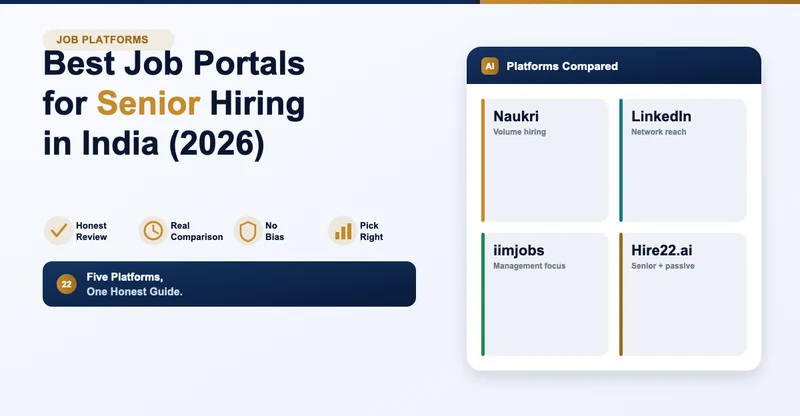
That's the core problem with using entry-level job boards for senior hiring: the tools that work on volume don't work on scarcity. Mid and senior candidates in India are mostly passive, not actively applying, reachable only through targeted outreach, confidential searches, or networks that know where they sit. This piece compares five platforms Indian employers actually use for mid-to-senior hiring (Naukri, LinkedIn, iimjobs, Instahyre, and Hire22.ai) on what each is genuinely good at, where each falls short, and how to pick based on your company's size, volume, and urgency.
Why Senior Hiring Needs Different Tools
Three things change once you move from entry-level or junior-mid hiring to Director-and-above roles. First, the candidate pool shrinks fast: there simply aren't that many VP Engineering or CFO-caliber people in any given city or sector. Second, most of that shrunk pool isn't actively job-hunting, so posting a listing and waiting for applications is a weak strategy. Third, confidentiality starts to matter: senior candidates often can't be seen applying anywhere, and employers often can't advertise that a leadership seat is open. A platform built for volume application intake handles none of these three problems particularly well on its own. That's why most serious senior hiring in India uses some combination of a broad database, a specialist board, and increasingly, AI-driven sourcing that reaches people who never applied anywhere.
| Platform | Core strength | Best for | Passive candidate reach | Confidentiality |
|---|---|---|---|---|
| Naukri.com | Database volume and breadth | High-volume hiring across all levels | Moderate (Resdex search) | Limited |
| LinkedIn (Jobs + Recruiter) | Professional network depth | Enterprise TA teams with outreach capacity | Strong, via InMail | Moderate |
| iimjobs | Management/senior-focused pool | Business leadership and MBA-track roles | Limited | Good for postings |
| Instahyre | AI-assisted matching for tech roles | Startups hiring tech/product talent | Moderate | Good |
| Hire22.ai | AI sourcing + confidential by default | Mid/senior hiring, repeat hirers | Strong, via Hunter AI outreach | Anonymous by default until candidate accepts |
Naukri.com: Best for Database Volume and Reach
Naukri is India's largest general job board, and its scale is the whole value proposition. Resdex, its resume database, gives recruiters searchable access to a huge number of profiles filtered by designation, CTC band, location, and notice period. For senior hiring, this matters most in sectors with deep candidate density (IT services, BFSI, manufacturing) where even a rare profile is statistically likely to exist somewhere in that database.
The honest limitation at the senior end is noise and freshness. A Director or VP-level search on Naukri competes with the platform's primary use case, which is mass application intake for junior and mid-level roles. Senior profiles in Resdex are also frequently stale; people update their Naukri profile when actively looking and then forget about it for years once settled into a role. Naukri works best as a volume layer in a broader senior hiring strategy, not as the sole channel for a Director-and-above search, and it rarely solves the confidentiality problem for sensitive mandates.
LinkedIn (Jobs + Recruiter): Best for Passive Outreach and Network Depth
LinkedIn's free Jobs product functions like most job boards: post a listing, receive applications. The real value for senior hiring is LinkedIn Recruiter, the paid tier, which gives access to the full LinkedIn database with boolean search by title, company, tenure, and industry, plus a limited number of InMails per seat per month to message candidates directly, including people who have never applied to anything.
This makes LinkedIn Recruiter arguably the strongest tool for reaching passive senior candidates specifically, because nearly every working professional at Director level and above maintains some kind of profile. The constraints are cost (Recruiter licenses are a meaningful annual line item) and the InMail cap, which limits how many candidates one recruiter seat can realistically reach in a month. There's also no shortlisting or scoring workflow built in. Recruiter is a search and outreach tool, not a candidate evaluation one, so screening still happens manually downstream. Our LinkedIn Recruiter alternative comparison goes into more detail on where that gap shows up in practice.
iimjobs: Best for Management and Business Leadership Roles
iimjobs occupies a specific niche: it's a job board built around management and senior business professionals, with a candidate base that leans heavily toward MBA graduates and people already in strategy, finance, marketing, or general management roles. For companies hiring a CFO, VP Strategy, or Head of Business, the self-selection on the platform does real work: the applicant pool is pre-filtered toward people who already identify as senior business talent, which cuts down on the unqualified-application problem that plagues broader boards.
The trade-off is scope. iimjobs is less useful for technical leadership hiring, because a VP Engineering or CTO search won't find the same depth there as on a tech-focused platform. Its overall database is also considerably smaller than Naukri's or LinkedIn's, which matters for very niche or rare role profiles. See our iimjobs alternative comparison for a closer look at how it stacks up for broader senior hiring needs.
Instahyre: Best for AI-Assisted Tech Hiring
Instahyre uses AI-assisted matching, primarily for technology and product roles, to connect employers with relevant candidates and reduce the manual screening load. Rather than a raw application inbox, employers get a filtered, algorithm-ranked set of candidates based on role fit signals, which tends to work well for mid-to-senior tech hiring where the required skill set is fairly well-defined (a specific stack, a certain years-of-experience band, a particular domain).
The platform's strength is fairly concentrated in tech and product functions, and its overall candidate base is smaller than the legacy generalist boards, which is a reasonable trade for quality but means it's not the right tool for, say, a VP HR or Head of Legal search. It's worth checking our Instahyre alternative comparison if your hiring spans both tech and non-tech senior roles and you're trying to decide whether to run two tools in parallel.
Hire22.ai: AI-Driven Sourcing and Confidential Hiring for Mid and Senior Roles
Hire22.ai, built by the Freshersworld team, takes a structurally different approach from a traditional job board: instead of posting a public listing and waiting for applications, employers post a JobCoNCT (a private job invitation rather than a public ad), and SARA, the AI recruiting agent, runs the process from there.
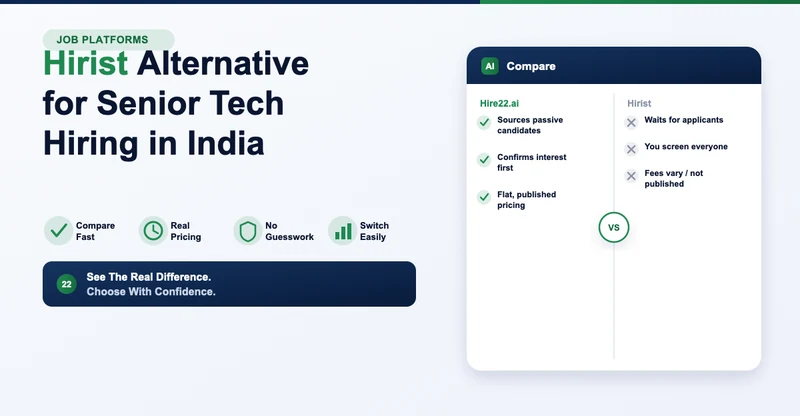
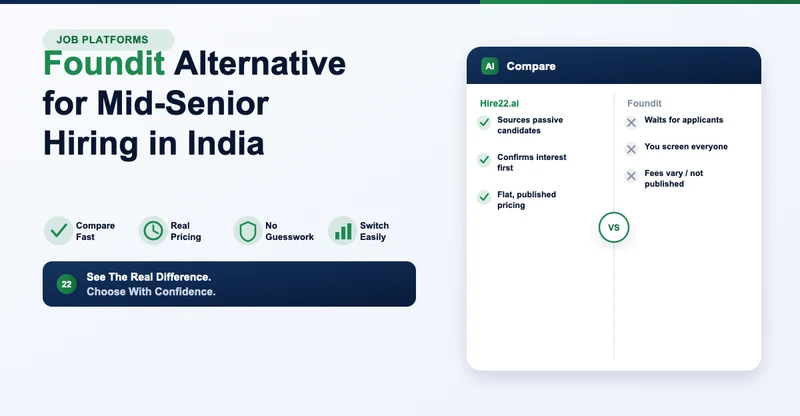
Hunter AI searches more than 40 platforms and sources to find matching candidates, specifically including passive candidates who haven't applied anywhere, which is exactly the population that's hardest to reach through a standard job board, and the same population that makes senior hiring difficult in the first place. CoNCT AI then handles outreach through SMS, WhatsApp, email, and AI voice calls (explicitly no telecalling) and confirms the candidate's interest before the employer ever sees their profile. JoinX AI scores and ranks every confirmed candidate on skills fit, experience, compensation fit, location, notice period, and joining-intent signals (the JoinX Score), so what lands in the employer's inbox is a ranked shortlist, not a pile of unfiltered applications. Most employers see this shortlist within 22 hours of posting.
Two things make this different from the other platforms on this list for senior roles specifically. One, both the employer and the candidate stay anonymous until the candidate accepts the JobCoNCT; confidentiality is the default behaviour, not an upgrade or a manual workaround, which matters for replacement hires and sensitive leadership searches. Two, because outreach confirms interest before you see a profile, you're not spending time evaluating candidates who were never actually reachable or willing in the first place. Hire22.ai doesn't interview or make hiring decisions on the employer's behalf. The shortlist is the deliverable, and the employer's team runs the interviews and makes the call. It's always free for candidates, and data handling follows the Digital Personal Data Protection Act, 2023. Pricing is fixed rather than CTC-linked: the Trial Package is ₹2,999 + GST for 3 job postings over 3 months for first-time employers, and the Starter Package is ₹60,000 + GST for 15 postings and 2 sub-users over 6 months. You can see the mechanism laid out further on the SARA, Hunter AI, and JoinX Score pages, and the confidentiality model on the anonymous hiring page.
This isn't a replacement for every platform above in every situation. Naukri's raw volume and LinkedIn's network depth are real advantages that Hire22.ai doesn't claim to match in sheer database size. It's a different approach aimed specifically at the part of senior hiring that generalist boards handle worst: reaching people who aren't looking, confirming they're genuinely interested before anyone's time is spent, and keeping the whole process confidential by default.
How to Choose Based on Your Hiring Situation
If you're a large enterprise with a dedicated TA team and multiple concurrent senior searches: Naukri Resdex for database breadth, layered with LinkedIn Recruiter for passive outreach on the hardest-to-fill roles, is a reasonable default. The licensing cost is justified by the volume.
If you're hiring business leadership (CFO, VP Strategy, General Manager roles): iimjobs' pre-filtered pool is worth including alongside LinkedIn for passive reach.
If you're a tech-first company hiring senior engineering or product talent: Instahyre's AI matching is built for exactly this, and pairs well with targeted LinkedIn outreach for the rarest technical profiles.
If you're a startup, SME, or any company hiring senior roles more than once or twice a year without a dedicated recruiting team: this is where Hire22.ai's fixed pricing, 22-hour shortlist turnaround, and default confidentiality tend to matter most. You get a filtered, interest-confirmed shortlist without the per-hire cost scaling up with seniority the way agency and some platform pricing models do.
If the role is highly confidential or board-sensitive: anonymous-by-default platforms or a retained search specialist are worth considering over any public-listing approach, regardless of which platform you otherwise prefer. Our guide to executive hiring platforms in India covers this scenario in more depth, including boutique search firms not covered here.
Most mid-sized companies end up running two tools in parallel rather than picking one: a broad database for reach, and a targeted or AI-driven tool for the roles that actually need passive outreach and confidentiality. That combination tends to outperform betting everything on a single platform, whichever one it is. If you're specifically hiring senior engineers, our piece on hiring senior software engineers in India goes deeper into that particular case.
Want to see what a ranked, interest-confirmed shortlist for your next senior role looks like within 22 hours? Post your role on Hire22.ai →
Frequently Asked Questions
What is the best job portal for senior-level hiring in India?
There isn't a single best platform for every senior hire; it depends on function, confidentiality needs, and hiring volume. Naukri offers the broadest database, LinkedIn Recruiter is strongest for passive outreach, iimjobs specialises in management and business leadership roles, Instahyre focuses on AI-matched tech hiring, and Hire22.ai is built specifically for confidential, AI-sourced mid and senior hiring with fixed pricing.
Why don't general job boards work well for senior and leadership roles?
Most senior candidates in India aren't actively browsing job listings. They're employed and not applying anywhere. General job boards are built around application intake, which works for roles with large active candidate pools but underperforms for scarce, mostly-passive senior talent that needs to be reached through targeted outreach rather than waiting for applications.
Is LinkedIn Recruiter worth the cost for senior hiring?
For companies with the budget and an in-house recruiter who can manage active outreach campaigns, LinkedIn Recruiter's access to the full LinkedIn database and InMail capability make it one of the strongest tools for reaching passive senior candidates. The InMail cap per seat limits scale, and there's no built-in shortlisting or scoring workflow, so screening still happens manually.
How is Hire22.ai different from a traditional job board for senior hiring?
Instead of a public listing that waits for applications, employers post a private JobCoNCT, and Hunter AI searches 40+ platforms to find matching candidates, including passive ones who never applied anywhere. CoNCT AI confirms their interest through outreach before the employer sees any profile, and JoinX AI ranks confirmed candidates by fit. Both employer and candidate stay anonymous until the candidate accepts, and most employers get a ranked shortlist within 22 hours.
Which platform is best for hiring senior tech talent specifically?
Instahyre's AI matching is built around tech and product roles specifically and works well when the required skill set is well-defined. LinkedIn Recruiter is strong for passive outreach to senior engineering leaders. Hire22.ai is also effective for senior tech hiring where confidentiality and a fast, interest-confirmed shortlist matter more than raw database size.
Can I hire for a confidential senior role without it becoming public?
Yes, but it requires a platform or process built for it. Public job listings on general boards aren't confidential by nature. iimjobs allows discreet postings for management roles. Hire22.ai keeps both employer and candidate identity anonymous by default until the candidate accepts the job invitation, which covers most confidentiality needs without requiring a retained search firm.
Should a startup use the same hiring platforms as a large enterprise?
Not necessarily. Large enterprises can justify Naukri enterprise plans and multiple LinkedIn Recruiter seats given their hiring volume. Startups and growing companies without a dedicated TA team typically get better value from fixed-price, AI-driven platforms like Hire22.ai, where the cost doesn't scale with the candidate's CTC the way agency commissions or some enterprise licenses do.
How many platforms should a company use at once for senior hiring?
Most mid-sized and growing companies end up using two tools rather than one: a broad database like Naukri or LinkedIn for reach, combined with a targeted or AI-driven platform for roles that specifically need passive outreach, confidentiality, or faster turnaround. Running a pilot mandate on two platforms before committing to an annual plan is a reasonable way to compare results directly.