Candidate screening is usually the slowest, most manual part of hiring. Someone has to open every resume, decide whether it's worth a closer look, and repeat that hundreds of times for a single role. When people search for how to automate it, they're usually asking one of two things: what does AI screening actually do, and how do we set it up without a large recruiting team. Here's a direct answer to both.
What "AI Candidate Screening" Actually Means
Screening is often used loosely to cover three different jobs, and it helps to separate them:
- Sourcing: finding candidates in the first place, whether from inbound applications or by actively searching for people who match a role.
- Screening and matching means comparing each candidate's resume and profile against the role's actual requirements: skills, experience level, and practical fit.
- Shortlisting is ranking the matched candidates so recruiters know who to talk to first, and in what order.
A tool that only parses resumes for keywords is doing a thin version of screening. Genuine AI screening also weighs things a keyword match misses entirely: compensation expectations, notice period, location, and whether the candidate is actually likely to accept an offer if one comes.
How AI Improves Hiring Efficiency
"Efficiency" in hiring breaks down into a few concrete things, and AI affects each differently:
Speed
Sourcing and initial screening can run in parallel instead of one after another, which is where most of the time savings come from. A recruiter manually reviewing a stack of resumes is doing work sequentially; an AI system scores the entire pool at once.
Consistency
Every candidate gets evaluated against the same criteria, regardless of which recruiter is reviewing the queue or how late in the day it is. That consistency matters more than it sounds, because manual screening quality tends to drop as reviewers get through dozens of similar resumes.
Reach
Screening is only as good as the pool it's drawing from. If sourcing is limited to whoever applies, AI screening is just filtering a small, self-selected group. The bigger efficiency gain comes when sourcing and screening work together, pulling in passive candidates who weren't going to apply on their own, then screening that larger pool automatically.
Recruiter time
The practical effect is that recruiters spend less time sorting and more time on the parts of the job that actually need human judgment: conversations, negotiation, and the final call.
How to Automate Candidate Screening, Step by Step
- Define screening criteria before you post the role. Skills, experience band, CTC range, location, and notice period should be explicit, not left for a recruiter to infer while reading resumes.
- Automate sourcing so screening has enough to work with. If you're only screening inbound applicants, you're screening a small and often weaker pool. Sourcing from multiple platforms, including passive candidates, gives the screening step something worth ranking.
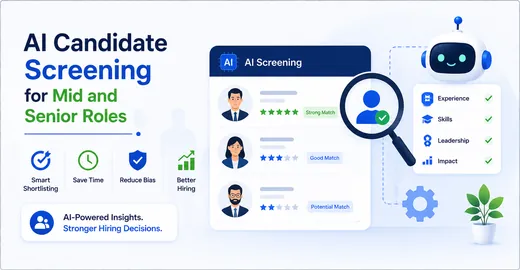
- Let AI parse and match against your criteria. This is the stage that replaces manual resume review, matching skills and experience against the role rather than just scanning for keywords.
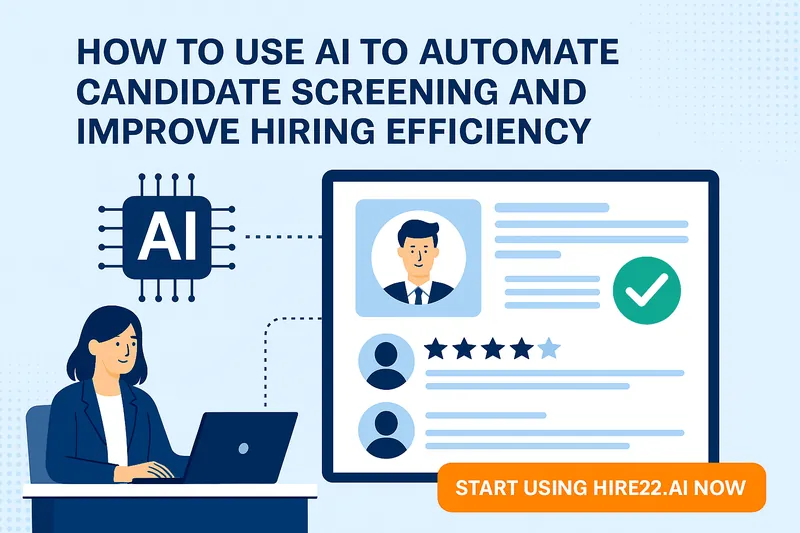
- Rank candidates with a transparent score. A simple pass/fail filter throws away useful information. A ranked score that shows why someone is ranked where they are lets recruiters trust the shortlist instead of re-checking it manually.
- Automate first-touch outreach to top-ranked candidates. Confirming interest and availability before a recruiter gets involved saves a round of back-and-forth that otherwise delays everything downstream.
- Keep a human in the loop for the final call. Automation should narrow the pool to a manageable, ranked shortlist. The interview and hiring decision stay with the recruiting team.
Automating Sourcing and Screening on a Small Recruitment Team
Small teams feel this problem the most acutely, because there's no spare capacity to manually source candidates on top of screening the ones who already applied. The fix usually isn't buying more point tools. It's consolidating sourcing, screening, and outreach into one connected flow instead of stitching together separate systems that don't share data.
A platform that handles sourcing and screening together means a two-person recruiting team can run a pipeline that would otherwise need several more hires just to keep up with manual resume review. The time that gets freed up goes toward the interviews and candidate conversations a small team usually doesn't have bandwidth for otherwise.
This matters even more for agencies and in-house teams juggling multiple open roles at once, where manual sourcing for one role inevitably steals time from screening on another. Automating both stages removes that trade-off, because the pipeline for each role keeps moving without one role starving another of recruiter attention.
How Hire22.ai Automates This End to End
Hire22.ai is built around this exact problem for mid and senior hiring in India. An employer posts a role through JobCoNCT, coordinated by SARA. Hunter AI sources candidates from more than 40 platforms, including passive candidates who aren't actively applying anywhere, which solves the reach problem that limits screening-only tools. CoNCT AI then handles outreach through SMS, WhatsApp, email, and AI voice calls, with no telecalling involved, to confirm interest from sourced candidates. Candidates who respond are scored by JoinX AI, which produces the JoinX Score based on skills fit, experience, CTC fit, location, notice period, and joining intent.
Employers typically receive a ranked shortlist within 22 hours of posting. Employer and candidate identities both stay anonymous until the candidate accepts the JobCoNCT. Hire22.ai never interviews, selects, or hires on an employer's behalf. The platform's job ends at a ranked shortlist, and the decision from there is entirely the employer's. It's free for candidates, with employer pricing on flat packages: a Trial Package at ₹2,999+GST for 3 postings over 3 months, and a Starter Package at ₹60,000+GST for 15 postings over 6 months.
Why Screening Automation Attempts Often Fall Short
A common pattern: a team adopts an AI screening tool, plugs it into their existing inbound pipeline, and sees little real improvement. The tool wasn't broken. It was solving the wrong problem. Screening faster only helps if there's a strong enough pool to screen in the first place. If sourcing is still limited to whoever happens to apply, automating the screening step just means you reject a weak pool more quickly, instead of building a better one.
The other common failure is treating the AI's ranking as final rather than as a starting point. A score should tell a recruiter where to look first, not replace the look entirely. Teams that get the most out of automation still review the top of the shortlist manually before reaching out; they just spend far less time getting to that shortlist.
What AI Screening Can't Do
Automated screening narrows a pool; it doesn't make the hiring decision. A few things still need a person:
- Culture and team fit. A score can tell you a candidate matches the job requirements, but it can't tell you how they'll actually work with a specific team.
- Negotiation and offer conversations. CTC fit can be screened for, but the actual negotiation is a human conversation.
- Edge cases. Strong candidates with unconventional career paths sometimes score lower on a standard match than they should. This is exactly where a recruiter's judgment should override the ranking.
Measuring Whether Your Screening Automation Is Actually Working
It's easy to assume automation is helping just because it's faster, but speed on its own isn't the goal; a faster bad shortlist is still a bad shortlist. A few indicators are worth tracking before and after automating screening, ideally over a few hiring cycles rather than one role:
- Time to shortlist: how long it takes from posting a role to having a ranked set of candidates worth interviewing.
- Interview-to-offer ratio. When this improves, screening is surfacing genuinely better-fit candidates, not just more of them.
- Candidate drop-off. Slow or inconsistent screening tends to lose strong candidates to other offers, and a faster, well-run process should reduce this.
- Recruiter time per hire: the clearest sign automation is helping is recruiters spending time on conversations rather than resume review.
Compliance and Candidate Data
Any automated screening process that touches candidate personal data in India needs to handle it in line with the DPDP Act 2023. That means being clear with candidates about what data is collected, how long it's retained, and who it's shared with. It's worth confirming directly with any platform you're evaluating, rather than assuming it's handled by default.
How does AI actually improve hiring efficiency?
Mainly through speed and consistency. Sourcing and screening happen in parallel instead of sequentially, every candidate is evaluated against the same criteria, and recruiters spend less time sorting resumes and more time on conversations and decisions.
What's the difference between automating candidate screening and automating candidate sourcing?
Sourcing is finding candidates in the first place, including passive ones who aren't actively applying. Screening is comparing the candidates you already have against a role's requirements. Automating screening alone only helps if sourcing is already bringing in a strong enough pool.
Can a small recruitment team realistically automate sourcing and screening?
Yes, and it tends to matter more for small teams, since there's less spare capacity to manually source on top of screening. The key is using one connected platform for sourcing, screening, and outreach rather than several disconnected tools.
Does automating screening remove human judgment from hiring?
No. Automation should narrow a large candidate pool to a ranked, manageable shortlist. Decisions like culture fit, negotiation, and the final hire stay with the recruiting team.
How long does it take to get a screened shortlist after automating the process?
It depends on the platform, but it should be measured in hours rather than days. On Hire22.ai, employers typically get a ranked shortlist within 22 hours of posting a role.
What criteria should AI screening actually rank candidates on?
At minimum: skills fit and experience against the role, plus practical factors like CTC fit, location, and notice period. For mid and senior roles especially, joining intent (how likely a candidate is to actually accept) matters as much as qualifications on paper.
Is candidate data safe when screening is automated?
It should be handled in line with the DPDP Act 2023, covering what's collected, how long it's kept, and who it's shared with. Ask any platform directly about this before sending candidate data through it.
How much does an AI candidate screening platform cost?
It varies by provider and pricing model. Hire22.ai uses flat packages rather than per-profile charges: a Trial Package at ₹2,999+GST for 3 postings over 3 months, and a Starter Package at ₹60,000+GST for 15 postings over 6 months. It's always free for candidates.
Where to Go From Here
Automating candidate screening only pays off if sourcing feeds it a strong enough pool to begin with. Screening a weak pool faster is still a weak pool. If you're hiring for mid or senior roles in India and want to see sourcing, screening, and outreach working as one flow rather than three separate tools, you can post a role on Hire22.ai or check pricing first.