AI tools now sit on both sides of the hiring table. Recruiters use them to find and screen candidates faster; job seekers use them to build better resumes, prep for interviews, and figure out what to apply for next. If you landed here searching for "best AI tools for career" or "AI hiring tools," you're probably looking for one of those two lists, so this covers both, organized by what you're actually trying to do, rather than one long undifferentiated list.
AI Hiring Tools for Recruiters and Employers
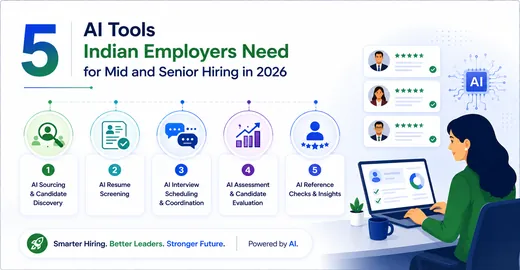
These are tools built to solve a specific part of the hiring funnel: finding candidates, screening them, or managing the process around interviews and offers.
Hire22.ai
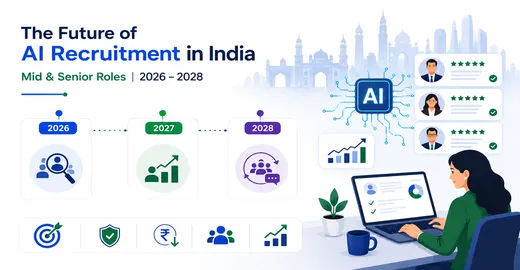
An AI recruitment platform built for mid and senior-level hiring in India. An employer posts a role through JobCoNCT, coordinated by SARA; Hunter AI then sources candidates from more than 40 platforms, including passive candidates who aren't actively applying anywhere. CoNCT AI handles outreach by SMS, WhatsApp, email, and AI voice calls (no telecalling), and JoinX AI ranks responders with a JoinX Score based on skills fit, experience, CTC fit, location, notice period, and joining intent. Employers typically get a ranked shortlist within 22 hours, and both employer and candidate identities stay anonymous until the candidate accepts the role. It's free for candidates, and employer pricing runs on flat packages starting at ₹2,999+GST for a 3-posting trial, rather than per-profile charges.
Applicant tracking systems with AI screening
Most mainstream ATS platforms now include some form of AI-assisted resume parsing and keyword matching to help recruiters sort inbound applications faster. These are useful for managing volume but generally don't source candidates on their own; they work with whoever applies.
AI interview scheduling tools
Scheduling assistants that sync calendars between recruiters and candidates automatically, cutting out the email back-and-forth that typically eats up days in a hiring cycle. Worth adding to any stack that still coordinates interviews manually.
AI-based skills assessment platforms
Tools that run structured coding tests, case studies, or role-specific assessments and score them automatically, giving recruiters an objective data point beyond the resume and interview. For technical and specialist roles especially, this tends to catch gaps between what a resume claims and what a candidate can actually do, before that gap shows up three weeks into an interview process.
AI job-matching and recommendation engines
Beyond standalone hiring platforms, most major job boards now run some form of AI matching behind the scenes, ranking which candidates see which postings based on profile signals rather than simple keyword search. The quality varies a lot between platforms, and for mid and senior roles especially, generic matching engines tend to perform worse than platforms purpose-built for that hiring level, since seniority brings variables like notice period and CTC negotiation that a generic matching model often doesn't weigh properly.
AI candidate relationship management (CRM) tools
Recruitment CRMs increasingly use AI to re-engage candidates sitting in a talent pool from past searches, flagging who's worth reaching out to again for a new role instead of starting sourcing from zero every time. This matters most for teams that hire the same kinds of roles repeatedly and keep losing track of strong candidates who weren't right for a previous opening.
AI bias-auditing tools
A smaller but growing category of tools that review hiring data and screening criteria for patterns that might disadvantage particular groups, separate from the screening tool itself. Useful as a check on whatever platform is doing the actual ranking, rather than as a replacement for it.
AI Career Tools for Job Seekers
On the other side of the table, these tools help professionals present themselves better and find the right roles faster.
EzCareers.ai
A career-focused AI platform that helps job seekers build ATS-friendly resumes, with suggestions on structure, keywords, and content tailored to the role being applied for.
AI resume and cover letter tools
A growing category of tools that take a draft resume or a LinkedIn profile and rewrite it for clarity, keyword relevance, and formatting that passes automated screening without reading like it was written for a machine.
AI interview preparation tools
Tools that generate likely interview questions based on a job description and let candidates practice answers, sometimes with feedback on clarity, pacing, or structure.
ChatGPT and Perplexity AI
General-purpose AI assistants that job seekers commonly use for drafting outreach messages, researching companies before an interview, and getting straight answers on things like salary benchmarks or industry trends. Perplexity in particular is useful when you want sourced, verifiable answers rather than a generated summary.
LinkedIn's AI-assisted job search features
LinkedIn has layered AI into job matching and application suggestions, surfacing roles based on profile signals rather than requiring manual search through every posting.
AI networking and personal branding tools
Tools that help draft LinkedIn posts, connection messages, and summaries that read like a professional wrote them rather than a template. For mid and senior professionals in particular, a consistent presence matters more for passive sourcing. Recruiters and platforms sourcing passive candidates often start with what's visible on a profile.
AI salary and compensation benchmarking tools
Tools that pull together publicly available compensation data to give candidates a reasonable range for a role before they negotiate, rather than guessing or relying on anecdotes from friends in similar roles.
AI learning and upskilling tools
Course platforms and learning assistants now use AI to recommend what to learn next based on a target role rather than a generic curriculum, and to generate practice problems or summaries on demand. For a candidate trying to move from mid-level to senior, or switching domains entirely, this closes a specific gap: knowing what to actually study rather than working through an entire course catalog.
Other AI Tools Worth Knowing About
These aren't hiring-specific, but they come up often enough in "best AI tools for career" searches that they're worth a quick mention, organized by category:
| Category | Tools | What they're for |
|---|---|---|
| Writing & editing | Grammarly, QuillBot | Grammar, clarity, and tone for professional writing |
| Content generation | Copy.ai, Writesonic | Drafting marketing copy, blog posts, and ad text |
| Design | Canva, Adobe AI tools | Automated layouts, image editing, creative templates |
| Video | HeyGen, Clipchamp, Filmora | AI-assisted video generation and editing |
| Customer support | Intercom, Zendesk, Drift | Automated responses and ticket handling |
| Software development | GitHub Copilot, Tabnine, Snyk | Code suggestions, autocomplete, and vulnerability scanning |
| Data analysis | DataRobot, Julius AI | Automated modeling and business intelligence |
| Email marketing | Mailchimp, MailerLite | Campaign automation and send-time optimization |
How to Choose the Right AI Tool for Your Situation
Most "best AI tools" lists are written as if every reader has the same problem, which is why they end up long and not especially useful to any one person. The category someone actually needs depends entirely on which side of hiring they're on and what's actually slowing them down. A few questions worth asking before adopting anything new:
- What's the actual bottleneck? If it's sourcing candidates, a resume formatter won't help. If it's getting past the first screen, a sourcing tool is the wrong fix.
- Does it integrate with what you already use? A standalone tool that doesn't connect to your ATS or calendar adds a manual step rather than removing one.
- Is the pricing predictable? Per-profile or usage-based pricing can get expensive fast at any real volume; flat pricing is easier to plan around.
- For hiring tools specifically: does it reach passive candidates? A tool that only works with inbound applicants is solving a much smaller problem than one that actively sources.
Fewer Tools Doing More Beats a Longer List
It's tempting to read a list like this and try to adopt one tool per category. In practice, that usually backfires. Recruiters end up re-entering the same candidate data into three systems that don't talk to each other, and job seekers end up with a resume tool, an interview prep tool, and a networking tool that all have a slightly different version of their profile. The more useful approach, on either side of hiring, is picking the smallest number of tools that cover the most ground, and only adding a new one when there's a specific gap none of the current ones fill.
On the hiring side, that's usually one platform that handles sourcing, screening, and outreach together rather than three separate point tools. On the career side, it's usually a resume tool plus a general-purpose assistant for research and drafting, and most people don't need five.
What are the best AI tools for career growth in 2026?
It depends on what stage you're at. For job searching, resume tools like EzCareers.ai and AI-assisted platforms like LinkedIn help you get noticed. For interview prep, AI practice tools and ChatGPT for research are commonly used. For ongoing career development, general-purpose assistants help with writing, research, and skill-building across almost any field.
What are the best AI hiring tools for recruiters?
It depends on which part of the funnel needs help. For mid and senior hiring specifically, platforms like Hire22.ai that handle sourcing, screening, and ranking together tend to save more time than point tools that only cover one stage, like an ATS with basic resume parsing.
Are AI career tools free to use?
Many have free tiers with paid upgrades for advanced features. On the hiring side, candidate-facing tools like Hire22.ai are free for job seekers with no exceptions; it's employers who pay for postings.
Can AI tools actually replace a recruiter?
No, and well-designed platforms don't try to. AI hiring tools narrow a large candidate pool to a ranked shortlist; the interview and hiring decision stay with the employer's recruiting team.
What's the difference between an AI resume tool and an AI hiring platform?
A resume tool helps a candidate present themselves better to get past screening. A hiring platform works on the employer's side: sourcing, screening, and ranking candidates against a role's requirements. They solve opposite sides of the same problem.
How do I know if an AI hiring tool is actually sourcing new candidates or just filtering applicants?
Ask directly how many platforms it sources from and whether it reaches passive candidates who haven't applied anywhere. A tool that only works with inbound applications is filtering, not sourcing.
Which AI tools are worth paying for versus using the free tier?
Start with the free tier for general-purpose tools like ChatGPT or Perplexity. For hiring-specific tools where sourcing breadth and ranking accuracy directly affect outcomes, a paid plan with flat, predictable pricing is usually worth it once you're hiring regularly.
Where to Start
If you're hiring for mid or senior roles in India, the fastest way to see whether an AI recruitment platform actually changes your pipeline is to try one directly. You can post a role on Hire22.ai or review pricing first. If you're on the candidate side, most of the tools above are free to start with: build your resume, run a mock interview, and see what actually saves you time before paying for anything.